Protect young bark
On exposed sites, wrap the lower trunk of young plants with a breathable tree guard or light-colored trunk wrap during the first 2–3 summers to prevent sunscald and mechanical damage from tools or animals.

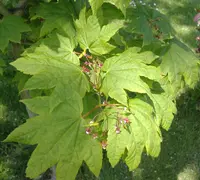
Vine maple, Acer circinatum, is a small deciduous tree or large shrub native to the Pacific Northwest of North America. It often forms multi-stemmed clumps with a graceful, arching habit. Its round, lobed leaves turn bright yellow, orange, or red in autumn, and small red and green flowers are followed by winged seeds. In the wild it grows along forest edges, streams, and shaded slopes, showing good tolerance to cool, moist conditions. This species is generally easy to grow in temperate climates, as long as it has well-drained soil and protection from harsh, drying conditions, which simplifies how to care for vine maple.

Care Difficulty
Moderate Care

Light Preference
Partial Shade

Water Requirements
Moderate Water

Temperature Preference
Cold Hardy

Hardiness Zone
5–9

Soil Texture
Loamy, Sandy, Organic-rich

Soil pH
Acidic (5.5–6.5), Slightly acidic (6.5–7.0)

Soil Drainage
Moist but well-drained

Fertilization
Minimal (feed rarely)
Scan your plant to receive care tips personalized for your specific plant
Available on iOS and Android
This species prefers bright conditions with protection from intense afternoon sun.
Acer circinatum prefers evenly moist, cool soil that never stays waterlogged.
This maple thrives in cool to mild climates with distinct seasons.
Humidity plays a minor role for Acer circinatum, which adapts well to typical outdoor conditions in temperate climates.
Acer circinatum prefers cool, moist, well-aerated soil that does not stay saturated.
This species can be grown in containers for several years, provided the pot is managed to support its spreading root system and canopy.
Acer circinatum benefits from light, targeted feeding but often needs little input in fertile garden soil.
Acer circinatum responds well to light, selective pruning that maintains its natural layered form.
Acer circinatum is usually grown in the ground, so focus on careful transplanting and only occasional container repotting.
Acer circinatum is most often propagated by seed or layering, with cuttings used less frequently in home settings.
Acer circinatum is cold hardy in much of its native range and usually needs minimal winter care in the ground.

Plant Health Check
Not sure what's wrong with your plant? Check your plant's health inside the app.
In its native range from British Columbia to northern California, vine maple is most abundant as an understory tree, naturally adapted to filtered forest light and cool, moist conditions along streams and woodland edges.
The species often develops long, pliable stems that arch or layer along the ground, allowing branches that touch moist soil to root and form new plants, which helps stabilize slopes and stream banks.
In suitable light and cool autumn nights, this maple can develop a wide spectrum of leaf colors on the same plant, ranging from yellow and orange to bright red, which makes it a key native species in Pacific Northwest fall foliage displays.
Vine maple is one of the few North American maples whose growth form can shift from a small, multi-stemmed tree to a sprawling, shrubby thicket depending on snow load, light, and disturbance, giving it a highly variable architecture that supports diverse nesting and cover sites for birds and small mammals.
This species is generally slow to moderate growing, adding about 20–30 cm per year once established. Growth is quicker in cool, moist climates with rich soil, and slower in hot, dry, or compacted sites.
Keep your plants happy and healthy with plant identification, disease detection, and easy care guidance.