Full Moon Maple Care (Acer japonicum 'Maiku Jaku')

Also known as: Downy Japanese Maple, Maple, Dancing Peacock Maple, Amur maple
Full Moon Maple

About Full Moon Maple

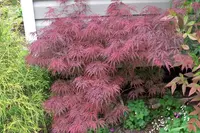
Acer japonicum 'Maiku Jaku', often called Full Moon Maple, is a small deciduous tree valued for its finely divided, almost fernlike leaves and elegant branching. It typically forms a layered, spreading shape that suits small gardens and courtyard spaces.

This cultivar comes from the cool, forested regions of Japan and performs best in temperate climates with some shelter from harsh conditions. Its delicate foliage and moderate growth rate make it more sensitive to heat, wind, and drought than many common landscape trees.

Gardeners who learn how to care for Full Moon Maple usually focus on providing dappled light, evenly moist but well-drained soil, and protection from strong afternoon sun.

Main Plant Requirements

Care Difficulty

Moderate Care

Light Preference

Partial Shade

Water Requirements

Moderate Water

Temperature Preference

Cold Hardy

Hardiness Zone

5–7

Soil Texture

Loamy, Sandy, Organic-rich

Soil pH

Acidic (5.5–6.5), Slightly acidic (6.5–7.0)

Soil Drainage

Moist but well-drained

Fertilization

Minimal (feed rarely)

Get Personalized Care Plan

Scan your plant to receive care tips personalized for your specific plant

Available on iOS and Android

How to Care for the Full Moon Maple

This maple prefers bright, gentle light that protects its delicate foliage from scorching.

  • Provide 3–5 hours of morning sun with light afternoon shade; dappled light under taller trees suits Full Moon Maple well.
  • In hot summers, shield from strong sun after 11 a.m. to prevent leaf scorch and crisp brown edges, especially on exposed or windy sites.
  • In cooler climates, it tolerates more direct sun, but if new growth is pale or leggy, increase light; if leaves scorch, increase shade.

This tree prefers steadily moist, never soggy soil with good drainage.

  • Water when the top 3–5 cm of soil feels dry, allowing moisture to reach the full root zone, especially during the first 2–3 growing seasons.
  • Use well-drained, loamy soil; avoid standing water, which can cause root rot, wilting despite wet soil, and blackened roots in Acer japonicum 'Maiku Jaku'.
  • In summer heat, monitor more often; in cool or rainy seasons, space waterings farther apart and watch for drooping leaves (too dry) or yellowing, soft leaves (too wet).

This maple thrives in cool to mild climates with distinct seasons.

  • Ideal growing temperatures are about 60–75°F (16–24°C) in spring and fall, with slightly warmer days tolerated if roots stay cool and soil moisture is stable.
  • Dormant trees withstand down to about -10°F (-23°C) once established, but young plants benefit from mulch and shelter from drying winter winds.
  • In summer, prolonged heat above 90°F (32°C) can stress foliage; provide shade, mulch, and consistent soil moisture to reduce leaf scorch and stress.

This maple prefers moderately moist air but adapts to most outdoor humidity levels.

  • Target 40–60% humidity; brief dips lower are tolerated if soil moisture is consistent.
  • Crisping leaf edges and stalled new growth in hot, windy periods can signal humidity stress combined with dryness.
  • In exposed sites, shelter the Full Moon Maple from strong drying winds and use mulch over the root zone to slow moisture loss.

Acer japonicum 'Maiku Jaku' grows best in deep, moisture-retentive but well-drained soil.

  • Use a loamy structure with high organic matter, such as garden loam mixed with composted bark or leaf mold, to support steady moisture and root health.
  • Aim for slightly acidic to neutral pH around 5.5–6.8, avoiding strongly alkaline soils where foliage can yellow from reduced nutrient availability.
  • Improve drainage and aeration in heavy clay by incorporating coarse bark, sharp sand, and fine gravel through the top 20–30 cm, not just in the planting hole.
  • Avoid compacted, waterlogged, or very shallow soils, which increase risk of root rot and stress during summer heat.

This species is suitable for long-term container growing when extra attention is given to root space and stability.

  • Choose a wide, heavy container to counterbalance spreading, top-heavy growth and reduce tipping in strong winds.
  • Use a deep potting volume that allows a broad, fibrous root system to develop rather than forcing tight circling roots near the surface.
  • Select a relatively thick-walled, non-porous pot material in hot regions to limit rapid substrate drying and temperature swings around the roots.

This cultivar benefits from light, targeted feeding rather than heavy fertilization.

  • Apply a balanced slow-release fertilizer (around 10-10-10) in early spring as new growth starts, following package rates at the lower end.
  • Use a thin layer of compost over the root zone once a year to improve soil structure and provide gentle nutrients for the Full Moon Maple.
  • Avoid summer overfeeding; skip or halve fertilizer if growth is strong or soil is already rich.
  • Stop feeding by late summer and do not fertilize in fall or winter to allow wood to harden and roots to rest.

Pruning Acer japonicum 'Maiku Jaku' focuses on light shaping and health rather than heavy cutting.

  • Best time is late winter to very early spring, before buds swell, in dry weather to reduce disease risk.
  • Remove dead, damaged, rubbing, or inward-growing branches first to open the canopy and improve air flow.
  • Use clean, sharp bypass pruners or a pruning saw, making smooth cuts just outside the branch collar.
  • Limit thinning cuts to small branches to maintain the tree’s natural layered form and avoid large structural wounds.

This maple is usually grown in the ground, so focus on careful transplanting when needed.

  • Look for signs such as circling roots in a container, water running off quickly, or noticeably slowed growth indicating it has outgrown its space.
  • Plan transplanting for early spring or early fall when soil is workable and temperatures are mild, avoiding hot or freezing conditions.
  • Transplant only every several years, moving to a site with well-drained, slightly acidic soil and partial shade if possible.
  • Dig a wide root ball, keep roots moist, replant at the same depth, water thoroughly, and mulch lightly to reduce transplant shock.

Acer japonicum 'Maiku Jaku' is usually propagated by specialists, as maintaining the exact cultivar requires grafting.

  • Nurseries commonly graft scions of this cultivar onto vigorous Acer japonicum rootstocks in late winter.
  • Seed-grown plants will not come true to type, so seed is mainly used for rootstock or breeding, not cloning the cultivar.
  • Softwood or semi-ripe cuttings in early summer need high humidity, bottom heat, and rooting hormone, but success rates are often low.
  • Home gardeners typically purchase grafted plants rather than relying on home propagation methods for consistent traits.

This Japanese maple is cold hardy in suitable USDA zones but still benefits from some winter attention.

  • Established trees tolerate normal frosts, though young plants are more sensitive to sudden hard freezes.
  • Apply 5–8 cm of organic mulch around the root zone in late fall, keeping it away from the trunk to insulate soil.
  • In very cold or windy sites, wrap the lower trunk with breathable tree wrap to limit bark cracking and sunscald.
  • Move container-grown trees into a sheltered, unheated space or against a protected wall to avoid root freezing in pots.

Care Tips

Canopy Layering

Underplant with shallow-rooted groundcovers instead of turf to keep the root zone cool, reduce evaporation, and minimize competition from lawn grasses that stress the tree in summer.

Summer Leaf Protection

In hotter regions, set up a temporary shade cloth on the west side during heatwaves to prevent marginal leaf scorch and preserve the fine foliage display.

Wind Management

Plant or install low windbreaks such as hedging or lattice on the prevailing wind side to reduce tearing of the delicate, deeply cut leaves and twig dieback in winter storms.

Root Zone Mulch Ring

Maintain a year-round 5–8 cm organic mulch ring out to at least the dripline, keeping it a few cm away from the trunk, to buffer soil temperature and encourage fine feeder roots.

Autumn Color Support

Avoid late-summer high-nitrogen feeding and excessive late watering, as a slightly drier, stable late season often improves fall color intensity when caring for Full Moon Maple.

Common Pests and Diseases

Verticillium wilt

This disease causes sudden wilting, branch dieback, and often one-sided decline, with discolored wood in affected branches. Symptoms include yellowing or scorching of leaves, usually starting on one section of the tree.

Solution

Prune out affected branches well below discolored wood and dispose of them, then disinfect pruning tools between cuts. Avoid overwatering and mechanical root damage, improve soil drainage and organic matter, and do not replant maples in the same spot if a tree dies, since this fungus persists in soil.

Japanese maple scale

This pest appears as tiny white to gray, oyster-shell like bumps on bark and twigs, leading to twig dieback, reduced vigor, and sticky honeydew. This scale often builds up on shaded, slow-growing wood of Japanese maples.

Solution

Prune out and destroy heavily infested twigs, then gently scrub remaining trunk and branches with a soft brush to remove loose scales. Apply horticultural oil during the crawler stage (usually late spring to early summer) and repeat as needed, and improve plant vigor through proper watering and mulching to help the tree tolerate light infestations while caring for Full Moon Maple.

Palmate leaf scorch

This disease produces irregular brown leaf margins and tips with a sharp line between dead and green tissue, often worse in mid to late summer. Symptoms include premature leaf drop and an overall scorched appearance, especially in hot, windy, or exposed sites.

Solution

Reduce stress by providing partial shade in hot climates, maintaining even soil moisture with a 5–8 cm mulch layer, and avoiding high-salt or high-nitrogen fertilizers. Remove and dispose of severely damaged leaves, and improve airflow and soil structure; if scorch recurs yearly, consider relocating young plants to a cooler, more sheltered position.

Leaf spot (fungal)

This disease causes small brown, tan, or purple spots on foliage that can merge into larger blotches, sometimes with tiny black fruiting bodies. Symptoms include premature leaf yellowing and drop, especially in cool, damp weather with poor air circulation.

Solution

Remove and discard fallen leaves in autumn to reduce fungal spores, and avoid overhead watering so foliage dries quickly. Thin crowded branches slightly to improve airflow, and if the problem is severe for several seasons, apply a labeled copper or chlorothalonil fungicide in early spring as new leaves emerge.

Aphids

These insects cluster on young shoots and leaf undersides, sucking sap and causing distorted new growth, sticky honeydew, and sometimes sooty mold. This pest is most active on tender spring growth and in sheltered, humid spots.

Solution

Spray colonies off with a firm stream of water, repeating every few days until numbers drop. Encourage natural predators such as lady beetles, avoid high-nitrogen fertilization, and if needed, use insecticidal soap or horticultural oil, coating leaf undersides and young stems thoroughly in cool, calm weather.

Interesting Facts

Finely dissected foliage

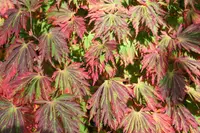
This cultivar has deeply cut, lace-like leaves with 7–11 lobes that twist slightly, giving the canopy a textured, almost feathery appearance distinct from typical Japanese maples.

Layered, vase-shaped habit

It naturally forms an upright, vase-shaped structure with gracefully layered branches, creating a tiered silhouette that shows foliage color and texture clearly at multiple levels.

Complex seasonal color shift

Leaves emerge in spring with soft green tones often flushed with bronze, stay a rich medium green in summer, then shift to a mix of orange, red, and gold in fall, producing a multi-toned autumn display rather than a single uniform color.

Botan icon

Did you know?

This cultivar was selected and named in Japan, and its name Maiku Jaku is often translated as dancing peacock, a reference to the way its finely divided, layered foliage spreads and overlaps like the tail of a displaying peacock.

FAQs about Full Moon Maple

This small tree grows slowly to moderately, often adding 15–30 cm per year once established. Over many years it may reach about 3–4.5 m tall with a similar spread, forming a layered, dome-shaped canopy.

Grow Healthy Plants with Botan Care

Keep your plants happy and healthy with plant identification, disease detection, and easy care guidance.


Botan plant care app — identify plants on mobile

Explore More Plants