Inoculate With Rhizobia
At planting, dust seeds or roots with a native legume inoculant containing compatible rhizobia to improve nitrogen fixation and support vigorous growth on poor, sandy sites.

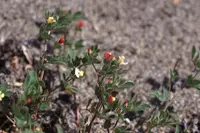
Desert deervetch (Acmispon micranthus) is a small, low-growing legume native to dry, open habitats in the southwestern United States and northern Mexico. It typically forms loose mats or small clumps with slender stems and tiny, divided leaves.
The plant produces small yellow to orange pea-like flowers, followed by narrow pods that fix nitrogen in the soil, which can benefit nearby plants. It is adapted to poor, well-drained soils and survives on low to moderate natural rainfall.
These traits make it a good option for low-input, water-wise landscapes when local climate and soil match its native conditions. Gardeners who want to care for Desert Deervetch should understand its preference for sun, dry air, and fast-draining soil.

Care Difficulty
Moderate Care

Light Preference
Full Sun

Water Requirements
Low Water

Temperature Preference
Warm Climate

Hardiness Zone
8–10

Soil Texture
Sandy, Loamy, Rocky

Soil pH
Slightly acidic (6.5–7.0), Neutral (7.0)

Soil Drainage
Well-drained

Fertilization
Minimal (feed rarely)
Scan your plant to receive care tips personalized for your specific plant
Available on iOS and Android
This sun-loving legume thrives in bright, exposed sites typical of arid and semi-arid habitats.
This drought-adapted species prefers infrequent, deep watering and fast-drying soil.
This species is adapted to warm, dry climates with mild winters and hot summers.
This dry-adapted legume tolerates low humidity and rarely needs special humidity management indoors or outdoors.
This species prefers lean, fast-draining, sandy soil that mimics its native dry habitats.
Acmispon micranthus can be grown in containers if the pot is set up to stay dry around the roots.
This drought-tolerant native legume usually needs little feeding, especially in garden soil.
Acmispon micranthus benefits from light, targeted pruning to maintain a compact, flowering form.
This species is usually grown in the ground, so focus on careful transplanting rather than frequent repotting.
Propagation of Acmispon micranthus is mainly done from seed for restoration and native plantings.
In mild, dry-summer climates, this native legume is generally cold hardy and needs minimal winter care.

Plant Health Check
Not sure what's wrong with your plant? Check your plant's health inside the app.
This species is a small annual in the pea family (Fabaceae) that completes its life cycle quickly in late winter to spring, then disappears as desert conditions become hot and dry.
Like many desert lotus species, it forms symbiotic nodules on its roots with nitrogen-fixing bacteria, allowing it to enrich poor, sandy or rocky soils with biologically available nitrogen.
Its very small, pale yellow to cream flowers are borne in tight clusters on short stalks, an adaptation that conserves resources while still attracting small pollinators in arid habitats.
This species is a good nectar and pollen source for native bees and small wasps. Flowers are less attractive to large butterflies but may host some smaller pollinators. Avoid broad-spectrum insecticides to maintain pollinator activity.
Keep your plants happy and healthy with plant identification, disease detection, and easy care guidance.