Sturdy staking
Install discreet stakes or a low pea fence in early spring and loosely tie the stems as they elongate so tall flower spikes stay upright and do not snap in wind or heavy rain.

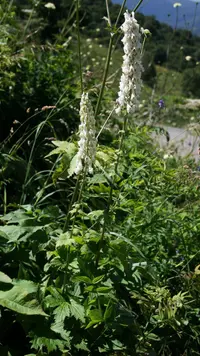
Aconitum orientale is a herbaceous perennial grown mainly for its tall spikes of hooded blue to violet flowers and deeply divided, glossy green leaves. It forms upright clumps that add strong vertical accents to mixed borders in cool and temperate gardens. Native to parts of Eastern Europe and western Asia, it typically grows in mountain meadows, woodland edges, and other cool, moist habitats. It prefers humus-rich, consistently moist, but well-drained soil and light shade to partial sun. Because the entire plant is highly poisonous, it requires careful handling and is not suitable for households with curious children or pets. Those who care for Aconitum orientale should always use gloves and place it where accidental contact is unlikely.

Care Difficulty
Moderate Care

Light Preference
Partial Shade

Water Requirements
Regular Water

Temperature Preference
Cold Hardy

Hardiness Zone
4–7

Soil Texture
Loamy, Silty, Organic-rich

Soil pH
Acidic (5.5–6.5), Slightly acidic (6.5–7.0)

Soil Drainage
Moist but well-drained

Fertilization
Minimal (feed rarely)
Scan your plant to receive care tips personalized for your specific plant
Available on iOS and Android
This hardy perennial prefers cool, bright conditions with protection from intense midday sun.
This plant prefers consistently moist, cool soil that never becomes waterlogged.
This cool-climate perennial thrives in moderate temperatures and tolerates substantial winter cold.
This species tolerates typical outdoor humidity and rarely needs special moisture management.
This perennial prefers deep, moist but free-draining ground that stays cool around the roots.
This species can grow in containers if the pot is large and the substrate stays cool and evenly moist.
Moderate feeding supports healthy growth and flowering in Aconitum orientale without encouraging weak, lush foliage.
Pruning Aconitum orientale is light and mainly focused on cleanliness and supporting flowering.
Transplanting is more relevant than repotting for Aconitum orientale, which prefers a stable position in the garden.
Propagation of Aconitum orientale is possible but should be done with care due to the plant’s toxicity.
Aconitum orientale is generally cold hardy in temperate climates and needs minimal winter care in the ground.

Plant Health Check
Not sure what's wrong with your plant? Check your plant's health inside the app.
This species is native to eastern alpine and subalpine regions of Europe and western Asia, where it grows in moist meadows and on mountain slopes rather than deep forests.
Compared with many other monkshood species, it often shows paler, greenish to whitish bracts below the flower clusters, which helps botanists separate it from closely related taxa in the field.
Its hooded blue to violet flowers are shaped for bumblebee pollination, and field observations show that only strong, long-tongued bumblebees can effectively reach the nectar and transfer pollen.

Aconitum orientale is one of the taxa that historically caused taxonomic debate, and some authors have treated it as a separate species while others considered it part of a broader Aconitum napellus group, reflecting subtle but consistent differences in flower and leaf morphology across its natural range.
All parts of this plant are highly toxic to humans and animals if ingested, and sap can irritate skin. Always wear gloves when handling, avoid planting near play areas, and seek medical help after suspected poisoning.
Keep your plants happy and healthy with plant identification, disease detection, and easy care guidance.