Mark Dormant Clumps
Flag planting spots with sturdy markers in late fall so the exact location of dormant crowns is visible and protected from digging or foot traffic in early spring.

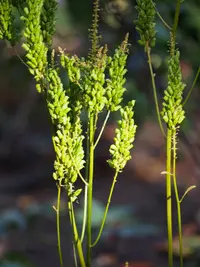
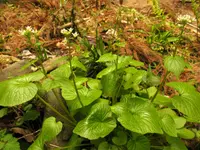
Actaea dahurica is a hardy, herbaceous perennial from woodland and forest edges in northeastern Asia. It belongs to the buttercup family and prefers cool, moist conditions. Plants form clumps of divided, fern-like leaves and produce upright spikes of small white flowers, followed by dark, bead-like berries. It has a quietly ornamental look suited to naturalistic or shade gardens. This species is adaptable but prefers partial shade, consistent moisture, and humus-rich, well-drained soil. Understanding how to care for Actaea dahurica helps gardeners keep it healthy and long-lived with steady, moderate growth.

Care Difficulty
Moderate Care

Light Preference
Partial Shade

Water Requirements
Keep Soil Moist

Temperature Preference
Cold Hardy

Hardiness Zone
3–7

Soil Texture
Loamy, Silty, Organic-rich

Soil pH
Acidic (5.5–6.5), Slightly acidic (6.5–7.0)

Soil Drainage
Moist but well-drained

Fertilization
Minimal (feed rarely)
Scan your plant to receive care tips personalized for your specific plant
Available on iOS and Android
This woodland perennial prefers cool, shaded light conditions that mimic its natural forest habitat.
This plant thrives in consistently moist, cool soil that never fully dries out.
This hardy perennial is adapted to cool to mild climates with cold winters and moderate summers.
This shade perennial prefers stable, moderately moist air rather than very dry conditions.
This species performs best in deep, moisture-retentive but well-aerated soil that mimics rich woodland conditions.
This species can be grown in containers if the pot is deep, cool, and kept evenly moist without saturation.
This woodland perennial grows best in rich soil but responds to light, thoughtful feeding.
Pruning is minimal and mainly helps maintain health and tidy appearance.
This species is usually grown in the ground and dislikes frequent disturbance once established.
Propagation is possible but slower than many perennials, so it is done thoughtfully.
This hardy perennial tolerates typical cold winters well and usually needs only light attention.

Plant Health Check
Not sure what's wrong with your plant? Check your plant's health inside the app.
This species is naturally distributed in cool, moist forests of northeastern China, the Russian Far East, Korea, and parts of Mongolia, showing a clear preference for rich, humus-heavy soils and partial shade along forest edges and clearings.
Unlike many spring-blooming woodland herbs, it typically flowers in late summer to early autumn, when canopy light increases again and many competing understory species have already completed their growth cycle.
After flowering, it forms dense clusters of shiny black berries held above the foliage, which are thought to attract frugivorous birds that disperse the seeds across forest habitats.

In parts of its native range, this species has been documented at the transition zones between coniferous and broadleaf forests, where its presence can indicate relatively undisturbed, mature woodland with stable, cool-moist microclimates.
This species slowly forms clumps by short rhizomes and self-seeding, but it is not usually aggressive. Seedlings are easy to pull. In small beds, monitor for unwanted seedlings and thin crowded clumps every few years.
Keep your plants happy and healthy with plant identification, disease detection, and easy care guidance.