Shade-tolerant siting
Place plants where taller shrubs or trees cast dappled shade so the delicate flower spikes stay upright and do not bleach or scorch in late-summer sun.

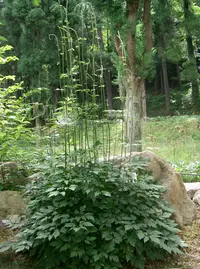
Baneberry (Actaea simplex) is a shade-loving perennial grown mainly for its tall, elegant flower spikes and striking fruit display. It forms clumps of divided, fernlike foliage that add fine texture to woodland or shaded borders.
In late summer to fall, it produces slender, bottlebrush-like flower spikes that are often fragrant, followed by showy berries on colored stems. The plant is native to woodland areas of East Asia, where it grows in cool, moist, humus-rich soils.
Its preference for consistent moisture, shade, and organic soil means it is moderate in difficulty for beginners. Understanding how to care for baneberry helps it establish well and remain long-lived in temperate gardens.

Care Difficulty
Moderate Care

Light Preference
Partial Shade

Water Requirements
Keep Soil Moist

Temperature Preference
Cold Hardy

Hardiness Zone
4–8

Soil Texture
Loamy, Peaty, Organic-rich

Soil pH
Acidic (5.5–6.5), Slightly acidic (6.5–7.0)

Soil Drainage
Moist but well-drained

Fertilization
Minimal (feed rarely)
Scan your plant to receive care tips personalized for your specific plant
Available on iOS and Android
Actaea simplex thrives in cool, woodland-style light with protection from harsh sun.
This plant prefers consistently moist, cool soil without becoming waterlogged.
This woodland perennial grows best in cool to mild conditions with distinct seasons.
This woodland perennial prefers moderate, stable humidity to support healthy foliage and flowering.
Actaea simplex grows best in consistently moist, humus-rich soil with air spaces around the roots.
This species can be grown in containers, but demands careful moisture and stability management.
Actaea simplex prefers modest feeding, especially in rich, humusy soil.
Actaea simplex needs only light pruning to stay healthy and tidy.
This perennial is more often transplanted in the ground than kept long term in containers.
Actaea simplex is usually propagated by division, with seed used mainly by experienced growers.
This species is cold hardy in many temperate gardens and usually needs minimal winter care.

Plant Health Check
Not sure what's wrong with your plant? Check your plant's health inside the app.
This species flowers unusually late for a woodland plant, often producing fragrant white bottlebrush-like spikes in late summer to autumn when many shade perennials have finished flowering.
The small individual flowers are most strongly scented in the evening and at night, which is associated with attracting nocturnal pollinators such as moths.
All parts of the plant, including seeds and berries, contain cardiogenic and neurotoxic compounds that are poisonous to humans and many mammals, yet some bird species can eat the berries and help disperse the seeds without apparent harm.

Several garden cultivars of this species, such as Actaea simplex 'Brunette' and 'Black Negligee', have been selected for their unusually dark, nearly black foliage, which is rare among temperate woodland perennials and used by breeders to create strong contrast plantings in shade gardens.
Lack of flowers usually comes from plants being too young, too dry in spring, or growing in deep shade. Nutrient-poor or compacted soil also reduces flowering. Improving moisture, soil structure, and light levels often restores normal blooming.
Keep your plants happy and healthy with plant identification, disease detection, and easy care guidance.

-1-200x133.webp)