Improve root aeration
Use a low, wide pot and mix in coarse sand or fine gravel in the bottom third of the container to keep the root zone airy, which helps prevent decline in this short-lived species.

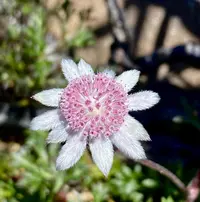
Pink flannel flower, Actinotus forsythii, is a small, short-lived perennial from sandstone heathlands in eastern New South Wales, Australia. It forms low, branching clumps with finely divided, grey-green foliage.
Soft, daisy-like flower heads with pale pink bracts give the plant a delicate, woolly look, despite its preference for exposed, nutrient-poor sites. It is naturally adapted to harsh conditions and often appears after fire.
This species can be challenging outside its native range because it dislikes rich, wet soils and needs excellent drainage and low to moderate fertility. Gardeners who care for Pink flannel flower should focus on recreating its lean, sandy, open habitat.

Care Difficulty
Hard Care

Light Preference
Full Sun

Water Requirements
Low Water

Temperature Preference
Warm Climate

Hardiness Zone
9–11

Soil Texture
Sandy, Loamy, Rocky

Soil pH
Acidic (5.5–6.5), Slightly acidic (6.5–7.0)

Soil Drainage
Well-drained

Fertilization
Minimal (feed rarely)
Scan your plant to receive care tips personalized for your specific plant
Available on iOS and Android
This species prefers bright, open conditions that mimic its native exposed habitats.
This plant prefers slightly dry, fast-draining conditions rather than consistently moist soil.
This species is adapted to mild, low-humidity climates with moderate temperature swings.
This species tolerates a wide humidity range and usually manages well in typical indoor air.
Actinotus forsythii prefers very free-draining, sandy soil that closely mimics its native heathland conditions.
This species can be grown in containers if the pot and medium are managed to stay sharply drained and airy.
Actinotus forsythii benefits from light feeding but is sensitive to heavy fertilizer applications.
Pruning Actinotus forsythii is mainly about tidying and supporting compact, floriferous growth.
Transplanting is more common than repotting, as this native-style plant is usually grown in well-drained beds or rocky sites.
Propagation of Actinotus forsythii is achievable but requires attention to timing and substrate.
Winter care for Actinotus forsythii focuses on preventing excess cold and moisture around the roots.

Plant Health Check
Not sure what's wrong with your plant? Check your plant's health inside the app.
Pink flannel flower is naturally found only in a narrow coastal to montane belt of eastern Australia, mainly in higher-altitude heath and open forest on nutrient-poor sandstone soils.
Its seeds are strongly stimulated to germinate after bushfire, responding to chemicals in smoke and post-fire soil conditions, so mass flowering often appears 1–2 years after a burn.
The pink “petals” are actually modified bracts and involucral leaves surrounding the small central flowers, giving the plant a daisy-like look even though it belongs to the Apiaceae (carrot) family.

This species is considered rare and unpredictable in the wild because its seed can remain dormant in the soil seed bank for many years, only emerging in abundance when a specific combination of fire, rainfall, and seasonal conditions occurs, creating spectacular but short-lived displays across parts of its limited range.
Lack of flowers usually relates to stress from poor drainage, excessive fertiliser, or pruning at the wrong time. This species forms buds on new growth after a cool period, so avoid hard pruning just before its natural flowering season.
Keep your plants happy and healthy with plant identification, disease detection, and easy care guidance.