red beadtree Care (Adenanthera pavonina)

Also known as: Saga Tree
red beadtree

About red beadtree

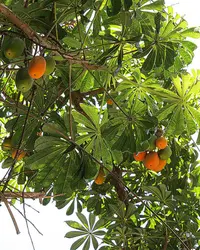
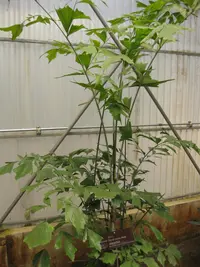
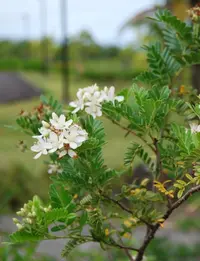
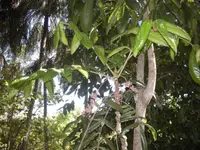
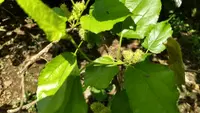
Red beadtree, Adenanthera pavonina, is a fast-growing, medium to large deciduous tree valued for its shade and ornamental seeds. It typically develops a broad, spreading crown with fine, feathery foliage and clusters of small yellowish flowers, followed by curved pods containing hard, bright red seeds. The species is native to tropical Asia but is now widely planted in many warm, humid regions as a shade and avenue tree.

This tree prefers full sun, warmth, and well-drained soil and is generally easy to establish in suitable tropical or subtropical climates. Gardeners often focus on how to care for red beadtree in outdoor landscapes rather than containers, as its mature size and root system make it unsuited to small spaces.

Main Plant Requirements

Care Difficulty

Moderate Care

Light Preference

Full Sun

Water Requirements

Moderate Water

Temperature Preference

Tropical / Frost Sensitive

Hardiness Zone

10–12

Soil Texture

Sandy, Loamy, Organic-rich

Soil pH

Acidic (5.5–6.5), Slightly acidic (6.5–7.0)

Soil Drainage

Well-drained

Fertilization

Minimal (feed rarely)

Get Personalized Care Plan

Scan your plant to receive care tips personalized for your specific plant

Available on iOS and Android

How to Care for the red beadtree

Adenanthera pavonina grows best in warm, bright locations with ample direct sun.

  • Provide 6–8 hours of direct sunlight daily; full sun is ideal for strong growth and dense foliage in open landscapes.
  • Allow light partial shade, especially light afternoon shade in very hot climates, to reduce leaf scorch on young or newly planted trees.
  • Avoid planting in deep shade; prolonged low light leads to sparse branching, slower growth, and reduced flowering and seed production in red beadtree.

Adenanthera pavonina prefers evenly moist, well-drained soil, especially while young and establishing.

  • Water when the top 3–5 cm of soil feels dry; young trees need more frequent watering than mature, deep-rooted trees.
  • Use soil that drains freely; avoid standing water, as persistent sogginess causes root rot and yellowing, dropping leaves.
  • In hot, dry seasons, increase watering depth rather than frequency; in cooler or rainy periods, reduce watering as long as leaves remain firm and not wilted.

This tropical tree thrives in consistently warm climates without frost exposure.

  • Aim for 70–90°F (21–32°C) for active growth; the tree grows fastest and produces best foliage and flowering within this range.
  • Protect from cold below 50°F (10°C); damage often occurs near 40°F (4°C), and freezing at 32°F (0°C) or below can kill young trees.
  • In hotter regions, brief peaks to 95–100°F (35–38°C) are tolerated if soil moisture is adequate, but combined extreme heat and drought can stress foliage and slow growth.

This species prefers moderately humid air but adapts to a range of household conditions.

  • Aim for 40–60% humidity, as very dry air can slow growth and cause marginal leaf browning.
  • Plants tolerate short dry spells but prolonged <30% humidity causes curled, dull, and shedding leaflets.
  • Increase humidity with grouped plants, a nearby humidifier, or an evaporative tray placed close to the red beadtree.

This tree prefers deep, well-drained, moderately fertile soil that still retains some moisture.

  • Use a loose loam or sandy loam with 30–40% organic matter such as compost to support steady growth of Adenanthera pavonina.
  • Ensure rapid drainage by blending coarse sand or fine grit plus some perlite to prevent waterlogging around the roots.
  • Target a slightly acidic to neutral pH, around 6.0–7.0, avoiding very alkaline or saline substrates that restrict nutrient uptake.
  • Avoid heavy, compacted clay; improve aeration by incorporating coarse materials and avoiding overworking wet soil.

This species can be grown in containers for the first years of life if the pot is large and very stable.

  • Choose a tall, heavy pot that reduces tipping as the woody trunk and canopy become top-heavy.
  • Select a container material such as thick ceramic that moderates rapid moisture swings in sunny, warm positions.
  • Use a pot with wide drainage holes and elevate it slightly so excess water exits freely and does not collect under the base.

This tropical legume needs only modest feeding, as it naturally fixes nitrogen in the soil.

  • Apply a light layer of compost or well-rotted manure around the root zone once in spring to support growth in red beadtree.
  • If using synthetic fertilizer, choose a balanced NPK such as 10-10-10 at half strength during the warm growing season.
  • Feed no more than 2–3 times per growing season to avoid overly lush, weak growth.
  • Stop feeding in late fall and avoid fertilizing in winter or during any dormant slowdown.

Pruning Adenanthera pavonina helps manage size, structure, and safety, especially in small gardens or near buildings.

  • Carry out main pruning at the end of the dry season or late winter, before strong new growth starts.
  • Remove dead, diseased, crossing, or storm-damaged branches first to maintain tree health.
  • Thin crowded interior branches to improve light penetration and airflow, encouraging stronger, balanced growth.
  • Use clean, sharp loppers or a pruning saw, making smooth cuts just outside the branch collar without leaving stubs.

This species is usually grown in the ground, so focus on timely transplanting of young trees rather than long-term container culture.

  • Shift seedlings from nursery bags or pots once roots reach the bottom or circle lightly, usually after 6–12 months.
  • Plan field planting for warm, frost-free seasons, giving Adenanthera pavonina time to establish before cooler weather.
  • Transplant every 1–2 years while young, stepping up only 1 pot size or moving into a permanent ground position.
  • Water thoroughly before and after transplanting, keep the root ball intact, and shade briefly to reduce transplant shock.

Propagation is most commonly done from seed, which is usually reliable when fresh and correctly prepared.

  • Collect mature red seeds from fully dried pods, discarding any moldy or damaged ones.
  • Scarify hard seed coats by lightly nicking with a blade or soaking in hot (not boiling) water for 12–24 hours.
  • Sow treated seeds in a free-draining mix, keep at 70–85°F, and maintain even, slightly moist conditions.
  • Provide bright, indirect light and good airflow; transplant seedlings once roots hold the mix and true leaves appear.

This tropical tree is frost-sensitive and needs protection or a warm climate to overwinter well.

  • Grow only in frost-free or very mild regions outdoors; young trees are especially vulnerable to freezing.
  • Apply 5–8 cm of organic mulch around the root zone, keeping it slightly away from the trunk base.
  • Move container-grown plants indoors or into a heated greenhouse before temperatures drop near 40°F.
  • In cool spells, reduce watering so the soil stays just lightly moist, preventing cold, soggy conditions around roots.

Care Tips

Early structural training

During the first 2–3 years, select a single strong leader and remove competing uprights to establish a clear trunk, which reduces future breakage and creates a stable canopy framework.

Wind and root anchoring

In windy sites, install 2–3 low, flexible stakes and remove them after 1–2 growing seasons to help the tree develop a strong root system and stable anchorage without creating a permanently weak trunk.

Seed pod management

Monitor and remove drying pods before they fully split if you want to limit volunteer seedlings and reduce litter in high-traffic areas such as driveways, patios, or play spaces.

Targeted canopy thinning

Every 2–4 years, selectively thin crowded interior branches instead of shortening the whole canopy; this improves air flow and light penetration, which lowers fungal disease pressure and encourages balanced growth.

Root zone protection

Keep the area under the drip line free from heavy foot traffic, vehicles, and repeated digging so fine feeder roots remain healthy, and use a 5–8 cm mulch layer to buffer soil temperature and moisture when growing red beadtree.

Common Pests and Diseases

Leaf-miner larvae

This pest tunnels inside the leaf tissue, creating pale winding trails and causing premature yellowing and drop of leaflets.

Solution

Remove and destroy affected leaflets as soon as mining trails appear, and collect fallen leaves from the ground to break the life cycle; in young trees, use fine netting or row covers during peak moth or fly activity where feasible, and encourage natural predators such as parasitic wasps by minimizing broad-spectrum insecticide use nearby.

Scale insects

These insects attach to young stems and leaf midribs, sucking sap and causing leaf yellowing, sooty mold growth, and general decline in vigor.

Solution

Prune heavily infested twigs, then wipe remaining colonies with a cloth or cotton pad dipped in diluted horticultural oil; for outdoor trees, direct a strong water spray at branches to dislodge crawlers and repeat oil applications according to label directions until new growth appears clean.

Mites

This pest causes fine stippling, bronzing, and a dusty appearance on leaflets, often with thin webbing on sheltered inner foliage during hot, dry weather.

Solution

Increase humidity around young plants, hose down foliage thoroughly to remove mites, and apply insecticidal soap or a light horticultural oil to the undersides of leaves at 5–7 day intervals until fresh, unstippled growth appears; avoid water stress, which makes trees more susceptible.

Leaf spot

This disease produces circular to irregular brown spots on leaflets that may coalesce, leading to premature defoliation in warm, humid conditions.

Solution

Rake and discard fallen leaves to reduce inoculum, avoid overhead irrigation that keeps foliage wet, and thin surrounding vegetation to improve airflow; in areas with repeated outbreaks on valuable trees, use a labeled copper-based fungicide at the start of warm, wet periods, following local regulations and label instructions.

Stem canker

This disease causes sunken, discolored lesions on young branches, sometimes accompanied by cracking bark, dieback of branch tips, and sparse foliage on affected sections.

Solution

Prune out infected branches well below visible symptoms during dry weather, disinfect pruning tools between cuts, and avoid trunk or root injury; maintain moderate, consistent soil moisture and good nutrition so the tree can compartmentalize small infections, and remove severely affected young trees to prevent spread in plantations or closely spaced plantings.

Interesting Facts

Brilliant scarlet seeds

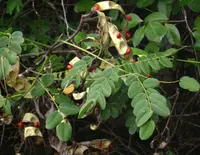
The tree produces hard, glossy, bright red seeds that develop inside curved brown pods, with 1–2 exposed seeds often remaining attached after the pod splits, which helps birds spot and disperse them.

Nitrogen-fixing legume

Although it looks like a typical shade tree, it belongs to the legume family and forms root nodules with nitrogen-fixing bacteria, improving soil fertility in warm, humid climates.

Valuable reddish timber

Its heavy, reddish heartwood is dense and durable, so in many tropical regions the wood is used for furniture, tool handles, and small construction where resistance to wear is important.

Botan icon

Did you know?

The bright red seeds have been widely used as natural weight standards in parts of Asia because they are remarkably uniform in mass, historically serving as a reference unit in jewelry making and small-scale trade.

FAQs about red beadtree

This species is generally fast-growing, especially in warm, frost-free climates, often adding 60–120 cm per year when young. Growth slows as it matures, and poor soil, drought, or root restriction can reduce vigor significantly.

Grow Healthy Plants with Botan Care

Keep your plants happy and healthy with plant identification, disease detection, and easy care guidance.

Botan plant care app — identify plants on mobile

Explore More Plants