Early trellis setup
Install a sturdy, narrow-gauge trellis or mesh before seedlings emerge so the young vines can climb immediately and avoid tangling on nearby plants.

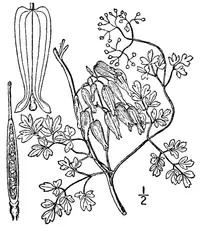
Allegheny vine (Adlumia fungosa) is a delicate biennial climber in the poppy family, valued for its light, lacy presence on supports or rocky slopes. It produces finely divided, fernlike foliage and long clusters of small, pale pink to white, tubular flowers that give a soft, airy look.
This species is native to cool, moist woodland ravines and shaded rocky areas in northeastern North America. It can be somewhat challenging, as it prefers cool summers, consistent moisture, and well-drained, humus-rich soil, and it depends on self-seeding to persist. Gardeners who learn how to care for allegheny vine often grow it on trellises, fences, or woodland edges where it can climb freely.

Care Difficulty
Moderate Care

Light Preference
Partial Shade

Water Requirements
Moderate Water

Temperature Preference
Cool Climate

Hardiness Zone
4–7

Soil Texture
Loamy, Silty, Organic-rich

Soil pH
Acidic (5.5–6.5), Slightly acidic (6.5–7.0)

Soil Drainage
Moist but well-drained

Fertilization
Minimal (feed rarely)
Scan your plant to receive care tips personalized for your specific plant
Available on iOS and Android
This twining biennial vine prefers bright, gentle light that mimics open woodland edges.
This vine prefers consistently moist but not saturated soil, similar to a cool woodland slope.
This cool-temperate vine grows best in mild conditions and dislikes extreme heat or hard freezes.
This species tolerates a broad humidity range and usually does not need special moisture control outdoors.
This biennial climber prefers cool, moist, well-aerated soil that stays evenly damp but never waterlogged.
This vine can be grown in containers if the pot supports its climbing and moisture needs.
This biennial vine grows acceptably in lean soil but benefits from light feeding in cultivation.
Adlumia fungosa needs only light, targeted pruning to manage size and support flowering.
This biennial climber is usually grown in the ground and dislikes frequent disturbance once established.
Adlumia fungosa is most reliably propagated from seed rather than cuttings or division.
This species is generally cold hardy in its native range and needs minimal winter care in the ground.

Plant Health Check
Not sure what's wrong with your plant? Check your plant's health inside the app.
This species is a biennial vine that spends its first year as a low, ferny rosette and only produces its long, twining flowering stems in the second year before dying after seed set.
It is naturally restricted to cool, shaded, rocky forests and ravines of northeastern North America, often scrambling over boulders, talus, or old stumps rather than open ground.
Each papery capsule contains many very small seeds that can be dispersed short distances by gravity and runoff water, allowing the plant to colonize crevices and steep, unstable slopes.

In parts of its native US range, this vine is considered historically uncommon and is now regionally rare or protected, so wild populations are sometimes monitored as indicators of relatively undisturbed, cool ravine and cliff habitats.
This biennial climber grows foliage in its first year, then can extend 1.8–4.5 m in a single season once established. Growth is fastest in cool, moist, partially shaded sites with consistently damp, well-drained soil.
Keep your plants happy and healthy with plant identification, disease detection, and easy care guidance.