Winter rosette management
During the cool, dry winter phase, reduce air movement and avoid disturbing the compact non-carnivorous rosettes so the plant can safely conserve energy until active growth resumes in spring.

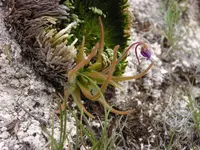
Pinguicula gypsicola is a small Mexican carnivorous plant that forms narrow, grassy rosettes covered in sticky leaves. It captures tiny insects on these glandular leaf surfaces. In habitat, it grows on gypsum-rich cliffs and rocky slopes, where soils are very mineral and low in nutrients. This background explains its sensitivity to rich, organic mixes. The plant has a marked seasonal cycle, producing slender carnivorous leaves in the warm, wet season and compact, non-carnivorous leaves in the dry season. These changes can make it slightly challenging for beginners who want to learn how to care for Pinguicula gypsicola. It generally prefers bright light, careful watering, and an airy, mineral substrate.

Care Difficulty
Hard Care

Light Preference
Partial Sun

Water Requirements
Keep Soil Moist

Temperature Preference
Tropical / Frost Sensitive

Hardiness Zone
Unknown

Soil Texture
Sandy, Rocky, Organic-rich

Soil pH
Slightly alkaline (7.0–7.5), Alkaline (7.5–8.5)

Soil Drainage
Well-drained

Fertilization
Minimal (feed rarely)
Scan your plant to receive care tips personalized for your specific plant
Available on iOS and Android
This Mexican butterwort prefers bright conditions that mimic its native open, rocky habitats.
Watering should respect this species’ preference for mineral, fast-draining substrates and seasonal moisture changes.
This species favors warm, stable conditions but reacts poorly to frost and extreme heat.
This species benefits from moderately humid air but adapts if extremes are avoided.
Soil must be very open, mineral-rich, and free of added fertilizer for healthy growth.
This species is well suited to container culture when drainage and stability are carefully managed.
This carnivorous species gains most nutrients from prey, so Pinguicula gypsicola needs only very light supplemental feeding, if any.
Only minimal pruning is needed, mainly to keep Pinguicula gypsicola clean and healthy.
This species dislikes disturbance, so repot Pinguicula gypsicola only when clearly necessary.
Pinguicula gypsicola is usually propagated vegetatively to keep desirable traits consistent.
This species is not frost hardy, so winter care for Pinguicula gypsicola focuses on maintaining a safe, cool, frost-free rest period.

Plant Health Check
Not sure what's wrong with your plant? Check your plant's health inside the app.
This species is naturally restricted to gypsum-rich cliffs and slopes in northeastern Mexico, where it grows in shallow mineral crusts that many other plants cannot tolerate.
Its leaves are unusually narrow and almost cylindrical for a butterwort, an adaptation that reduces water loss while still providing a sticky surface to trap small insects.
In the dry season, it forms a tight rosette of tiny, non-carnivorous leaves that help it survive drought, then resumes producing larger insect-trapping leaves when moisture returns.

This species is considered a narrow endemic, known only from a small geographic area in Mexico, which makes its natural populations especially vulnerable to habitat disturbance and collection pressure.
This species can work indoors if given strong light, coolish nights, and very airy, mineral substrate. High humidity around the leaves helps. Pinguicula gypsicola indoor care is easier in small terrariums or display cases than on open windowsills.
Keep your plants happy and healthy with plant identification, disease detection, and easy care guidance.

-200x133.webp)