Mark Dormant Clumps
Label planting spots in late spring once the foliage dies back, so you avoid disturbing the crowns when the plant is completely dormant and invisible in summer.

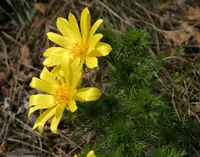
Yellow pheasant's eye, Adonis vernalis, is a hardy, early-flowering perennial from the buttercup family. It forms low clumps with finely divided, feathery foliage and large, bright yellow, cup-shaped flowers.
This species is native to dry, sunny grasslands and steppes in central and eastern Europe and parts of Asia. It grows slowly and dislikes disturbance, which can make it more difficult to establish in gardens.
To care for yellow pheasant's eye, provide a sunny, well-drained spot with relatively dry conditions in summer. Once settled, it is long-lived but resents frequent division or moving.

Care Difficulty
Hard Care

Light Preference
Full Sun

Water Requirements
Moderate Water

Temperature Preference
Cold Hardy

Hardiness Zone
3–7

Soil Texture
Sandy, Loamy, Organic-rich

Soil pH
Slightly acidic (6.5–7.0), Neutral (7.0)

Soil Drainage
Well-drained

Fertilization
Minimal (feed rarely)
Scan your plant to receive care tips personalized for your specific plant
Available on iOS and Android
This spring perennial thrives in open, bright sites with cool roots and long hours of sun.
This species prefers evenly moist but not saturated soil, especially during active spring growth.
This cold-hardy perennial is adapted to climates with cold winters and mild to warm summers.
Humidity is usually not critical for Adonis vernalis, which thrives in relatively dry air.
Adonis vernalis prefers a light, well-drained mineral soil that does not stay wet.
This species is suitable for container growing when its deep root system is given enough space and sharp drainage.
This sun-loving perennial needs only light feeding, as yellow pheasant's eye is adapted to lean, well-drained soils.
Pruning needs for Adonis vernalis are minimal and focus on cleanliness rather than reshaping.
This perennial dislikes root disturbance, so transplant Adonis vernalis only when clearly necessary.
Propagation of this species is slow and somewhat specialized, so it is usually attempted by patient gardeners only.
This hardy perennial is adapted to cold climates and usually needs very little winter attention in the ground.

Plant Health Check
Not sure what's wrong with your plant? Check your plant's health inside the app.
This species is among the first herbaceous plants to flower in early spring across the Eurasian steppe, often blooming while surrounding vegetation is still dormant and leafless.
It naturally occurs in dry, open steppe grasslands and light pine or oak woods on calcareous or sandy soils, which is why wild populations decline when these habitats are plowed or overgrown by shrubs.
Individual plants develop a thick, slowly expanding rootstock that can persist for many years in the same spot, making established clumps difficult to relocate without damage.

Adonis vernalis is legally protected or red‑listed in many European countries because of habitat loss and historical overharvesting, and is now considered one of the characteristic flagship species used to indicate well-preserved steppe grassland remnants.
All parts contain cardiac glycosides, compounds that affect the heart. Ingestion can cause nausea, vomiting, abdominal pain, irregular heartbeat, and potentially serious poisoning in people and animals. Handle with care and keep away from children, dogs, cats, and livestock.
Keep your plants happy and healthy with plant identification, disease detection, and easy care guidance.