Support Tall Stems
In windy or exposed sites, install low peony rings or discreet twiggy branches around clumps in spring so the slender flowering stems stay upright and do not lodge as they lengthen and bloom.

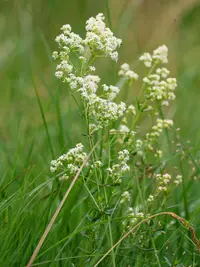
Northern bedstraw (Galium boreale) is a hardy, herbaceous perennial found in meadows, open woods, and along stream banks across cooler regions of North America and Eurasia. It forms upright clumps with square stems, narrow whorled leaves, and clusters of small white star-shaped flowers in early to midsummer.
The plant spreads slowly by rhizomes, creating loose colonies that compete well with grasses and other wildflowers without being overly aggressive in most garden settings. It is generally easy to grow, preferring sun to light shade, moderate moisture, and well-drained, not overly rich soil. For gardeners learning how to care for northern bedstraw, its toughness and low nutrient needs are usually helpful traits.

Care Difficulty
Easy Care

Light Preference
Full Sun

Water Requirements
Moderate Water

Temperature Preference
Cold Hardy

Hardiness Zone
3–7

Soil Texture
Sandy, Loamy, Silty

Soil pH
Slightly acidic (6.5–7.0), Neutral (7.0)

Soil Drainage
Moist but well-drained

Fertilization
Minimal (feed rarely)
Scan your plant to receive care tips personalized for your specific plant
Available on iOS and Android
This perennial thrives in cool climates with moderate, consistent sun exposure.
This species prefers evenly moist soil but dislikes standing water.
This cold-hardy perennial is adapted to temperate climates with cool to mild summers.
Humidity is not a major factor for Galium boreale, which naturally thrives in open, temperate habitats.
Soil for Galium boreale should be moderately fertile, well-structured, and free-draining to prevent root decline.
This species can be grown in containers if the pot supports its spreading root system and upright stems.
This native perennial usually thrives in lean soils, so northern bedstraw needs only light, occasional feeding in garden settings.
Pruning Galium boreale is mainly done to tidy the clump and support vigorous flowering.
This species is usually grown in the ground, so care focuses on dividing and transplanting established clumps rather than frequent repotting.
Galium boreale is commonly propagated by division, rhizome pieces, or seed in garden settings.
This hardy perennial tolerates freezing temperatures well and usually requires minimal winter care in the ground.

Plant Health Check
Not sure what's wrong with your plant? Check your plant's health inside the app.
The roots of this species have been traditionally used as a source of red to reddish-brown dye, similar to its relative Rubia tinctorum but weaker in intensity.
This plant often shows highest abundance on calcareous substrates such as limestone-rich grasslands and rocky slopes, reflecting a preference for alkaline to neutral soils.
It spreads via slender rhizomes that form dense clonal patches, allowing it to persist and slowly expand in stable meadows and open woodland edges without becoming aggressively invasive.

Northern bedstraw is an important larval host plant for several noctuid moths in northern and boreal regions, where its upright stems and fine leaves provide both food and structural support for developing caterpillars in open meadow ecosystems.
This species spreads gradually by rhizomes and self-seeding, forming loose colonies rather than dense monocultures. In garden beds it can wander, so light edging, occasional lifting, or controlled divisions usually keep it within bounds.
Keep your plants happy and healthy with plant identification, disease detection, and easy care guidance.