matchstick airplant Care (Aechmea cylindrata)

matchstick airplant

About matchstick airplant

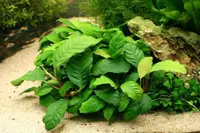
The matchstick airplant, Aechmea cylindrata, is a bromeliad that often grows as an epiphyte, anchored to trees rather than rooted in deep soil. It forms a stiff rosette of narrow, arching leaves that can collect water in the center.

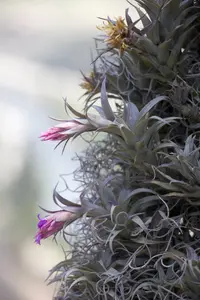
Flower spikes rise above the foliage with cylindrical clusters of bright bracts and small flowers that resemble matchsticks. It is native to Brazil’s Atlantic Forest, where it experiences bright filtered light and good air movement.

This background makes it relatively adaptable for indoor display, as long as it receives bright indirect light and moderate moisture. Understanding how to care for matchstick airplant is mainly about recreating those airy, lightly shaded conditions without waterlogging the roots or crown.

Main Plant Requirements

Care Difficulty

Moderate Care

Light Preference

Partial Shade

Water Requirements

Moderate Water

Temperature Preference

Tropical / Frost Sensitive

Hardiness Zone

10–11

Soil Texture

Sandy, Loamy, Organic-rich

Soil pH

Acidic (5.5–6.5), Slightly acidic (6.5–7.0)

Soil Drainage

Well-drained

Fertilization

Light (every 4–6 weeks)

Get Personalized Care Plan

Scan your plant to receive care tips personalized for your specific plant

Available on iOS and Android

How to Care for the matchstick airplant

This bromeliad prefers bright, indirect light that mimics filtered forest conditions.

  • Provide 4–6 hours of bright, filtered light daily, such as dappled shade under taller plants or sheer-curtained windows for matchstick airplant indoor care.
  • Allow gentle morning sun but protect from strong midday and afternoon sun, which can scorch leaves and cause pale or brown patches.
  • In lower light or heavier shade, expect slower growth and reduced flowering; move gradually to a brighter spot, especially in winter when natural light is weaker.

Aechmea cylindrata needs moderate watering with attention to both the central cup and root zone.

  • Keep the central rosette cup about half full with fresh water and flush it every 1–2 weeks to prevent stagnation and salt buildup.
  • Water the soil only when the top 3–5 cm feel dry, then soak thoroughly so excess drains away; use a loose, fast-draining mix to avoid root rot.
  • Reduce watering volume and frequency in cooler months; signs of overwatering include mushy leaf bases, while curling or crisp leaf tips suggest underwatering.

This bromeliad thrives in warm, frost-free conditions with only moderate temperature swings.

  • Aim for 65–80°F (18–27°C) for steady growth, with good air movement but no direct drafts from air conditioning or heaters.
  • Protect from cold; growth slows below 55°F (13°C), and exposure near or below 40°F (4°C) can cause tissue damage or death, especially to young plants.
  • Tolerates brief heat up to about 90°F (32°C) if shaded and humidity is moderate; in hot, dry spells, avoid intense sun and increase air humidity rather than overwatering.

This bromeliad prefers moderately humid air but adapts to typical household conditions if not extremely dry.

  • Aim for 40–60% humidity to keep leaf tips and bracts from drying prematurely on the matchstick airplant.
  • Tolerates brief dry indoor air, but prolonged levels below 30% cause crispy leaf tips and dull, shriveled inflorescences.
  • Increase humidity with a nearby pebble tray or grouped plants rather than misting heavily, which can leave water trapped in leaf bases.

This species needs a very free-draining, airy mix that mimics epiphytic conditions.

  • Use a loose mix such as 50% fine orchid bark, 25% coarse perlite or pumice, and 25% peat-free compost or coco coir.
  • Ensure rapid drainage; water should exit the pot within seconds, leaving roots moist but never waterlogged.
  • Keep pH slightly acidic to neutral, roughly pH 5.5–7.0, which suits Aechmea cylindrata and supports nutrient uptake.
  • Avoid compact, clay-heavy, or peat-dense mixes that stay wet, and add extra bark or perlite if the medium feels heavy.

This bromeliad is well suited to container growing due to its compact root system and upright rosette form.

  • Choose a squat, heavy pot to counterbalance the tall flowering spike and prevent tipping in light winds or on narrow shelves.
  • Select a container just 2–4 cm wider than the root ball to keep the medium drying at a similar rate to the leaf tank.
  • Use unglazed terracotta if extra moisture loss is needed, or glazed ceramic if the existing mix dries too quickly in your climate.

Aechmea cylindrata benefits from light, controlled feeding rather than heavy fertilization.

  • Apply a balanced liquid NPK fertilizer at 1/4–1/2 strength every 4–6 weeks during spring–summer, over the root zone or lightly into the central cup.
  • Use a slow-release bromeliad-appropriate fertilizer in pots, avoiding direct contact with the cup to prevent salt buildup.
  • Reduce feeding in fall and stop during winter dormancy, resuming only when new growth appears.
  • When caring for matchstick airplant, always water before fertilizing to limit root and leaf burn.

Pruning Aechmea cylindrata focuses on hygiene and managing spent flowering stems and offsets.

  • Best timing is after flowering finishes, typically late spring to summer, when offsets are well-formed.
  • Remove dead, damaged, or rotting leaves at the base with clean, sharp scissors or pruning shears.
  • Cut the spent flowering stalk at its base to tidy the plant; this does not trigger rebloom on the same rosette.
  • Thin crowded offsets if needed to improve air flow and maintain an open, balanced clump.

Aechmea cylindrata grows slowly in containers and needs repotting only when clearly root-bound or top-heavy.

  • Check for roots circling the pot, very slow growth, or a rosette that leans or tips the container as signs to move up one size.
  • Plan repotting for spring, every 3–4 years, when new roots are forming and temperatures are stable.
  • Gently loosen the root ball, remove old, decomposed mix, and trim dead roots, handling the plant by the base of the rosette.
  • Replant in a well-drained, airy bromeliad mix, keep slightly shaded for 1–2 weeks, and water lightly to limit root stress.

Aechmea cylindrata is most commonly propagated by division of offsets rather than by seed.

  • Separate offsets in spring–summer when they reach about 1/3–1/2 the size of the mother rosette and show their own roots.
  • Remove the plant from the pot, gently tease pups away using a clean knife if needed, keeping as many roots as possible.
  • Pot each offset into a small container with free-draining bromeliad mix and keep the crown above the soil line.
  • Maintain bright, indirect light, high humidity, and lightly moist mix until new leaves and roots confirm establishment.

Aechmea cylindrata is frost-sensitive and needs protection in regions with cold winters.

  • Keep outdoor plants in zones milder than about 30°F; in colder climates, grow in containers for seasonal movement.
  • Before first frost, move potted plants indoors to bright, indirect light and away from heat vents or drafts.
  • In mild climates, mulch lightly around the root zone, keeping mulch off the rosette to prevent rot.
  • Water sparingly in winter, allowing the mix to dry slightly, and avoid letting water sit cold in the central cup.

Care Tips

Use rainwater wells

Collect rainwater or use filtered, low-mineral water in the central tank and for misting to reduce leaf spotting and scale buildup from hard tap water over time.

Secure top-heavy rosettes

If the pot is light relative to the leaf mass, add stones to the bottom or use a cachepot to stabilize the plant and prevent tipping as the flower spike develops.

Support offset clusters

When several pups form around the mother plant, place a wider, heavier container or shallow bowl around the nursery pot to support the expanding clump without disturbing roots.

Time pup division

Separate offsets only when they are at least one-third to one-half the size of the mother rosette, then cut with a clean, sharp knife and allow the cut base to dry for 1–2 days before repotting.

Rotate for even form

Turn the pot 90° every 2–3 weeks so the rosette develops symmetrically and the inflorescence stands more upright, especially important when caring for matchstick airplant indoors near a strong side light source.

Common Pests and Diseases

Scale insects

This pest often settles on the stiff leaves and in the leaf bases, feeding on plant sap and causing yellow spotting, sticky honeydew, and sooty mold growth. Infestations are favored by warm, still indoor air and plants kept too dry at the roots but with dusty foliage.

Solution

Remove visible insects manually with a cotton swab dipped in 70% isopropyl alcohol, then rinse the foliage thoroughly, including leaf bases. Improve air movement, avoid overfertilizing, and, if needed, use an insecticidal soap or horticultural oil labeled for bromeliads, applied in the early morning and rinsed lightly after drying to prevent buildup in the central cup.

Mealybugs

These insects hide in leaf axils, around the central tank, and at the base of the rosette, forming white cottony masses and causing stunted growth and leaf distortion. Honeydew from feeding can lead to secondary sooty mold on the leaf surface.

Solution

Flush the central cup and leaf bases with lukewarm water and gently scrub cottony clusters with a soft brush or cotton swab dipped in 70% isopropyl alcohol. Repeat weekly until no new insects appear, and use an insecticidal soap spray specifically tested on a small section of the plant first to confirm there is no phytotoxic reaction, especially under indoor light conditions typical of matchstick airplant indoor care.

Bromeliad tank rot

This disease affects the water-holding rosette (tank), where stagnant, dirty water encourages bacterial and fungal growth, leading to a foul smell, browning leaf bases, and collapse of the plant center. Symptoms include soft, mushy tissue around the cup while outer leaves may stay green for some time.

Solution

Immediately empty the central tank, trim out any soft, rotting tissue with sterilized tools, and improve air circulation around the plant. Refill the cup only lightly with fresh, chlorine-free water, change it frequently, keep the crown slightly tilted so water does not sit deeply in the base, and avoid splashing fertilizer solution directly into the tank.

Leaf spot (fungal)

This disease produces small, round to irregular brown or dark purplish spots on the stiff leaves, sometimes with a yellow halo, which may coalesce under high humidity and poor air circulation. Spots often start where water droplets sit on the leaves for long periods under low light.

Solution

Remove the most heavily spotted leaves to reduce spore load, then adjust watering so foliage dries quickly and avoid overhead misting late in the day. Increase light and airflow, space plants so leaves do not touch, and, if the problem persists, apply a broad-spectrum fungicide labeled for ornamental bromeliads, following label directions carefully.

Spider mites

These pests can occur on plants kept in very dry indoor air, leading to fine webbing, dull or stippled leaves, and a general grayish cast to the foliage. Damage is often more visible than the mites themselves and may be concentrated on older or more shaded leaves.

Solution

Rinse both sides of the leaves thoroughly with a strong but gentle stream of lukewarm water, repeating every few days to disrupt their life cycle. Raise humidity slightly around the plant without keeping the foliage constantly wet, increase air movement and light, and, if needed, use insecticidal soap or a miticide labeled as safe for bromeliads, applied carefully to leaf undersides where mites hide.

Interesting Facts

Tubular rosette habitat

This species forms tall, cylindrical leaf rosettes that naturally collect rainwater and organic debris, creating small water reservoirs used by insects and other invertebrates in its native Atlantic Forest range in southeastern Brazil.

Color-shifting flower spikes

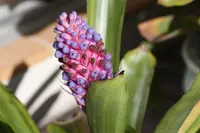
Its inflorescences show a striking color contrast, with pink to reddish bracts and bluish flowers that can shift toward purplish tones as the blooms age, a pattern thought to help guide pollinators to the freshest flowers.

Epiphytic and rupicolous growth

In the wild it often grows as an epiphyte on trees or as a rupicolous plant on rocks, anchoring with roots mainly for support while relying largely on leaf surfaces to absorb water and nutrients from rain and humid air.

Botan icon

Did you know?

In its Atlantic Forest habitat, this bromeliad can form dense clumps on tree branches or rock outcrops, creating miniature canopy or cliff communities that offer shelter and breeding sites for frogs, insects, and other small organisms, contributing to local microhabitat diversity.

FAQs about matchstick airplant

This bromeliad usually blooms only once on each rosette, often after several years of mature growth. Lack of flowering is usually normal age-related timing, not a problem, provided foliage looks firm, colored, and free from rot.

Grow Healthy Plants with Botan Care

Keep your plants happy and healthy with plant identification, disease detection, and easy care guidance.

Botan plant care app — identify plants on mobile

Explore More Plants