Fairy bentspur orchid Care (Campylocentrum micranthum)

Fairy bentspur orchid

About Fairy bentspur orchid

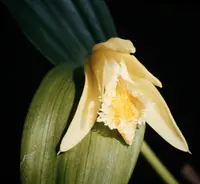
Campylocentrum micranthum, commonly called the Fairy bentspur orchid, is a small epiphytic orchid that grows attached to tree trunks and branches. It often forms dense tangles of roots with very small, inconspicuous flowers.

This species is native to tropical regions of Central and South America, where it thrives in warm, moist forests with moving air. Its leafless or nearly leafless growth habit means it relies heavily on its roots for both anchoring and moisture uptake.

Because it demands stable warmth, high humidity, and good air circulation, it is considered challenging for beginners. Understanding how to care for Fairy bentspur orchid starts with replicating its airy, bark-mounted forest habitat indoors.

Main Plant Requirements

Care Difficulty

Hard Care

Light Preference

Partial Shade

Water Requirements

Keep Soil Moist

Temperature Preference

Tropical / Frost Sensitive

Hardiness Zone

11–13

Soil Texture

Organic-rich, Peaty, Sandy

Soil pH

Acidic (5.5–6.5)

Soil Drainage

Moist but well-drained

Fertilization

Light (every 4–6 weeks)

Get Personalized Care Plan

Scan your plant to receive care tips personalized for your specific plant

Available on iOS and Android

How to Care for the Fairy bentspur orchid

This small epiphytic orchid thrives in bright, filtered light that mimics dappled forest canopy conditions.

  • Provide 6–8 hours of bright, indirect light each day, such as under 40–60% shade cloth or beneath open tree cover.
  • Allow gentle early morning sun, but protect from strong midday and afternoon sun that can cause leaf scorch and yellowing.
  • In winter or overcast seasons, increase light exposure by thinning overhead shade or moving to a brighter, still filtered position; this supports compact growth for the Fairy bentspur orchid.

This epiphytic orchid prefers frequent moisture on its roots but dries slightly between waterings.

  • Water when surface roots look silvery and feel dry, then soak thoroughly so water runs off quickly rather than pooling.
  • In warm, active growth periods, mist or water lightly once roots turn pale, often every 1–3 days outdoors in airy mounting; reduce frequency during cooler seasons.
  • Watch for shriveled, wrinkling roots as a sign of underwatering, and for blackened, mushy roots or a sour smell as clear indicators of overwatering and poor drainage in Campylocentrum micranthum.

This species favors warm, frost‑free conditions similar to lowland to mid‑elevation tropical forests.

  • Aim for 65–80°F (18–27°C) for steady growth, with only slight nighttime drops to avoid stress.
  • Protect from temperatures below 50°F (10°C); exposure near 40°F (4°C) or any frost can permanently damage roots and stems.
  • In hot weather above 86°F (30°C), increase air movement and humidity while shading from harsh sun so tissues do not overheat and desiccate.

This miniature epiphytic orchid needs consistently high humidity to thrive.

  • Aim for 60–80% humidity, mimicking its moist forest habitat for stable growth.
  • Tolerates brief drops to 40–50%, but prolonged dry indoor air leads to shriveling roots and dull, leathery leaves in the Fairy bentspur orchid.
  • Increase humidity with a nearby humidifier, grouped plants, or an open-water tray placed close but not directly under the plant.

This species naturally grows as an epiphyte, so it needs an airy, fast-draining mount or mix rather than compact potting soil.

  • Use a loose orchid-style mix of medium bark, fine bark, and a small amount of sphagnum moss to retain some moisture without becoming dense.
  • Ensure excellent drainage and aeration so roots dry quickly between waterings; avoid any peat-heavy or garden soil that compacts around roots.
  • Aim for slightly acidic to neutral conditions, around pH 5.5–7.0, which suits most epiphytic orchids including Campylocentrum micranthum.
  • For mounted culture, secure roots on cork or hardwood with a thin layer of moss, allowing ample air circulation around the root system.

This orchid can be grown in small containers or baskets, though mounting is often preferred.

  • Choose shallow, slotted orchid pots or mesh baskets that let roots grip surfaces and allow rapid drainage.
  • Select a pot just large enough to fit the root mass, since excess volume keeps the mix wet and reduces air around roots.
  • Use a heavier container or add weight to baskets if foliage makes the plant top-heavy, preventing tipping in bright, breezy positions.

This epiphytic orchid needs only light feeding; overfertilizing can damage roots and reduce flowering in the Fairy bentspur orchid.

  • Use a balanced orchid fertilizer (around 20-20-20) diluted to 1/4–1/2 strength in low-mineral water.
  • Feed every 2–4 weeks during active growth in spring–summer, skipping applications if growth is slow.
  • In autumn–winter, reduce feeding to once every 4–6 weeks or pause if the plant rests.
  • Rinse roots with plain water between feedings to limit salt buildup on bark or mount.

Campylocentrum micranthum needs minimal pruning, focused on plant health rather than shaping.

  • Best timing is after the main flowering flush, when new growth can be seen starting.
  • Use fine, sterilized scissors to remove dead, blackened, or rotting roots and spent flower spikes.
  • Trim only clearly dead or diseased tissue; retain firm green or silvery roots to support growth.
  • Light hygiene pruning improves air flow around the roots and reduces risk of fungal problems.

This species is usually grown mounted or in very open media and dislikes frequent disturbance.

  • Repot or remount only when roots circle tightly, media has broken down, or growth stalls despite good care.
  • Plan any move for late winter to early spring, just before strong new root growth begins.
  • Typical intervals are 3–5 years; healthy plants on stable mounts may remain longer undisturbed.
  • Soak roots first, then gently free them, trimming only dead tissue and securing the plant firmly to fresh bark or a new mount.

Home propagation of Campylocentrum micranthum is challenging and not commonly attempted outside specialist collections.

This warm- to intermediate-growing orchid is frost-sensitive and needs careful winter management in most temperate climates.

  • Keep temperatures above 55°F, ideally 60–70°F, with good air circulation but no cold drafts.
  • For potted plants, move containers indoors to a bright, cool–warm room before night temperatures drop near 50°F.
  • Water less often in winter, allowing roots to dry slightly between waterings while maintaining moderate humidity (50–70%).
  • Avoid placing plants against cold window glass; use a gap or sheer curtain to buffer sudden temperature swings.

Care Tips

Mounting selection

Use rough-barked hardwood mounts such as cork or tree fern that allow roots to grip firmly and dry quickly, and avoid soft or resinous woods that can stay wet and promote rot.

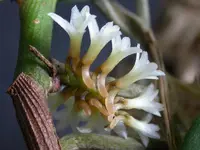
Root hydration check

Mist the exposed roots until they turn from silvery to green, then stop; this simple color change helps prevent both underwatering and chronic overwatering when caring for Fairy bentspur orchid.

Airflow management

Position a small fan on a low setting to provide gentle, constant air movement around the plant, which reduces fungal issues and helps the roots dry evenly after each watering.

Seasonal rest adjustment

During the plant’s drier rest period, keep the roots slightly less moist but maintain good humidity and air movement, rather than stopping water completely, to avoid root dieback.

Fertilizer dilution routine

Apply a very dilute orchid fertilizer solution more frequently instead of strong, infrequent doses, and flush the mount with plain water once a month to prevent mineral buildup on exposed roots.

Common Pests and Diseases

Scale insects

This pest often settles along roots, stems, and leaf bases, feeding on sap and weakening the plant, especially in warm, low‑airflow orchid setups. Symptoms include sticky residue, slow growth, and pale, stressed foliage or stem tissue.

Solution

Remove infested plants from close contact with others, then wipe or gently brush visible scale from roots and stems with cotton swabs dipped in 70% isopropyl alcohol. Improve air movement around the plant, avoid overfertilizing with high nitrogen, and repeat alcohol treatments weekly until no new scale appears; in severe cases, use a labeled systemic insecticide suitable for epiphytic orchids following all safety directions.

Spider mites

These insects thrive in warm, dry, still air, and on leafless orchids like Campylocentrum micranthum they often attack young green root tips and stem tissue. Symptoms include silvery stippling, fine webbing, and slowed growth under high light and low humidity conditions.

Solution

Increase humidity to around 60–70% while maintaining good airflow, and rinse the plant thoroughly with lukewarm water, focusing on root tips and crevices. For persistent infestations, apply a miticide or neem‑based spray labeled for orchids, repeating at 5–7 day intervals until no new damage appears, and avoid letting the micro‑habitat get too dry in the future.

Mealybugs

This pest hides in tight crotches, under root masses, and at mounting points, where it sucks sap and deposits white cottony masses. Symptoms include sticky honeydew, localized yellowing, and deformed new growth or root tips.

Solution

Isolate affected plants and physically remove mealybugs with cotton swabs dipped in 70% isopropyl alcohol, paying special attention to root junctions and under bark or cork mounts. After manual cleaning, use a systemic insecticide or repeated neem or insecticidal soap sprays safe for orchids, and reduce overcrowding on the mount or slab to limit re‑infestation while following general Campylocentrum micranthum care to keep the plant vigorous.

Soft rot (bacterial)

This disease develops rapidly in warm, stagnant, very humid conditions, especially when water remains trapped around the stem base or damaged root areas. Symptoms include water‑soaked, foul‑smelling tissue that turns brown to black and can spread quickly through the small stem and attached roots.

Solution

Cut away all affected tissue with a sterile blade, dust the cut surfaces and surrounding area with ground cinnamon or a labeled bactericide, and allow the plant to dry with strong airflow for several hours before resuming light misting. Avoid overhead watering late in the day, keep the mount or slab from staying constantly soggy, and maintain good air circulation to prevent recurrence.

Fungal leaf spot and stem blight

This disease appears when plants are kept in high humidity with poor air circulation and frequent wetting of stems and any small leaflike structures. Symptoms include small dark spots that may enlarge into sunken lesions on the stem or emerging growth, sometimes with yellow halos.

Solution

Prune out affected tissue with sterile tools, then allow the plant to dry and increase airflow around the mount or basket. Apply a broad‑spectrum fungicide labeled for orchids as a preventive spray, space plants so they do not touch, and water early in the day so surfaces dry quickly, which greatly reduces the risk when trying to grow Campylocentrum micranthum in warm indoor or greenhouse conditions.

Interesting Facts

Leafless adult habit

Mature plants often lose their leaves completely and rely on green, photosynthetic roots to produce energy, a growth strategy seen in several neotropical orchids adapted to high-humidity forest canopies.

Miniature night-scented flowers

The species produces very small, pale flowers that open mainly at night and release a faint scent, indicating adaptation to nocturnal pollinators such as small moths.

Wide Neotropical range

This orchid occurs from southern Mexico through Central America into parts of northern South America and the Caribbean, showing strong ecological flexibility across humid lowland and montane forests.

FAQs about Fairy bentspur orchid

This species often skips flowering if light is too low, nights are too warm, or nutrition is inadequate. Provide bright, filtered light, a slight day–night temperature drop, stable moisture, and very light, regular fertilizing to encourage blooms.

Grow Healthy Plants with Botan Care

Keep your plants happy and healthy with plant identification, disease detection, and easy care guidance.

Botan plant care app — identify plants on mobile

Explore More Plants