Aerangis ellisii Care

Aerangis ellisii

About Aerangis ellisii

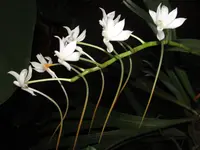
Aerangis ellisii is a small epiphytic orchid that usually grows on tree trunks, forming compact clumps of roots and leaves. It is valued for its elegant white, star-shaped flowers with long nectar spurs and a light fragrance.

This species comes from Madagascar’s humid forests, where it enjoys warm, stable conditions and good air movement. It is considered moderately challenging, as it dislikes drying out completely yet is also sensitive to stagnant moisture around the roots.

Understanding how to care for Aerangis ellisii starts with providing bright, gentle light, consistent humidity, and a very airy orchid substrate or mounted setup that allows fast drainage.

Main Plant Requirements

Care Difficulty

Hard Care

Light Preference

Bright Indirect Light

Water Requirements

Regular Water

Temperature Preference

Tropical / Frost Sensitive

Hardiness Zone

Unknown

Soil Texture

Sandy, Organic-rich

Soil pH

Acidic (5.5–6.5)

Soil Drainage

Well-drained

Fertilization

Light (every 4–6 weeks)

Get Personalized Care Plan

Scan your plant to receive care tips personalized for your specific plant

Available on iOS and Android

How to Care for the Aerangis ellisii

This orchid prefers bright, gentle light that mimics high, filtered forest canopy conditions.

  • Provide 6–8 hours of bright, filtered light daily, such as dappled shade under taller plants or shade cloth that cuts direct sun by 40–60%.
  • Allow only soft morning sun; protect from direct midday and afternoon sun, which can cause yellowing leaves, bleached patches, or leaf scorch on Aerangis ellisii.
  • Increase light slightly in winter with brighter exposure or supplemental light, but reduce intensity in summer when the sun is stronger to prevent stress.

Watering should keep roots lightly moist but never stagnant or waterlogged.

  • Before watering, let the upper 2–3 cm of bark or mounting material feel barely dry, then water thoroughly so all roots are soaked and excess drains away quickly.
  • In warm, active growth, expect to water more often, while in cooler months or reduced light, extend the interval so surfaces dry a bit longer between waterings.
  • Watch for wrinkled, limp leaves as a sign of underwatering and soft, blackened roots or a sour smell as signs of overwatering in Aerangis ellisii.

This species prefers intermediate to warm conditions with limited temperature swings.

  • Aim for daytime temperatures of 70–80°F (21–27°C) and nights of 60–68°F (16–20°C) to support steady growth and flowering.
  • Avoid letting temperatures drop below 55°F (13°C); short dips may be tolerated, but repeated chills slow growth and increase disease risk.
  • In hot weather above 85°F (29°C), increase air movement and humidity and avoid hot, stagnant spots, as the plant is sensitive to extreme heat and cannot tolerate frost.

This orchid needs consistently high humidity to grow well in cultivation.

  • Aim for 60–80% humidity; lower levels slow growth and reduce flowering.
  • Dry air causes leaf tip browning, shriveling roots, and bud blast, especially near heating or AC vents.
  • Increase humidity with a nearby humidifier, grouped plants, and a fan on low to keep moist air moving around Aerangis ellisii.

Aerangis ellisii grows best in very airy, fast-draining orchid media rather than regular potting soil.

  • Use a mix of medium bark, charcoal, and a little sphagnum moss to hold some moisture without becoming compacted.
  • Ensure large air pockets around roots; avoid fine peat-based mixes that stay wet and exclude oxygen.
  • Keep pH slightly acidic to neutral (about 5.5–7.0), which suits epiphytic orchid roots.
  • Improve drainage by using coarse-grade bark and a pot with many side and bottom openings.

This species is suitable for container growing when mounted-style conditions are simulated in a pot or basket.

  • Choose a slatted basket or pot with side openings so roots can attach and air can circulate freely.
  • Secure the plant firmly so the root zone does not move when watered, which protects fragile root tips.
  • Use a shallow but wide container to spread roots horizontally and prevent the light, airy mix from staying wet at the center.

This epiphytic orchid benefits from light, consistent feeding during active growth in spring and summer.

  • Use a balanced orchid fertilizer (around 20-20-20) diluted to 1/4–1/2 strength in low-mineral water.
  • Feed Aerangis ellisii every 2–3 weeks while new leaves or roots are forming, then flush with plain water monthly.
  • In autumn and winter, reduce feeding to 1× month or pause if growth stops.
  • Avoid slow-release pellets in bark mounts; they can burn roots and accumulate salts.

This orchid needs minimal pruning, mainly to keep it clean and healthy.

  • Best time for any pruning is after flowering, once spikes have fully faded and dried.
  • Use small, sharp, sterilized scissors to remove dead flower spikes at their base without cutting live tissue.
  • Trim only dead, mushy, or hollow roots; leave firm, green or silvery roots intact to support growth.
  • Light grooming improves air circulation and reduces fungal issues without changing Aerangis ellisii natural form.

Handling of this orchid focuses on remounting or refreshing its airy medium rather than frequent potting changes.

  • Plan to repot or remount every 2–3 years, or when bark breaks down, drainage slows, or roots circle tightly.
  • Best timing is in late winter to early spring, just before active root growth begins.
  • Gently soak the root zone first so roots become flexible, then carefully tease them free from the old mount or pot.
  • Place roots on fresh bark or cork with sphagnum around them, keep slightly shaded, and maintain high humidity to reduce stress.

Reproducing this species at home is challenging and usually left to experienced growers or labs.

  • Vegetative propagation is mainly through keikis, which are small offsets forming on flower spikes or the stem.
  • Wait until keikis have several roots 3–5 cm long before removing them with a sterile blade.
  • Mount keikis on fine bark or cork, keep humidity high (70–80%), and provide gentle, bright indirect light.
  • Seed propagation requires sterile flasking conditions, so most home growers do not attempt it for Aerangis ellisii.

This orchid is not frost hardy and needs warm, stable indoor conditions during winter in temperate climates.

  • Keep temperatures around 60–70°F at night and 65–80°F by day, avoiding drafts and cold window glass.
  • Move mounted or potted plants indoors before temperatures drop below 55°F outside.
  • Maintain moderate humidity (50–70%) with good air movement to prevent fungal problems in cool, still air.
  • Water slightly less often but never allow the roots to stay completely dry for long periods.

Care Tips

Mounting strategy

Mount plants on cork or hardwood slabs with a thin pad of long-fiber sphagnum only around the roots, leaving the crown exposed so water can drain and air can circulate freely after each misting.

Nighttime ventilation

Provide gentle air movement at night with a small fan on a low, indirect setting aimed past, not at, the plant to reduce fungal risk and support this species’ preference for cool, fresh night air.

Cool-night cueing

In late fall, give slightly cooler nights and a drier, but not bone-dry, root zone for several weeks to help cue spike initiation without allowing the roots to shrivel.

Spike protection

Once a flower spike emerges, avoid moving or rotating the mount and protect the spike from direct fan airflow or accidental knocks, as mechanical damage can halt bud development on this species.

Water-quality checks

Use low-mineral water and inspect root tips monthly for signs of salt stress, such as browning or stalled growth, adjusting fertilizer strength or flushing the mount more often as needed when caring for Aerangis ellisii.

Common Pests and Diseases

Scale insects

These insects attach to leaves, pseudobulbs, and flower spikes, sucking sap and weakening the plant, especially under warm, stagnant conditions typical of mounted orchids. Symptoms include sticky honeydew, yellowing patches, and small dome-shaped bumps that do not brush off easily.

Solution

Physically remove adults with a cotton swab dipped in 70% isopropyl alcohol, then rinse the plant thoroughly with lukewarm water. Improve air movement around mounted plants, avoid overfertilizing with high nitrogen formulas, and use a labeled horticultural oil or insecticidal soap in repeated light applications to control remaining juveniles.

Mealybugs

This pest often hides in leaf axils, on roots, and around flower spikes, feeding on sap and causing leaf yellowing and stunted growth. Symptoms include cottony white clusters, sticky honeydew, and sooty mold growing on excretions in high-humidity orchid setups.

Solution

Isolate the plant, then dab visible insects with 70% isopropyl alcohol and gently wash affected areas. Inspect roots, mount material, and basket crevices, remove heavily infested plant parts if possible, and repeat spot treatments weekly until no new insects appear, using insecticidal soap if infestations persist.

Spider mites

These pests thrive in warm, dry air and can damage the fine leaves of this epiphytic orchid, especially in indoor collections with low humidity. Symptoms include tiny yellow stippling, dull leaf surfaces, fine webbing on leaf undersides, and leaf edge browning.

Solution

Increase humidity to 50–70%, rinse foliage thoroughly under a gentle stream of lukewarm water, and wipe leaf undersides. Improve air circulation, avoid placing plants near dry heat sources, and use a labeled miticidal soap or horticultural oil in several light treatments, focusing on leaf undersides where mites cluster.

Bacterial soft rot

This disease spreads quickly in warm, stagnant, high-humidity conditions and is favored by water sitting in leaf bases and crowns. Symptoms include sudden wet, translucent patches on leaves or pseudobulbs, a foul smell, and rapid tissue collapse, especially at the base of the plant or near mounting points.

Solution

Immediately cut out all affected tissue with a sterile blade, dust cuts with ground cinnamon or a bactericidal product, and allow the plant to dry with strong air movement. Reduce watering and misting on leaves, ensure the mount or medium dries quickly between waterings, and space plants so moisture does not remain trapped around the foliage, which is essential for proper Aerangis ellisii care.

Fungal leaf spot

This disease often develops where water remains on leaves for long periods under low air movement, as in crowded orchid cases. Symptoms include small yellow or translucent spots that slowly turn brown or black, sometimes with a purple margin, primarily on older leaves exposed to frequent misting or overhead watering.

Solution

Remove and discard affected leaves or cut out localized spots with a sterile tool, then allow cuts to dry in good airflow. Water early in the day so foliage dries before night, avoid constant overhead misting, and apply a broad-spectrum fungicide labeled for orchids if new spots continue to form despite improved cultural conditions.

Interesting Facts

Comet-moth pollination

In its native Madagascar, this orchid is pollinated mainly by long-tongued sphinx moths, including the Madagascar comet moth, which can reach the nectar stored deep in the flower’s long spur at night.

Pendant, many-flowered spikes

Mature plants produce gracefully hanging inflorescences that can carry long chains of small, starry white flowers, creating a cascading effect in their forest-edge habitat.

Fragrant night-blooming flowers

The flowers open pale and waxy and release a stronger fragrance at night, an adaptation that helps guide nocturnal moth pollinators in low-light conditions.

Botan icon

Did you know?

This species is considered rare in the wild and is native to specific regions of Madagascar, where it grows as an epiphyte on trees in humid forest and woodland edges, making in-situ conservation and responsible cultivated propagation especially important.

FAQs about Aerangis ellisii

Lack of blooms often comes from insufficient night temperature drop, too little light, or inconsistent feeding. This species needs a slight cool-down at night, stable moisture, and regular low-dose orchid fertilizer to form and open flower spikes.

Grow Healthy Plants with Botan Care

Keep your plants happy and healthy with plant identification, disease detection, and easy care guidance.

Botan plant care app — identify plants on mobile

Explore More Plants