Encourage Bushy Growth
Pinch back soft stem tips just above a leaf pair every few months to promote branching and create a fuller, cascading plant rather than long, sparse vines.

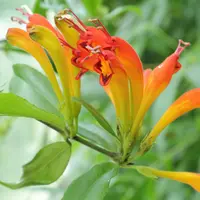
Basket plant, Aeschynanthus speciosus, is a tropical evergreen vine grown mainly in hanging containers for its trailing stems and showy flowers. It belongs to the gesneriad group, the same family as African violets.
Stems can grow long and arching, with glossy, medium-green leaves that create a dense, cascading effect. Clusters of tubular orange to red flowers appear at the stem tips and give strong color contrast.
In nature, it grows as an epiphyte on trees in humid forests of Southeast Asia. This background explains its preference for bright, filtered light, moderate moisture, and airy, well-drained potting mixes.
Its needs are moderate and consistent, so it suits growers who want to learn how to care for basket plant without constant adjustments or complex routines.

Care Difficulty
Moderate Care

Light Preference
Bright Indirect Light

Water Requirements
Moderate Water

Temperature Preference
Tropical / Frost Sensitive

Hardiness Zone
11–12

Soil Texture
Loamy, Peaty, Organic-rich

Soil pH
Acidic (5.5–6.5), Slightly acidic (6.5–7.0)

Soil Drainage
Moist but well-drained

Fertilization
Light (every 4–6 weeks)
Scan your plant to receive care tips personalized for your specific plant
Available on iOS and Android
This tropical epiphyte prefers bright, indirect light that mimics dappled forest canopy conditions.
This species needs consistent moisture with brief drying of the upper soil layer between waterings.
This plant grows best in warm, stable conditions similar to a tropical understory.
This species needs moderately high humidity to maintain healthy foliage and flowering.
This epiphyte prefers a light, airy, fast-draining mix that still holds some moisture.
This species is well suited to container cultivation, especially in hanging baskets.
Aeschynanthus speciosus benefits from light, consistent feeding during its active growing season.
Aeschynanthus speciosus responds well to light, strategic pruning that keeps plants compact and flowering well.
This species prefers slightly snug containers and only occasional repotting when clearly rootbound.
Aeschynanthus speciosus is most often propagated from stem cuttings taken during the warmer months.
This tropical species dislikes cold and needs indoor winter care in regions with frost.

Plant Health Check
Not sure what's wrong with your plant? Check your plant's health inside the app.
This species is native to humid montane forests of Southeast Asia, where it often grows as an epiphyte on tree branches rather than in soil, anchoring by roots that mainly serve for attachment rather than heavy nutrient uptake.
The long tubular orange-red flowers are adapted for pollination by nectar-feeding birds, which brush against the stamens and stigma as they probe for nectar, transferring pollen efficiently between blooms.
After flowering, the plant forms narrow capsules that dry and split open along seams, releasing many small seeds equipped with fine hairs that help them disperse on air currents and lodge in tree bark crevices.
Lack of flowers usually comes from insufficient light, no cool, short rest period, or heavy feeding with high-nitrogen fertilizer. Slightly cooler nights, steady bright light, and balanced feeding encourage buds and support Aeschynanthus speciosus plant care.
Keep your plants happy and healthy with plant identification, disease detection, and easy care guidance.