Protect Young Bark
Install a light-colored tree guard or hardware cloth around the lower trunk of young trees to prevent sunscald and animal damage without trapping moisture against the bark.

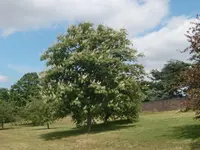
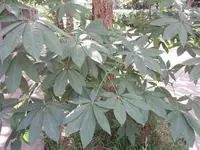
Japanese horse-chestnut, Aesculus turbinata, is a large, deciduous tree grown mainly for its bold foliage and decorative, spiky fruits. It forms a tall, rounded crown with stout branches and attractive palmate leaves made of several leaflets.
This species is native to Japan, where it grows in mountain forests and river valleys. In gardens and parks it is used as a shade and landscape tree rather than a small-space specimen.
The tree is moderately demanding, needing space, consistent moisture, and cool to mild climates. Understanding how to care for Japanese Horse-chestnut starts with giving it deep soil, good drainage, and access to full sun or light shade.

Care Difficulty
Moderate Care

Light Preference
Full Sun

Water Requirements
Regular Water

Temperature Preference
Cold Hardy

Hardiness Zone
5–8

Soil Texture
Loamy, Clay, Organic-rich

Soil pH
Acidic (5.5–6.5), Slightly acidic (6.5–7.0)

Soil Drainage
Moist but well-drained

Fertilization
Minimal (feed rarely)
Scan your plant to receive care tips personalized for your specific plant
Available on iOS and Android
This large deciduous tree grows best with ample outdoor light and some protection from harsh afternoon sun.
This species prefers consistently moist, deep soil but not standing water.
This temperate-climate tree is hardy to cold winters and prefers moderate summer temperatures.
This species tolerates a wide humidity range and usually does not need special humidity control outdoors.
Aesculus turbinata prefers deep, moisture-retentive but freely draining soil that supports extensive root development.
This tree is only suitable for short- to medium-term container growing, such as for young specimens or patio displays.
This large tree usually manages well in fertile ground and needs only modest feeding in managed landscapes.
Pruning Aesculus turbinata focuses on safety, structure, and removal of unhealthy wood rather than frequent shaping.
This species is usually grown as a landscape tree, so transplanting young stock is more relevant than long-term container culture.
Propagation of this tree is typically done from seed rather than vegetative methods, which are less practical.
Mature trees are cold hardy and generally need little special winter care in most temperate climates.

Plant Health Check
Not sure what's wrong with your plant? Check your plant's health inside the app.
This species has some of the largest leaves in the genus, with palmately compound blades that can reach over 60 cm across, helping it capture light efficiently in moist, temperate forests of Japan.
It is naturally distributed in mountainous regions of Honshu, Shikoku, and Kyushu, where it grows along streams and in cool, humid valleys, often forming part of mixed deciduous forests.
The seeds contain toxic saponins and are not safe to eat raw, but traditional practices in Japan involve careful leaching and processing to remove toxins before using the flour in food.

In parts of Japan, the durable and finely grained wood of this tree has been valued for specialty uses such as wooden clogs (geta) and small crafted items, reflecting its role as both a forest species and a traditional material resource.
This species is moderately fast when young, often adding 30–60 cm per year under good conditions. Over several decades it can form a large shade tree, commonly reaching 15–25 m tall with a broad crown.
Keep your plants happy and healthy with plant identification, disease detection, and easy care guidance.