Formative framework pruning
During the first 3–5 years, select 3–5 well-spaced main branches and remove steep, crossing, or crowded shoots to build a strong, open canopy that can support heavy pods and resist wind damage.

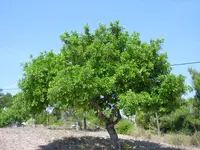
The carob tree, Ceratonia siliqua, is an evergreen legume tree known for its thick, glossy leaves and long, brown pods used as a cocoa substitute. It forms a broad, rounded crown and develops a sturdy trunk, making it a long-lived landscape or orchard tree in warm, dry regions.
This species is native to the Mediterranean basin and is adapted to hot, sunny climates with poor, rocky soils. It grows slowly but is resilient once established, tolerating drought and coastal conditions.
Due to its toughness and low water needs, basic knowledge of how to care for Carob Tree makes it a manageable option for experienced beginners in suitable climates. It prefers full sun, sharply drained soil, and infrequent deep watering once mature.

Care Difficulty
Moderate Care

Light Preference
Full Sun

Water Requirements
Low Water

Temperature Preference
Warm Climate

Hardiness Zone
9–11

Soil Texture
Sandy, Loamy, Rocky

Soil pH
Slightly alkaline (7.0–7.5), Alkaline (7.5–8.5)

Soil Drainage
Well-drained

Fertilization
Minimal (feed rarely)
Scan your plant to receive care tips personalized for your specific plant
Available on iOS and Android
Ceratonia siliqua thrives in bright, open sites with strong sun exposure in warm climates.
Ceratonia siliqua prefers dry to slightly moist soil and is highly drought-tolerant once established.
This species is a warm-temperate to subtropical tree that prefers mild winters and hot, dry summers.
This species is adapted to dry climates and usually does not need special humidity management indoors.
Ceratonia siliqua prefers mineral, well-aerated soil that dries between waterings and never stays waterlogged.
This species can be grown in containers, especially in cooler climates or where ground planting is not practical.
Ceratonia siliqua is adapted to low-nutrient soils, but light feeding improves growth in containers or poor ground sites.
Pruning Ceratonia siliqua is mainly used to develop a stable framework and remove weak growth.
Ceratonia siliqua is usually grown in the ground, so management focuses on correct transplanting rather than frequent repotting.
Propagation of Ceratonia siliqua is usually done from seed, with cuttings used when specific traits must be preserved.
Ceratonia siliqua is moderately frost-sensitive and benefits from basic winter protection in colder regions.

Plant Health Check
Not sure what's wrong with your plant? Check your plant's health inside the app.
The mature pods of Ceratonia siliqua are naturally sweet due to high sugar content and have been widely used as a caffeine‑free cocoa substitute in baking and confectionery. The roasted, ground pulp provides a similar flavor profile to chocolate but contains virtually no theobromine, the stimulant compound that makes chocolate unsafe for many animals.
The seeds of this species are unusually uniform in mass, which led ancient Mediterranean traders to use them as a reference for small weights. The term carat, used for gemstones and gold, originated from the historic use of these seeds as a standard measure.
This tree develops a very deep taproot system and thick, leathery evergreen leaves that reduce water loss, allowing it to survive long, dry summers typical of Mediterranean climates. Its physiological adaptations make it capable of remaining productive in sites where many other fruit trees fail.

Genetic and archaeological evidence indicates that Ceratonia siliqua was domesticated thousands of years ago in the eastern Mediterranean, and selected cultivars have been maintained continuously since classical antiquity, making it one of the oldest documented perennial tree crops still under cultivation.
Yes, it can be grown in large, deep containers with excellent drainage. Use a gritty, well-draining mix and avoid waterlogged conditions. Container plants stay smaller and need regular root pruning and repotting every few years.
Keep your plants happy and healthy with plant identification, disease detection, and easy care guidance.