Stake Young Leaders
Install a sturdy stake on the windward side of newly planted trees and tie the central leader with flexible, figure-eight ties so the trunk stays upright but can still move slightly and develop strong taper.

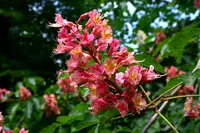
The red horse-chestnut, Aesculus × carnea, is a medium to large deciduous tree grown mainly as an ornamental in parks, streets, and larger gardens. It is a hybrid between common horse-chestnut and red buckeye, forming a dense, rounded crown with strong branches.
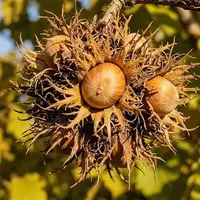
Its showy pink to red flower clusters appear in late spring, followed by spiny capsules containing glossy brown seeds. The tree is not native to North America but is widely planted in temperate regions with cool to mild summers.
It is relatively easy to grow where there is space, preferring full sun, consistent moisture, and fertile, well-drained soil. Gardeners who learn how to care for red horse-chestnut usually value it for reliable seasonal interest and shade.

Care Difficulty
Moderate Care

Light Preference
Full Sun

Water Requirements
Regular Water

Temperature Preference
Cold Hardy

Hardiness Zone
5–8

Soil Texture
Loamy, Clay, Organic-rich

Soil pH
Slightly acidic (6.5–7.0), Neutral (7.0)

Soil Drainage
Moist but well-drained

Fertilization
Minimal (feed rarely)
Scan your plant to receive care tips personalized for your specific plant
Available on iOS and Android
This large ornamental tree thrives in bright outdoor conditions with stable, predictable light.
This species prefers evenly moist, deep soil rather than frequent light watering.
This hardy deciduous tree tolerates a wide temperature range but flowers best in moderate climates.
Humidity is generally not a limiting factor for Aesculus × carnea grown outdoors in its usual climates.
This tree performs best in deep, moisture-retentive but well-drained soil with stable structure.
This large, long-lived tree is not suitable for long-term container growing beyond very short juvenile stages.
Aesculus × carnea benefits from light, targeted feeding but grows acceptably on decent garden soil without heavy fertilization.
Pruning Aesculus × carnea is mainly structural and corrective, rather than a frequent maintenance task.
Red horse-chestnut is usually grown in the ground, so guidance focuses on transplanting young trees rather than long-term container culture.
Propagation of Aesculus × carnea is possible but mostly handled by nurseries, so home attempts require patience and suitable conditions.
Mature Aesculus × carnea trees are generally cold hardy in suitable climates and need only modest winter attention.

Plant Health Check
Not sure what's wrong with your plant? Check your plant's health inside the app.
This ornamental tree is a stable hybrid between the European horse-chestnut (Aesculus hippocastanum) and the North American red buckeye (Aesculus pavia), combining the larger stature of the former with the red to pink flower color of the latter.
Its inflorescences form dense, upright clusters about 10–20 cm long, packed with pink to deep red flowers that provide a striking vertical accent and are rich in nectar for bees and other insect pollinators.
Compared with common horse-chestnut, many cultivated forms of this hybrid set fewer viable seeds, which lowers the litter of spiny capsules and makes it more suitable for use above sidewalks and parking areas.

This hybrid was first recorded and named in European cultivation in the early 19th century, and it does not have a known wild native range because it arose and spread primarily through intentional selection and planting in parks, avenues, and large gardens.
Poor flowering is often linked to too much shade, drought stress in late spring, or heavy pruning of young wood where buds form. Avoid fertilizer high in nitrogen, which encourages leaf growth instead of flower production.
Keep your plants happy and healthy with plant identification, disease detection, and easy care guidance.