Improve drainage mound
In heavier soils, plant on a low gravelly mound raised 5–8 cm above the surrounding bed to keep the woody crown dry and reduce winter rot when growing Aethionema thomasianum.

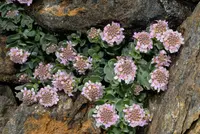
Aethionema thomasianum is a compact, mat-forming perennial in the brassica family, valued mainly for its fine foliage and small, delicate flowers. It typically forms low cushions that suit rock gardens, troughs, and dry, sunny borders.
This species is native to rocky, mountainous areas of the eastern Mediterranean, where it grows in well-drained, often calcareous soils. Its natural habitat makes it relatively drought-tolerant but sensitive to waterlogged conditions.
Gardeners who care for Aethionema thomasianum usually find it manageable if its need for sharp drainage, full sun, and moderate watering is respected. It is better suited to mild, dry-summer climates than to very humid or wet regions.

Care Difficulty
Moderate Care

Light Preference
Full Sun

Water Requirements
Low Water

Temperature Preference
Cool Climate

Hardiness Zone
6–8

Soil Texture
Sandy, Loamy, Rocky

Soil pH
Slightly acidic (6.5–7.0), Slightly alkaline (7.0–7.5)

Soil Drainage
Well-drained

Fertilization
Minimal (feed rarely)
Scan your plant to receive care tips personalized for your specific plant
Available on iOS and Android
This alpine perennial prefers bright, open exposure with plenty of direct sun for compact, floriferous growth.
This species favors drier, well-drained conditions and is sensitive to persistent moisture around the roots.
This plant prefers cool to mild conditions but can cope with moderate summer heat if soil drainage is sharp.
This species prefers dry to moderately dry air and does not need elevated humidity.
Aethionema thomasianum needs very free-draining, mineral-rich soil to prevent root rot.
This species is suitable for container growing, especially in shallow, very free-draining pots.
This alpine perennial from dry, rocky habitats needs only light feeding in cultivation.
Light, timely pruning keeps this mat-forming species compact and encourages better flowering.
This rock-garden plant dislikes frequent disturbance, so transplanting should be minimal and careful.
Propagation is most practical from semi-ripe cuttings or fresh seed collected from healthy plants.
Mature plants are generally cold hardy but benefit from some protection in very wet or severe winters.

Plant Health Check
Not sure what's wrong with your plant? Check your plant's health inside the app.
This species is native to rocky limestone slopes in parts of Turkey, where it grows in thin, nutrient-poor soils and intense sun, forming low, tufted cushions that help it withstand wind and temperature fluctuations.
Unlike many showy ornamentals, this plant produces delicate racemes of small pink to pale lilac flowers without enlarged colorful bracts, relying on the petals themselves and dense floral clusters to attract pollinators.
As a member of the mustard family Brassicaceae, it forms tiny, flattened seed pods (siliques) after flowering, which dry and split to release seeds that often fall close to the parent, slowly expanding the cushion over time.
This species is generally evergreen in mild, dry, well-drained conditions, keeping its small blue-green leaves year-round. In colder or very wet winters it may thin out, lose foliage, or suffer partial dieback, then regrow from the base.
Keep your plants happy and healthy with plant identification, disease detection, and easy care guidance.