Structured leader training
Select one strong central leader when the plant is young and lightly remove competing upright shoots over several seasons to build a stable, wind-resistant framework for long-term health.

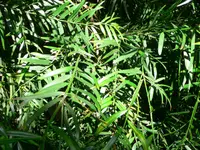
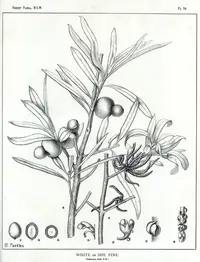
East African yellowwood, Afrocarpus gracilior, is an evergreen conifer often grown as an ornamental tree or large container plant. It has fine, feathery foliage that gives a soft, airy look. In its native range of East Africa, it can form tall forest trees, but in gardens and indoor spaces it is usually kept smaller through pruning. The plant grows with a generally upright, graceful habit that suits hedging, screening, or a single specimen. It is considered moderately easy to grow when given bright light, well-drained soil, and steady, moderate moisture. Understanding how to care for East African Yellowwood helps keep its foliage dense and healthy over time.

Care Difficulty
Moderate Care

Light Preference
Full Sun

Water Requirements
Moderate Water

Temperature Preference
Warm Climate

Hardiness Zone
9–11

Soil Texture
Sandy, Loamy, Organic-rich

Soil pH
Acidic (5.5–6.5), Slightly acidic (6.5–7.0)

Soil Drainage
Well-drained

Fertilization
Minimal (feed rarely)
Scan your plant to receive care tips personalized for your specific plant
Available on iOS and Android
Afrocarpus gracilior grows best in bright, open exposure with some protection from harsh extremes.
Afrocarpus gracilior prefers evenly moist but well-drained soil once established outdoors.
This species prefers mild, frost-free climates and tolerates moderate summer heat once established.
This conifer prefers moderate household humidity and copes well with drier indoor air.
Afrocarpus gracilior prefers well-aerated, fast-draining, slightly acidic to neutral soil.
This species can grow successfully in containers when given stable, well-drained conditions.
Afrocarpus gracilior grows well in average soils but responds to modest, balanced feeding in containers or nutrient-poor ground.
Pruning Afrocarpus gracilior is mainly for structure, safety, and clearance rather than heavy shaping.
This species is usually grown as a landscape tree, so transplanting young plants correctly is more important than frequent repotting.
Propagation of Afrocarpus gracilior is possible but slow and usually handled by nurseries rather than home growers.
Afrocarpus gracilior prefers mild climates and needs attention where winter temperatures drop below freezing.

Plant Health Check
Not sure what's wrong with your plant? Check your plant's health inside the app.
Afrocarpus gracilior belongs to the Podocarpaceae, an old Southern Hemisphere conifer family whose fossil record extends back to the Mesozoic era, making it a living representative of a once much more widespread group.
This species is dioecious, meaning individual trees are either male or female, so seed production occurs only when pollen-bearing and seed-bearing trees grow within range of each other.
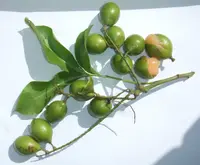
Its fleshy, olive-like seed cones are adapted for bird dispersal; birds eat the outer tissue and later pass or drop the hard seeds, helping the species colonize new sites along East African highland forests.

In its native highland habitat of Ethiopia, Kenya, Tanzania, and surrounding regions, this species often forms part of cloud forest and Afromontane forest communities, where its tall, narrow crown structure helps intercept mist and contribute to local moisture cycling and microclimate regulation.
Growth is moderate, usually 20–40 cm per year in suitable climates. Young trees establish slowly, then speed up once roots are strong. Poor soil, limited water, container restriction, or heavy shade all reduce growth rate.
Keep your plants happy and healthy with plant identification, disease detection, and easy care guidance.