Train Central Leader
In the first 3–5 years, select one strong upright stem as the central leader and remove or shorten competing vertical shoots to develop a stable, timber-like structure and reduce future storm damage.

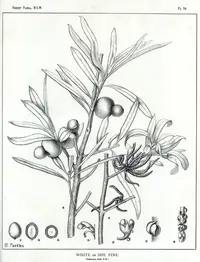
Plum pine (Podocarpus elatus) is an evergreen coniferous tree native to eastern Australia, often grown as an ornamental or clipped hedge. It has dense, glossy, narrow leaves and a naturally upright, columnar habit that can be shaped easily. In the landscape, it can reach tree size, but in containers it stays more compact and manageable. This species tolerates pruning, urban conditions, and a range of soils, which makes it adaptable for gardens and patios. It prefers moderate light, regular moisture, and well-drained soil, so learning how to care for Plum Pine mainly involves providing stable, non-extreme conditions.

Care Difficulty
Moderate Care

Light Preference
Full Sun

Water Requirements
Moderate Water

Temperature Preference
Warm Climate

Hardiness Zone
9–11

Soil Texture
Sandy, Loamy, Organic-rich

Soil pH
Acidic (5.5–6.5), Slightly acidic (6.5–7.0)

Soil Drainage
Well-drained

Fertilization
Minimal (feed rarely)
Scan your plant to receive care tips personalized for your specific plant
Available on iOS and Android
Podocarpus elatus grows best in bright, soft light with some daily sun exposure.
Podocarpus elatus prefers steady moisture but dislikes waterlogged soil.
This species grows best in mild, frost-free climates with moderate seasonal variation.
Podocarpus elatus prefers moderate household humidity but tolerates relatively dry indoor air.
Podocarpus elatus grows best in free-draining, slightly acidic to neutral, structured mixes.
This species is well suited to container growing when the pot supports its deep, eventually woody root system.
Podocarpus elatus grows steadily with modest feeding in containers or nutrient-poor garden soils.
Podocarpus elatus responds well to light, targeted pruning to maintain structure and density.
This species is often grown as a landscape tree, with transplanting more common than frequent repotting.
Podocarpus elatus is most reliably propagated from semi-hardwood cuttings, with seed used less often in home settings.
In mild coastal and frost-free climates, Podocarpus elatus usually needs minimal winter care.

Plant Health Check
Not sure what's wrong with your plant? Check your plant's health inside the app.
This species is native to warm temperate and subtropical rainforests of eastern Australia, where it often grows on deep, fertile soils alongside laurels and figs rather than in dry sclerophyll forests.
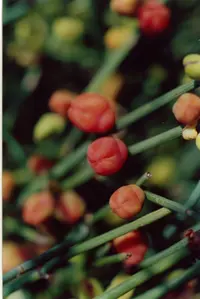
The tree produces elongated, plum-like purple fruits whose fleshy receptacle is edible and mildly sweet, and has traditionally been used in jams and preserves in parts of Australia.
Although it looks like a broadleaf tree, it is a conifer that forms small cones on separate male and female plants, with the female cones developing into the fleshy, plum-like structures commonly mistaken for true berries.

In its native range, this long-lived tree can reach 20–30 m in height with a dense, columnar crown, and mature individuals become important structural elements of rainforest canopies, providing stable, year-round shelter and food for a wide range of birds and fruit-eating animals.
Growth is moderate. In good outdoor conditions, this species typically adds about 20–40 cm per year, sometimes more when young. Container plants grow more slowly due to root restriction and limited nutrients.
Keep your plants happy and healthy with plant identification, disease detection, and easy care guidance.