Safe handling setup
Keep dedicated nitrile gloves, eye protection, and paper towels near the plant so you can immediately protect skin and eyes and blot off the toxic white sap whenever you cut or accidentally damage stems.

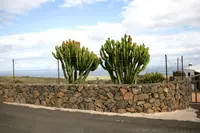
Desert candle, Euphorbia abyssinica, is a tall, columnar succulent shrub or tree that resembles a cactus but belongs to the spurge family. Its upright, many-ribbed green stems create a strong architectural look indoors or in warm outdoor climates.
This species naturally occurs in arid and semi-arid regions of East Africa, where it adapts to strong sun and low rainfall. It is generally tough and drought-tolerant, but its milky sap is irritating, so care for desert candle should avoid damage to the stems.
It usually prefers bright light, infrequent watering, and very well-draining soil, which makes it suitable for growers who like low-maintenance, structured plants.

Care Difficulty
Easy Care

Light Preference
Full Sun

Water Requirements
Low Water

Temperature Preference
Tropical / Frost Sensitive

Hardiness Zone
10–12

Soil Texture
Sandy, Loamy, Rocky

Soil pH
Slightly acidic (6.5–7.0), Neutral (7.0)

Soil Drainage
Well-drained

Fertilization
Minimal (feed rarely)
Scan your plant to receive care tips personalized for your specific plant
Available on iOS and Android
This succulent tree thrives in bright, mostly direct sun that mimics its native arid habitat.
This drought-adapted species is highly sensitive to excess moisture and needs a thorough-dry cycle.
This plant prefers warm, arid conditions with strong seasonal protection from cold and frost.
This species handles typical indoor humidity well and rarely needs special adjustments.
Use a very fast-draining, mineral-rich mix to prevent root rot in Euphorbia abyssinica.
This species is well suited to container growing if the pot is stable and drains quickly.
This drought-tolerant succulent tree needs modest feeding to support slow, steady growth in containers or poor soils.
Pruning Euphorbia abyssinica is mainly for safety, size control, and removing weak growth.
This species is slow growing and dislikes frequent disturbance, so repotting or transplanting is done only when clearly needed.
Propagation of this columnar succulent is usually done by stem cuttings, which root slowly but reliably under the right conditions.
Cold sensitivity means this plant needs thoughtful winter care, especially in regions with frost or extended cool, wet periods.

Plant Health Check
Not sure what's wrong with your plant? Check your plant's health inside the app.
This species develops a tall, tree-like stem with regularly spaced, upright branches, giving it a rigid candelabra outline that is characteristic of dry East African landscapes where it naturally occurs.
Its milky white sap contains irritating diterpenoid compounds that effectively deter herbivores, a common chemical defense strategy in the spurge family but especially prominent in this species, where browsing pressure can be intense in its native range.
Native populations are concentrated in arid to semi-arid highlands of Ethiopia and neighboring regions, where the plant copes with intense sun, rocky soils, and prolonged dry periods by storing water in its thick, photosynthetic stems.

In parts of Ethiopia, this species has been traditionally planted as a living fence and boundary marker, as its dense, branching structure and caustic sap make it an effective barrier against both livestock and human trespassers.
Growth is moderately fast for a succulent cactus-like species. In warm, bright conditions it often adds around 10–30 cm per year, slowing as it ages. Container size, root health, and light intensity strongly influence its speed.
Keep your plants happy and healthy with plant identification, disease detection, and easy care guidance.