Prepare Bulk Substrate
For higher yields, mix well-aged composted manure with pasteurized straw or hardwood chips, then pack it into shallow trays 10–15 cm deep to provide a stable, nutrient-rich base for the mycelium.

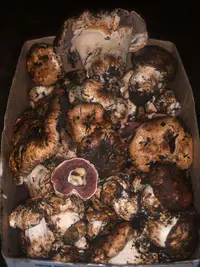
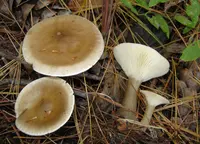
The giant cypress agaricus, Agaricus lilaceps, is a large, fleshy mushroom rather than a leafy plant. It typically forms stout, white to cream caps with a smooth surface and thick stems. Mature specimens often show lilac to brownish tones on the gills and bruised areas.
This species is associated with cypress and other conifers, most often in coastal or mild-climate regions. It tends to appear in nutrient-rich, disturbed or landscaped soils, sometimes in groups or arcs. For those who want to learn how to care for Giant Cypress Agaricus, conditions that mimic cool, moist, well-drained woodland soil are most suitable.
The species can be difficult to cultivate at home because it relies on specific soil life and tree associations. It is better suited to experienced mushroom growers than absolute beginners.

Care Difficulty
Moderate Care

Light Preference
Partial Shade

Water Requirements
Keep Soil Moist

Temperature Preference
Cool Climate

Hardiness Zone
9–11

Soil Texture
Loamy, Organic-rich

Soil pH
Slightly acidic (6.5–7.0)

Soil Drainage
Moist but well-drained

Fertilization
Minimal (feed rarely)
Scan your plant to receive care tips personalized for your specific plant
Available on iOS and Android
This species prefers bright, dappled woodland-style light rather than full, open exposure.
Agaricus lilaceps performs best in evenly moist, well-aerated soil that never stays waterlogged.
This fungus favors cool to mild conditions and reacts clearly to temperature extremes.
This fungus requires consistently moist conditions and benefits from controlled humidity during cultivation.
Agaricus lilaceps grows best in a loose, compost-rich substrate that mimics decomposing woodland organic matter.
This species can be grown in containers or trays if substrate depth and moisture are managed carefully.
Agaricus lilaceps, often called the wood-loving agaricus, usually gains enough nutrients from rich, woody organic matter and needs no targeted fertilization.
Pruning is not a standard practice for Agaricus lilaceps because it is a mushroom-forming fungus rather than a leafy plant.
Transplanting Agaricus lilaceps focuses on moving or renewing its colonized substrate rather than handling it like a root-based potted plant.
Propagation of Agaricus lilaceps is specialized and usually managed by trained growers rather than casual home cultivation.
In mild, frost-free to light-frost climates, Agaricus lilaceps usually needs no special winter care beyond stable moisture in its wood-chip bed.

Plant Health Check
Not sure what's wrong with your plant? Check your plant's health inside the app.
This mushroom is naturally associated with Monterey cypress and other ornamental conifers along the California coast, where it often fruits in landscaped areas rather than deep natural forests.
Fresh fruiting bodies typically have a distinct sweet almond or marzipan-like smell due to aromatic compounds that are characteristic of several edible Agaricus species.
It often produces large, dense clusters with very thick, fleshy caps, making individual flushes much more substantial than those of common field mushrooms.

Early mycological descriptions noted that Agaricus lilaceps frequently appears in urban and suburban plantings of imported cypress and pine trees, illustrating how ornamental landscaping can create new ecological niches for native fungi.
This mushroom is relatively fast-growing under controlled conditions. From colonization to harvest, expect 4–8 weeks, depending on temperature, substrate quality, and hygiene. Consistent moisture, stable temperatures, and fresh air exchange strongly influence development speed and yield.
Keep your plants happy and healthy with plant identification, disease detection, and easy care guidance.