
yellow-stainer Identification (Agaricus xanthodermus)

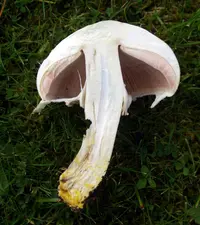
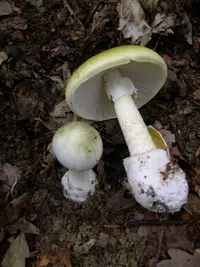
To recognize yellow-stainer, check for a white cap about 2 to 6 inches (5 to 15 cm) wide, free gills that are not attached to the stem, and a clear ring high on the stem.

A strong chrome-yellow stain at the stem base and along cap margins is another key first-glance feature.

Agaricus xanthodermus Identification

Confirm What Plant You Have

Upload a plant photo and check the identification in seconds.

Clear images work best. Avoid photos taken too close or too far away

Check the mushroom’s cap, gills, stem, and base at a glance.

  • Cap white to pale cream, smooth, rounded at first, then broadly convex to nearly flat, often 2-6 inches (5-15 cm) across.
  • Gills are crowded and free from the stem, so they stop short instead of attaching to it.
  • Stem is white with a skirt-like ring near the upper part and a noticeably bulbous base.
  • The yellow-stainer often shows strong chrome-yellow staining on the stem base and cap edge when handled or bruised.

Check the base carefully, since it often shows the clearest field mark.

Agaricus xanthodermus shows useful visible changes as the fruiting body expands and ages.

  • Young plant: Button stage is rounded, with the cap margin tightly inrolled over hidden gills and a stout stem; the partial veil still closes the underside.
  • Fruiting stage: As it expands, the cap opens to about 2-6 inches (5-15 cm) wide, becoming flatter; free gills shift from pale pink to darker brown.
  • Mature plant: Older specimens show a persistent ring on the stem after veil breakage, and the cap often appears broader and flatter than in young buttons.

Agaricus xanthodermus is most often noticed from summer into fall, when its mushrooms appear above ground. That seasonal fruiting is the main visible change that helps with identification. In the fruiting season, look for fresh caps and stems that bruise chrome yellow, especially at the stem base and cap margin. Outside that period, there is usually no persistent above-ground structure to inspect.

Several edible Agaricus species are regularly mistaken for yellow-stainer.

horse mushroom(Agaricus arvensis)

Similar white cap and ring. It may yellow slightly, but lacks the bright chrome-yellow staining at the base and usually has a pleasant anise scent.

field mushroom(Agaricus campestris)

A white to pale cap can suggest yellow-stainer. It has little or no yellow bruising, a smaller, simpler ring, and pink gills that darken with age.

the prince(Agaricus augustus)

Young pale specimens can confuse beginners. It usually shows brown cap scales and a strong almond odor, rather than smooth whitish caps with sharp yellow staining.

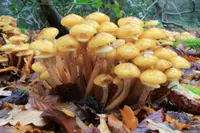
Agaricus xanthodermus is thought to be native to Europe and is now widely recorded in other temperate regions. It most often appears in disturbed ground rather than deep forest, which makes setting a useful identification clue. Typical sites include lawns, parks, gardens, roadside verges, and the edges of woodland, often in groups or rings. Finding an Agaricus in urban or suburban grass near trees can help narrow it toward this species complex rather than pasture-only or strictly woodland mushrooms.

  • Poisonous if eaten: Agaricus xanthodermus is toxic to humans, and ingestion of the fruiting body can cause gastrointestinal poisoning. Pets are also at risk if they eat the mushroom.
  • Misidentification risk: This mushroom is often confused with edible Agaricus species. A key warning sign is strong yellow staining, especially at the stem base, often with a phenolic or ink-like odor.

Confirm the Species with Botan

Upload a photo to compare key features and get a quicker, more confident identification before labeling your find.

FAQ

A key check is the strong chrome-yellow bruising at the stem base and cap margin, often followed by a phenolic, ink-like odor. For Agaricus xanthodermus identification, the gills also darken from pink to chocolate brown.

More Plant Identification Guides

Identify the Plant and Get Its Profile

Use a photo to identify it with Botan, then review plant details, safety notes, and common problems for that species.

Botan app identifying a plant from a photo
12 Most Wanted Rare Houseplants to Grow at Home

6 min read · 21 Sept 2026

12 Most Wanted Rare Houseplants to Grow at Home

Rare houseplants can turn an ordinary corner in your apartment into a living botanical collection. This guide covers 12 most admired picks, what makes them special, and how to grow them successfully at home.

Plant Recommendations
12 Most Wanted Rare Houseplants to Grow at Home
Plant Pot Sizes: How to Choose the Right Plant Container

7 min read · 20 Aug 2026

Plant Pot Sizes: How to Choose the Right Plant Container

Plant pot sizes can be confusing because the number on the label only tells you part of the required information. A container may look spacious but actually be too shallow. So, how to choose pot size for plant species?

Beginner Guides
Plant Pot Sizes: How to Choose the Right Plant Container
12 Best Plants That Repel Spiders For Your Home and Garden

8 min read · 24 Jul 2026

12 Best Plants That Repel Spiders For Your Home and Garden

Spiders constantly appear in places you don't want them. A few common plants can help repel them using scent alone. Here are 12 options suitable for both indoors and outdoors, plus care tips for each.

Plant Recommendations
12 Best Plants That Repel Spiders For Your Home and Garden