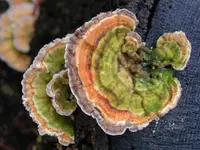


turkey tail mushroom Identification (Trametes versicolor)

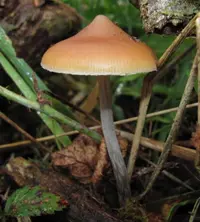
Recognize turkey tail mushroom by its thin, fan-shaped brackets growing in overlapping tiers, usually 1 to 4 inches (2.5 to 10 cm) across, with concentric bands of contrasting color.

The underside is white to pale and covered with very small pores, not gills, and each bracket attaches directly to wood without a stem.

Trametes versicolor Identification

Is This turkey tail mushroom?

Upload a clear photo to check your plant identification with Botan.

Clear images work best. Avoid photos taken too close or too far away

Check for thin, shelf-like brackets growing in overlapping rows on wood.

  • Caps are fan-shaped to semicircular, usually 1-4 inches (2.5-10 cm) across and very thin.
  • Upper surfaces show many narrow, concentric bands in alternating colors, often brown, tan, gray, or whitish.
  • The cap surface looks velvety or finely fuzzy, especially in the colored zones.
  • Undersides are pale and covered with tiny pores rather than gills.
  • Each bracket attaches from the side, with no central stem visible.

A clustered, many-banded, pore-backed growth form is the most useful visual combination.

Trametes versicolor shows visible age-related changes in cap form, edge shape, and colony structure.

  • Young plant: New brackets begin as small, thin, moist-looking patches with rolled margins. Zoning is faint at first, and the surface can appear velvety before firm shelf form develops.
  • Mature plant: Older brackets expand into overlapping semicircular shelves, often 1-4 inches (2.5-10 cm) across. Concentric color bands sharpen, edges flatten, and the underside stays pale with fine pores.
  • Fruiting stage: The fruiting body becomes tougher and more leathery than young growth. Shelves stack in dense rosettes or tiers, making the clustered, layered structure easier to recognize from a distance.

Turkey tail mushroom can look fresher and more vividly zoned during wet periods, especially from fall into spring, when new bracket edges may appear brighter and slightly softer in texture. Older brackets often persist through dry or cold weather. By late season they usually fade, look tougher, and may darken or collect green algae, but the thin, banded shelves remain visible for identification year-round.

A few bracket fungi are often mistaken for turkey tail mushroom.

False turkey tail(Stereum ostrea)

Both form thin, banded shelf clusters on wood. False turkey tail has a smooth underside with no pores; Trametes versicolor has a white pore surface underneath.

Violet-toothed polypore(Trichaptum biforme)

It also makes thin, zoned brackets on dead wood. Check the underside: it is lilac to purple when fresh and becomes toothed or ragged, not evenly white and finely pored.

Mossy maze polypore(Cerrena unicolor)

This species can share the same fan shape and gray-brown zoning. Its underside forms stretched, maze-like pores rather than the small, round pores typical of turkey tail.

Trametes versicolor is widespread across temperate North America, Europe, and Asia, and is also recorded in many other regions. It is most often found in deciduous and mixed woodlands. For identification, habitat is useful because this fungus usually grows on dead or dying hardwood logs, stumps, and fallen branches, sometimes on conifers. Finding it as overlapping brackets on wood, rather than on soil, helps narrow the ID.

  • Misidentification risk: This is a mushroom, so the main safety concern is ingestion after a wrong ID by humans or pets. Visual similarity alone is not enough to judge use.
  • Look-alike check: Stereum ostrea, often called false turkey tail, is a realistic confusion species. Trametes versicolor has tiny pores on the underside; Stereum ostrea has a smooth underside with no pores.

Does Your Plant Match?

Botan can compare a photo and help identify or confirm it, which is useful when similar species are easy to confuse.

FAQ

Check three points together: a thin, flexible bracket with many concentric color bands, a white underside covered in tiny pores, and growth in overlapping shelves on dead wood. Smooth or gilled undersides usually indicate another species.

More Plant Identification Guides

Find Out What Plant It Is

Use Botan to identify it from a photo, then see plant details, care information, and common problems.

Botan app identifying a plant from a photo
Best Bedroom Plants – Top 10 to Grow in Your Space

8 min read · 8 Jul 2026

Best Bedroom Plants – Top 10 to Grow in Your Space

Discover the top 10 houseplants that are suitable for growing in your bedroom. Compare their light and water needs, pet safety, and benefits. Find out where best to place greenery in your relaxation space and what species to avoid.

Plant Recommendations

Best Bedroom Plants – Top 10 to Grow in Your Space
20 Most Popular Fruits Around the World

7 min read · 22 Jul 2026

20 Most Popular Fruits Around the World

Curious which fruits the world actually eats the most? Here's the top-20 by production volume, an overview of what people choose in each region, and a few figures that defy common assumptions.

Plant Recommendations
20 Most Popular Fruits Around the World
Plant Pot Sizes: How to Choose the Right Plant Container

7 min read · 20 Aug 2026

Plant Pot Sizes: How to Choose the Right Plant Container

Plant pot sizes can be confusing because the number on the label only tells you part of the required information. A container may look spacious but actually be too shallow. So, how to choose pot size for plant species?

Beginner Guides
Plant Pot Sizes: How to Choose the Right Plant Container