


Berkeley's Polypore Identification (Bondarzewia berkeleyi)

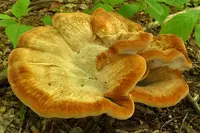
Recognize Berkeley's Polypore by its massive rosette of overlapping caps growing from one thick base, often at the base of a trunk. Individual caps are fan-shaped to kidney-shaped.

The pore surface underneath is white, not gilled, and the whole cluster can reach several feet across.

Bondarzewia berkeleyi Identification

Identify a Plant by Photo

Check your plant ID by uploading a clear photo to Botan.

Clear images work best. Avoid photos taken too close or too far away

Check the overall form first.

  • Forms one large rosette at the tree base, made of many overlapping fan-shaped caps.
  • The cluster often reaches 2 to 3 feet (0.6 to 0.9 m) across when mature.
  • Each cap is thick, broad, and pale tan to buff, usually with wavy margins.
  • The undersides are white and pore-covered, not gilled, and run down into a short shared base.

A single massive, layered cluster is the main visual clue.

Berkeley's Polypore shows clear visual changes as its fruiting body expands and ages.

  • Young plant: It begins as a compact, pale knob or a few thick lobes at the tree base, with smooth margins and little layering.
  • Mature plant: The fruiting body becomes a broad rosette of many overlapping caps, often 2-3 feet (0.6-0.9 m) across, with thicker, more distinctly zoned upper surfaces.
  • Fruiting stage: Undersides show dense white pores instead of gills, while older lobes broaden, margins thin, and the overall cluster forms a layered, cabbage-like mass.

Bondarzewia berkeleyi is most noticeable from late summer into fall, when large rosettes of overlapping caps appear at the base of hardwoods or from nearby roots. Fresh growth is pale buff to yellowish, then becomes tan to brown with age. As the fruiting body matures, the margins often darken and the rosette can look heavier and more ragged. Outside the fruiting season, this fungus is usually absent above ground.

Several large rosette-forming polypores can be mistaken for Berkeley's Polypore.

black-staining polypore(Meripilus sumstinei)

Both form broad clusters at the base of hardwoods. Meripilus usually has thinner, more numerous fronds and bruises dark brown to black quickly on the pore surface and edges. Bondarzewia berkeleyi stays pale longer and has thicker caps.

hen of the woods(Grifola frondosa)

This also grows as a many-branched mass near tree bases. It differs by having many smaller, gray-brown spoon-shaped fronds, often only a few inches across, rather than the larger, broader cream to tan caps of Bondarzewia berkeleyi.

Bondarzewia berkeleyi is native to eastern North America. It is reported from much of the eastern United States and adjacent parts of southeastern Canada. Habitat can help with identification because this fungus grows at the base of hardwoods, especially oaks, in deciduous woods, parks, and old landscaped areas. Finding a large rosette fruiting from roots or the lower trunk of a living or dead hardwood helps narrow it down.

As a large wild mushroom, Bondarzewia berkeleyi has a meaningful safety issue because mushroom misidentification can lead to ingestion of harmful species. Identification should be confirmed before any handling for food use.

  • Misidentification risk: The concern is ingestion by humans. Berkeley’s polypore can be confused with other large rosette-forming mushrooms in the field, and using a wrong identification for eating creates the hazard.

Scan. Check. Confirm.

Use Botan to compare a photo and help verify the identification before you label it or rule out similar finds.

FAQ

The best clue is its huge rosette of many overlapping caps at the base of hardwoods, especially oak. For Berkeley's Polypore identification, check the white pore surface underneath rather than gills.

More Plant Identification Guides

From Plant ID to Plant Info

Identify a plant from a photo with Botan, then get species-specific plant details, care information, and common problems.

Botan app identifying a plant from a photo
How to Winterize Your Garden in 6 Steps

5 min read · 28 Sept 2026

How to Winterize Your Garden in 6 Steps

Learn how to prepare your garden for winter with a practical six-step checklist covering cleanup, tender plant care, watering, mulching, winter protection, and winterizing equipment and containers.

Plant Care
How to Winterize Your Garden in 6 Steps
How to Increase Humidity for Plants – 8 Simple Ways That Work

8 min read · 14 Aug 2026

How to Increase Humidity for Plants – 8 Simple Ways That Work

Dry indoor air stresses a lot of houseplants. You usually notice it first in the browning leaf tips. This guide describes 8 simple ways to raise the moisture around your plants, from humidifiers to pebble trays.

Plant Care
How to Increase Humidity for Plants – 8 Simple Ways That Work
8 Glow-in-the-Dark Plants and Fungi That Really Exist

8 min read · 6 Nov 2026

8 Glow-in-the-Dark Plants and Fungi That Really Exist

Plants that glow in the dusk really exist. Some of them produce their own light, while others need UV exposure or special treatments. Explore eight fascinating examples, including glowing petunias, bioluminescent mushrooms, fluorescent flowers, and experimental succulents.

Plant Recommendations
8 Glow-in-the-Dark Plants and Fungi That Really Exist