


Candy Cap Identification (Lactarius rubidus)

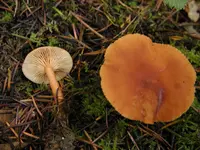
Recognize Candy Cap by its small to medium cap, usually 1-3 inches (2.5-7.5 cm) wide, with a central depression and dry surface.

Check the close, pale gills and the slender stem, often 1-3 inches (2.5-7.5 cm) tall, which releases a watery white latex when cut or broken.

Lactarius rubidus Identification

Check Your Plant with Botan

Take or upload a photo to confirm your plant ID with Botan.

Clear images work best. Avoid photos taken too close or too far away

Use these visible traits to check for Lactarius rubidus.

  • Cap is small, usually 1-3 inches (2.5-7.5 cm) wide, with a shallow funnel or depressed center.
  • Gills are close together, pale to cinnamon, and run slightly down the stem.
  • Stem is slender and fairly even, often matching the cap color and lacking a ring.
  • Caps often appear dry and matte, with a warm tan, reddish brown, or cinnamon-brown surface.

Check several mushrooms together, since size and cap depth can vary.

Lactarius rubidus shows useful age-related changes mainly in its mushroom fruiting body.

  • Young plant: New caps are convex with the margin rolled inward, often cinnamon to reddish brown, and the stem looks proportionally stouter than in older specimens.
  • Mature plant: As the mushroom expands to about 1-3 inches (2.5-7.5 cm) wide, the cap flattens or becomes shallowly depressed, and the margin usually straightens.
  • Fruiting stage: Fully developed fruiting bodies show crowded pale gills beneath the cap and a slender stem; cut or broken flesh may release a watery latex.

The clearest seasonal clue is fruiting. Lactarius rubidus is usually most visible from fall into winter, when fresh mushrooms appear on the ground in clusters or scattered groups. In dry weather the caps can fade and shrivel, while moist conditions make them look fresher and more distinctly reddish brown. As they age in season, the cap often develops a shallow central depression, which can help with recognition.

A few milkcaps are regularly mistaken for Candy Cap.

Curry milkcap(Lactarius camphoratus)

Similar small reddish-brown cap and milkcap shape. It is usually darker chestnut to purplish brown, with more crowded gills and a less distinctly zoneless, matte cap.

Fishy milkcap(Lactarius volemus)

Can share warm brown to orange-brown tones and exude white latex. It is much larger, often with caps 3-6 inches (8-15 cm) wide, and has widely spaced gills and a thicker stem.

Orange milkcap(Lactarius luculentus)

May look similar in color and stature. It usually shows brighter orange tones and often has visible cap zoning, while Lactarius rubidus is typically more cinnamon-brown and more evenly colored.

Lactarius rubidus is native to western North America, especially coastal California, Oregon, and Washington. Geography helps here because this species is strongly associated with that region. It fruits on the ground in moist conifer and mixed evergreen woods, often with tanoak or spruce, from lowlands into montane forests. Finding a similar milkcap outside this Pacific coastal habitat makes L. rubidus less likely.

  • Serious misidentification risk: Lactarius rubidus is a mushroom, so identification matters because confusing wild mushrooms can lead to poisoning in humans and pets through ingestion.
  • Dangerous look-alike: A key concern is confusion with deadly Galerina marginata. Unlike Lactarius rubidus, Galerina marginata lacks milky latex when cut or broken and has a rusty-brown spore print rather than a pale one.

Scan. Check. Confirm.

Use Botan to identify or verify it from a photo when you want a faster second opinion before labeling your find.

FAQ

The clearest feature is its strong maple syrup or burnt sugar scent, especially when dried. For Candy Cap identification, look for a small reddish brown milkcap with crowded gills and a watery white latex.

More Plant Identification Guides

From Plant ID to Plant Info

Identify it from a photo with Botan, then review species details, safety notes, and common problems in one place.

Botan app identifying a plant from a photo
12 Best Cold-Hardy Vegetables for Cold Weather

7 min read · 13 Oct 2026

12 Best Cold-Hardy Vegetables for Cold Weather

Cold-hardy vegetables can keep a garden productive through chilly fall, winter, and early spring weather. This guide covers 12 reliable crops, their frost tolerance, and practical growing tips for better cold-season harvests.

Plant Recommendations
12 Best Cold-Hardy Vegetables for Cold Weather
15 Best Scary Halloween Plants and Fungi for a Spooky Garden

8 min read · 9 Oct 2026

15 Best Scary Halloween Plants and Fungi for a Spooky Garden

Want a garden that looks eerie in October? Here are 15 Halloween plants and fungi, from carnivorous traps to bleeding mushrooms. For each species, we cover its appearance, care requirements, and potential uses in your landscape.

Plant Recommendations
15 Best Scary Halloween Plants and Fungi for a Spooky Garden
Top 15 Fast-Growing Trees For Your Garden

13 min read · 28 Jul 2026

Top 15 Fast-Growing Trees For Your Garden

Learn which of the 15 fastest-growing trees will suit your area. We’ll share detailed information on each: growth rate, mature spread, key tree demands, and main vulnerabilities. Read on and make the best choice possible.

Plant Recommendations
Top 15 Fast-Growing Trees For Your Garden