
alcohol inky cap Identification (Coprinopsis atramentaria)

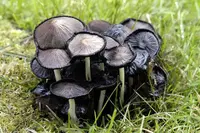
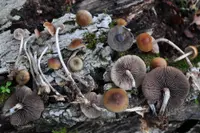
Recognize alcohol inky cap by its crowded, bell-shaped to egg-shaped cap, usually 1-4 inches (3-10 cm) across, in dense clusters from a shared base.

The smooth gray-brown cap shows fine radial grooves, and the white stem is slender, hollow, and typically 2-6 inches (5-15 cm) tall.

Coprinopsis atramentaria Identification

Check Your Plant with Botan

Check your plant ID by uploading a clear photo to Botan.

Clear images work best. Avoid photos taken too close or too far away

Use these visible traits to check for Coprinopsis atramentaria.

  • Fruiting bodies grow in tight clusters rather than singly.
  • Caps are egg-shaped to bell-shaped, usually 1.5-4 inches (4-10 cm) across, with a smooth to faintly grooved surface.
  • Cap color is gray to gray-brown, often darker at the center.
  • Stems are slender, white, and mostly straight, lifting the caps above the cluster.
  • Gills are crowded under the cap and appear very dark, almost black, at maturity.

Check several mushrooms in the cluster, since shape and color can vary a little across the group.

Coprinopsis atramentaria shows clear, useful shape changes as the fruiting body expands and ages.

  • Young plant: Very young mushrooms appear as tight, egg-shaped gray caps with margins wrapped inward, hiding the gills and giving a smooth, compact outline.
  • Mature plant: As the stem elongates to about 3-6 inches (8-15 cm), the cap becomes bell-shaped, then broader, with radial grooves and exposed crowded gills.
  • Fruiting stage: Older fruiting bodies darken from below as the gills liquefy into black ink, and the cap margin splits and curls upward.

Coprinopsis atramentaria is most noticeable in wet periods from spring through fall, when dense clusters of gray to gray-brown caps appear on soil, lawns, and wood-buried ground. A key seasonal clue comes as the caps age over a day or two. The margins blacken and dissolve into an inky liquid, so fresh gray mushrooms and collapsing black ones may be visible together.

A few inkcaps are regularly mistaken for alcohol inky cap.

common inkcap(Coprinopsis cinerea)

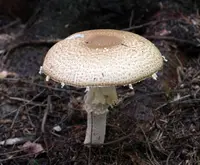
Both are gray-brown, clustered inkcaps that darken and dissolve. Common inkcap is usually smaller, with a more bell-shaped cap and finer surface granules; it lacks the smoother, thicker gray cap typical of mature C. atramentaria.

magpie inkcap(Coprinopsis picacea)

It can suggest the same inky, collapsing mushroom shape. Magpie inkcap stands out by its dark cap covered with large white patches, giving a bold black-and-white pattern, unlike the plain gray to gray-brown cap of C. atramentaria.

Coprinopsis atramentaria is native across much of Europe and is also widely recorded in temperate parts of North America. Geography alone is not decisive, but a temperate setting supports the ID. Habitat is more useful. It usually appears on disturbed ground, lawns, roadsides, wood-chip beds, and at the base of buried wood or tree roots, often in urban or suburban sites. That wood-associated, human-settled habitat helps separate it from grassland-only lookalikes.

  • Alcohol interaction: The fruiting body contains coprine. In humans, ingestion can cause poisoning if alcohol is consumed with it or within a few days after eating it.
  • Misidentification risk: As a mushroom, wrong identification is a serious ingestion risk for humans. It can be confused with other gray inkcaps; correct identification depends on features such as the clustered growth and smooth gray cap.

Check Your Plant ID

Use Botan to compare a photo and help confirm the species before you label it or move to the next step.

FAQ

The best clue is the gray to gray-brown, smooth cap with fine radial grooves, paired with crowded gills that quickly darken and dissolve into black ink. It often grows in dense clumps from buried wood or disturbed ground.

More Plant Identification Guides

Identify Your Plant with Botan

Upload a photo to identify it, then review species details, care information, and common problems matched to that result.

Botan app identifying a plant from a photo
Top 15 Plants That Don’t Need Sunlight

8 min read · 17 Sept 2026

Top 15 Plants That Don’t Need Sunlight

Some plants thrive in dim rooms, shaded corners, and places with indirect light. In this guide, you’ll explore the top 15 species best suited to low-light conditions and how to care for them.

Plant Recommendations
Top 15 Plants That Don’t Need Sunlight
20 Most Popular Fruits Around the World

7 min read · 22 Jul 2026

20 Most Popular Fruits Around the World

Curious which fruits the world actually eats the most? Here's the top-20 by production volume, an overview of what people choose in each region, and a few figures that defy common assumptions.

Plant Recommendations
20 Most Popular Fruits Around the World
What Do Plants Need to Grow – 5 Things Every Greenery Can't Live Without

8 min read · 31 Jul 2026

What Do Plants Need to Grow – 5 Things Every Greenery Can't Live Without

To keep plants healthy and thriving, provide the right balance of light, humidity, nutrients, airflow, and quality soil. This guide covers the essentials of year-round plant care.

Beginner Guides
What Do Plants Need to Grow – 5 Things Every Greenery Can't Live Without