
summer oyster mushroom Identification (Pleurotus pulmonarius)

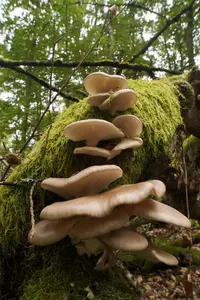
Recognize Pleurotus pulmonarius by its fan- to shell-shaped caps, usually 2-6 inches (5-15 cm) across, growing in overlapping clusters. Caps attach from the side with a short or absent stem.

Check the gills next. They are white, crowded, and run down the stem, a feature called decurrent.

Pleurotus pulmonarius Identification

Check Your Plant ID

Check your plant ID by uploading a clear photo to Botan.

Clear images work best. Avoid photos taken too close or too far away

Check the cap shape, gills, stem position, and clustered growth of Pleurotus pulmonarius.

  • Caps are fan-shaped to shell-like, often with a smooth, slightly dry surface and a curved margin.
  • Caps usually measure about 2-8 inches (5-20 cm) across and often overlap in layered clusters.
  • Gills are white to pale cream, crowded, and run down the stem, a feature called decurrent.
  • The stem is short or absent, and when present it sits off-center rather than in the middle of the cap.

A side-attached cap with decurrent gills is one of the quickest visual checks.

Pleurotus pulmonarius shows clear visual shifts from pin formation to broad, layered fruit bodies.

  • Young plant: Early pins appear as small white to pale gray knobs, then quickly form short lateral stems with tightly inrolled cap margins.
  • Mature plant: Expanded caps become fan-shaped to oyster-like, often 2-8 inches (5-20 cm) across, with smoother surfaces and edges that flatten or turn wavy.
  • Fruiting stage: Clusters are more obvious than in earlier stages, with overlapping shelves and crowded white gills running down the off-center stem.

Pleurotus pulmonarius is most useful seasonally when fresh fruiting bodies appear in warm weather, often from late spring through summer. Look for pale to white, fan-shaped caps on wood, usually in overlapping clusters. In colder periods, those soft mushrooms are usually absent, so this seasonal appearance can help separate a fresh find from species that fruit mainly in cooler weather.

A few oyster mushrooms can be confused with Pleurotus pulmonarius.

phoenix oyster(Pleurotus citrinopileatus)

Young clusters can look similar in shape, but this species is usually bright yellow to golden, not white to pale gray.

winter oyster(Pleurotus ostreatus)

Both form shelf-like clusters with decurrent gills, but winter oyster is darker gray to brown and often has a thicker, fleshier cap.

elm oyster(Hypsizygus ulmarius)

It can appear oyster-like on wood, yet its gills are not strongly decurrent and it often has a more central stem.

Pleurotus pulmonarius is widely reported from temperate and subtropical regions and is considered broadly distributed rather than tied to one narrow native range. For identification, habitat is more useful than geography alone. It typically fruits on dead or dying hardwood in woodland and forest-edge settings, including logs, stumps, and standing trunks. Finding it attached to wood, rather than from soil, helps separate it from many pale gilled mushrooms with a similar overall look.

  • Misidentification risk: This mushroom has safety importance because oyster mushrooms can be confused with toxic jack-o'-lantern mushrooms, Omphalotus illudens. The key visible difference is that Pleurotus pulmonarius usually grows on wood with decurrent gills, while jack-o'-lanterns are bright orange and often grow in dense clusters from wood or buried roots. The concern is ingestion by humans.

Confirm the Species with Botan

Use a photo to identify or verify the species, which helps avoid mix-ups before you label, log, or compare it.

FAQ

It forms shell- to fan-shaped caps, usually white to pale cream, often in overlapping clusters on wood. The gills run down a short off-center stem, and mature caps commonly reach about 2 to 8 inches (5 to 20 cm) wide.

More Plant Identification Guides

From Plant ID to Plant Info

Identify it from a photo with Botan, then see plant details, care information, and common problems for that species.

Botan app identifying a plant from a photo
12 Best Plants That Repel Spiders For Your Home and Garden

8 min read · 24 Jul 2026

12 Best Plants That Repel Spiders For Your Home and Garden

Spiders constantly appear in places you don't want them. A few common plants can help repel them using scent alone. Here are 12 options suitable for both indoors and outdoors, plus care tips for each.

Plant Recommendations
12 Best Plants That Repel Spiders For Your Home and Garden
Top 5 Best Indoor Plants for Air Quality

5 min read · 11 Sept 2026

Top 5 Best Indoor Plants for Air Quality

Indoor plants can make a room feel fresher thanks to their air-purifying qualities. Here are 5 of the most suitable choices for your routine and living space.

Plant Recommendations
Top 5 Best Indoor Plants for Air Quality
How to Water Houseplants: Watering Guide

7 min read · 24 Aug 2026

How to Water Houseplants: Watering Guide

Learn how often to water indoor plants, key factors for proper watering, and how to adjust the care routine by plant type, season, pot size, light, and indoor conditions.

Plant Care
How to Water Houseplants: Watering Guide