
blue meanies Identification (Panaeolus cyanescens)

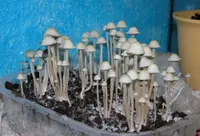
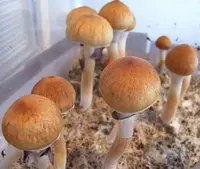
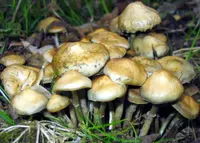
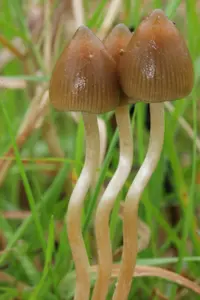
Recognize Panaeolus cyanescens by its small gray to whitish cap, usually 1/2 to 1-1/2 inches (1-4 cm) wide, on a thin white stem about 2-1/2 to 4 inches (6-10 cm) tall.

The gills turn very dark and appear mottled, and the stem often bruises blue where handled.

Panaeolus cyanescens Identification

Scan to Confirm blue meanies

Upload a clear image to check whether your plant ID is correct.

Clear images work best. Avoid photos taken too close or too far away

Check Panaeolus cyanescens for a small, slender mushroom with crowded dark gills.

  • Cap is bell-shaped to broadly convex, usually about 0.5-1.5 inches (1.5-4 cm) across, with a smooth surface.
  • Gills sit close together under the cap and turn very dark gray to black, often with a mottled look.
  • Stem is thin, pale, and taller than the cap is wide, often straight or slightly curved.
  • Bruised areas on the cap or stem can show blue staining, especially where handled.

A dark spore deposit on nearby surfaces can add another visible clue.

Panaeolus cyanescens shows useful visual changes from immature pins to mature, spore-bearing mushrooms.

  • Young plant: Very young pins are small, rounded, and pale, with a closed cap margin and a short, thick stem that hides the gills.
  • Mature plant: As it expands, the cap becomes broadly bell-shaped to flat, about 0.5-1.5 inches (1.5-4 cm) wide, and the stem turns longer and more slender.
  • Fruiting stage: Fully developed fruiting bodies show dark mottled gills, a thin fragile stem, and stronger blue bruising where the cap edge or stem is handled.

A few small dung-loving mushrooms are regularly confused with blue meanies.

mottlegill(Panaeolus antillarum)

Often shares the same habitat and pale cap. It is usually larger, does not bruise blue, and has dark gills with whitish edges rather than a distinctly mottled look.

banded mottlegill(Panaeolus cinctulus)

Similar in size and shape when young. Its cap commonly shows a darker band near the edge as it dries, and bruising is weak or absent instead of clear blue tones.

haymaker's mushroom(Panaeolina foenisecii)

Can be a similar small brown lawn mushroom. It lacks blue bruising and has brown, not black, spore color, giving the gills a softer cinnamon-brown look.

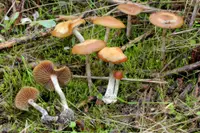
Panaeolus cyanescens is widely reported from tropical and subtropical regions rather than a clearly defined native range, so habitat is more useful than geography for identification. It is typically found on dung in open, heavily grazed pastures and lawns, especially in humid lowland areas. Finding it in cattle country helps narrow identification far more than country alone.

  • Psychoactive compounds: The fruiting body contains psilocybin and related compounds. Ingestion is hazardous to humans and pets because it can cause intoxication and impaired judgment.
  • Serious misidentification risk: Wrong identification can lead to poisoning. Small brown mushrooms can resemble dangerous Galerina species, which contain amatoxins. A key difference is that Galerina usually has a rusty-brown spore print, while Panaeolus cyanescens has a very dark black spore print.

Not Sure About the ID?

Use Botan to compare a photo and help confirm the identification before you label or log it.

FAQ

It is easiest to identify when mature, after the cap and gills are fully developed. For blue meanies identification, check the pale gray to whitish cap, crowded dark mottled gills, and blue bruising on damaged tissue.

More Plant Identification Guides

Know Your Plant Better

Identify it from a photo with Botan, then review plant details, care information, and common problems for that species.

Botan app identifying a plant from a photo
Best Time to Mow Lawn – A Complete Guide

5 min read · 10 Aug 2026

Best Time to Mow Lawn – A Complete Guide

Explore when to mow your lawn for its health and a pleasant green color. Find out the best time for this task during the summer heat, and follow practical tips for correctly cutting the grass, and learn common mistakes to avoid.

Plant Care
Best Time to Mow Lawn – A Complete Guide
Top 15 Fast-Growing Trees For Your Garden

13 min read · 28 Jul 2026

Top 15 Fast-Growing Trees For Your Garden

Learn which of the 15 fastest-growing trees will suit your area. We’ll share detailed information on each: growth rate, mature spread, key tree demands, and main vulnerabilities. Read on and make the best choice possible.

Plant Recommendations
Top 15 Fast-Growing Trees For Your Garden
How to Repot a Plant: A Step-by-Step Guide

7 min read · 28 May 2026

How to Repot a Plant: A Step-by-Step Guide

In spring, many plants need repotting—an essential part of care. To avoid stress, consider the plant’s type and size. This article offers a step-by-step guide for repotting indoors or outdoors and shows how to check plant health and get care tips using the Botan app.

Plant Care
How to Repot a Plant: A Step-by-Step Guide