Offset management
Remove offsets with a clean, sharp knife once they reach about 5–8 cm across, letting cut surfaces dry for 5–7 days before replanting to reduce rot and keep the mother rosette well shaped.

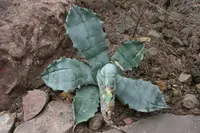
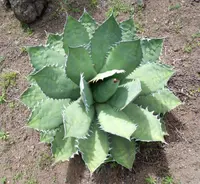
Mescal ceniza, Agave colorata, is a slow-growing succulent from arid regions of northwestern Mexico. It forms a compact rosette of broad, blue-gray leaves with wavy edges and sharp spines. Mature plants may eventually produce a tall flowering stalk once in their lifetime, then die after setting seed. This growth pattern makes it a long-lived focal plant in dry gardens and containers. It tolerates heat, sun, and drought well, so established plants need little attention. Well-draining, gritty soil and strong light support healthy growth and make it easier to care for mescal ceniza.

Care Difficulty
Easy Care

Light Preference
Full Sun

Water Requirements
Low Water

Temperature Preference
Warm Climate

Hardiness Zone
8–11

Soil Texture
Sandy, Loamy, Rocky

Soil pH
Slightly acidic (6.5–7.0), Slightly alkaline (7.0–7.5)

Soil Drainage
Well-drained

Fertilization
Minimal (feed rarely)
Scan your plant to receive care tips personalized for your specific plant
Available on iOS and Android
Agave colorata thrives in strong light that mimics its native desert exposure.
This species prefers deep but infrequent watering that allows the soil to dry between soakings.
This desert agave prefers warm, dry conditions with only brief exposure to cold.
Agave colorata handles a wide humidity range and rarely needs special humidity management.
Agave colorata prefers a very fast-draining, mineral-rich substrate that dries quickly between waterings.
This species is very suitable for container growing in sunny outdoor spaces.
Agave colorata is adapted to lean, rocky soils and needs only light feeding in cultivation.
Agave colorata needs minimal pruning, focused on hygiene rather than shaping.
This species grows slowly and seldom needs repotting, but container plants benefit from occasional size upgrades.
Agave colorata is most often propagated from offsets, with seed used mainly by collectors and breeders.
This agave is relatively cold tolerant but benefits from simple winter precautions in climates colder than its native range.

Plant Health Check
Not sure what's wrong with your plant? Check your plant's health inside the app.
The leaves are covered with a natural bluish, powdery wax called epicuticular wax, which helps reduce water loss and reflects intense desert sunlight in its native Sonoran habitats.
Each new leaf carries crisp, decorative impressions left by the teeth of adjacent leaves in the bud, creating the characteristic zigzag patterns often used to identify this species in the wild.
This species is naturally restricted to rocky slopes in parts of Sonora, Mexico, where it grows slowly in very arid conditions on limestone or volcanic substrates, contributing to its local conservation concern.

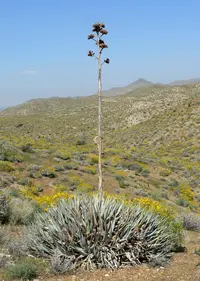
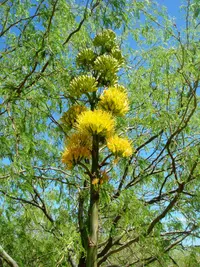
Agave colorata can take several decades to reach maturity and then flowers only once, producing a tall branched inflorescence with hundreds of yellowish blooms before the original rosette dies, a life history pattern known as monocarpic reproduction.
This species is monocarpic, so it flowers only once at maturity, often after 10–20 years. Lack of size, stress from cold or rot, or recent transplanting commonly delays blooming rather than preventing it entirely.
Keep your plants happy and healthy with plant identification, disease detection, and easy care guidance.