Safe access planning
Install flat stones or a gravel path around the plant during planting so you can safely weed, inspect, and work around the sharp spines without damaging the rosette.

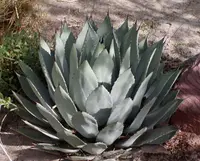
Palmer's century plant, Agave palmeri, is a large, slow-growing succulent native to arid regions of the southwestern United States and northern Mexico. It forms a stiff rosette of thick, blue-green leaves with sharp spines along the edges and at the tips.
Mature plants eventually send up a very tall flowering stalk once in their lifetime, then die after flowering, leaving offsets around the base. This species is drought tolerant and prefers strong sun, fast-draining soil, and minimal watering once established.
Due to its size, spines, and need for bright, dry conditions, it suits outdoor landscapes or very bright indoor spaces. Understanding how to care for Palmer's century plant helps keep it healthy and long lived.

Care Difficulty
Easy Care

Light Preference
Full Sun

Water Requirements
Low Water

Temperature Preference
Warm Climate

Hardiness Zone
8–11

Soil Texture
Sandy, Loamy, Rocky

Soil pH
Slightly acidic (6.5–7.0), Slightly alkaline (7.0–7.5)

Soil Drainage
Well-drained

Fertilization
Minimal (feed rarely)
Scan your plant to receive care tips personalized for your specific plant
Available on iOS and Android
This desert succulent needs strong, direct light to maintain compact growth and leaf color.
This species is highly drought tolerant and prefers infrequent, deep watering.
This agave thrives in hot, arid conditions but has notable cold tolerance once established.
This desert agave tolerates a wide humidity range and rarely needs adjustment indoors.
Soil for Agave palmeri must be very fast-draining and mineral-based to prevent root and crown rot.
This species adapts well to container growing when the pot is stable and drains very quickly.
This desert succulent needs very modest feeding, and overfertilizing can cause weak, fast growth in Palmer's century plant.
Pruning Agave palmeri is mainly hygienic, not shaping, since the rosette form is naturally symmetrical.
This agave is usually grown in the ground; container plants or young specimens need only rare repotting or transplanting.
Agave palmeri is most often propagated from offsets, with seed used mainly for larger-scale or breeding projects.
Mature plants are fairly cold hardy but benefit from simple winter precautions in colder regions.

Plant Health Check
Not sure what's wrong with your plant? Check your plant's health inside the app.
Agave palmeri is the largest native agave in the US borderlands of Arizona and New Mexico, forming rosettes that can exceed 1.5 m across in rocky desert slopes and canyons.
This species is monocarpic, meaning each rosette flowers only once after several decades of vegetative growth, then dies, leaving behind offsets that continue the colony.
Its tall flowering stalks, often 3–5 m high, open pale greenish-yellow, nectar-rich flowers at night that are an important food source for migratory nectar-feeding bats in the Sonoran and Chihuahuan Desert regions.

Indigenous communities in the southwestern US and northern Mexico have long used Agave palmeri for food, fermented beverages, fiber, and tools, carefully harvesting the plants in ways that maintain wild populations and reflect a detailed understanding of the species’ slow life cycle.
This species flowers only once at maturity, often after several decades. Lack of bloom usually means it is not old or large enough yet. Container restriction, deep shade, or severe drought can further delay flowering.
Keep your plants happy and healthy with plant identification, disease detection, and easy care guidance.