Offset management
Remove offsets with a clean, sharp knife when they have at least 4–5 leaves and a visible root nub, then heel them in a dry, shaded spot for 3–5 days before potting to reduce rot risk and encourage faster establishment.

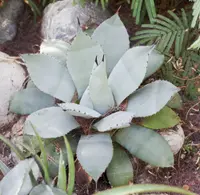
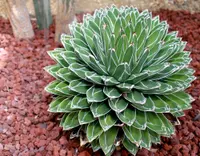
Artichoke agave (Agave parryi) is a compact, rosette-forming succulent native to high desert regions of Mexico and the southwestern United States. It stores water in thick, blue-gray leaves and naturally grows in harsh, rocky conditions. The plant has broad, overlapping leaves with strong spines along the margins and at the tip, giving it a sculptural, geometric look. Mature plants may eventually send up a tall flowering stalk, then the rosette dies after blooming. Agave parryi is slow-growing, drought-tolerant, and generally low-maintenance if its basic needs are met. To care for Artichoke agave, provide strong light, very well-drained gritty soil, and avoid frequent watering or heavy fertilizing.

Care Difficulty
Easy Care

Light Preference
Full Sun

Water Requirements
Low Water

Temperature Preference
Cold Hardy

Hardiness Zone
5–9

Soil Texture
Sandy, Loamy, Rocky

Soil pH
Slightly acidic (6.5–7.0), Neutral (7.0)

Soil Drainage
Well-drained

Fertilization
Minimal (feed rarely)
Scan your plant to receive care tips personalized for your specific plant
Available on iOS and Android
This desert succulent thrives in strong sun but adapts to slightly lower light in hot regions.
Agave parryi prefers infrequent, deep watering in sharply drained soil.
This species is notably cold hardy but still benefits from stable, dry conditions.
Humidity is rarely a concern for Agave parryi in typical household or outdoor conditions.
Agave parryi needs very fast-draining, mineral-based soil to prevent root and crown rot.
This species is well suited to container growing when provided with stable, fast-draining conditions.
Agave parryi thrives in lean soils and needs only light, cautious feeding during active growth.
Pruning needs for Agave parryi are minimal and focus on safety and sanitation rather than shaping.
Container-grown plants and young offsets of Artichoke agave benefit from infrequent but careful repotting or transplanting.
New Agave parryi plants are most reliably produced from offsets rather than seeds.
Mature Agave parryi is notably cold hardy but still benefits from simple winter precautions in colder regions.

Plant Health Check
Not sure what's wrong with your plant? Check your plant's health inside the app.
This species survives winter temperatures well below freezing in its native range in Arizona, New Mexico, and northern Mexico, making it one of the more cold-hardy agaves compared with many tropical relatives.
Its tight, symmetrical rosettes have thick, bluish leaves edged with sharp marginal teeth and a strong terminal spine, which together reduce water loss and provide defense against grazing animals in arid habitats.
In addition to reproducing by seed after flowering, it produces basal offsets (pups) that can form dense clumps, allowing a single individual to gradually occupy a wider patch of rocky ground over time.

The plant is monocarpic, meaning each rosette flowers only once in its lifetime, sending up a tall flowering stalk that can exceed 3 m, then dies afterward while its surrounding offsets continue the colony.
This species is monocarpic, meaning each rosette flowers once at maturity, often after 10–30 years. It will not bloom if still immature or stressed by poor drainage, severe root disturbance, or repeated heavy damage.
Keep your plants happy and healthy with plant identification, disease detection, and easy care guidance.