Encourage Compact Form
Lightly pinch back the tips of new shoots in early spring to encourage a low, bushy habit and reduce the chance of the stems becoming leggy or floppy later in the season.

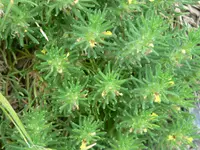
Ground-pine, Ajuga chamaepitys, is a low, mat-forming perennial herb that resembles a tiny conifer, with aromatic, pine-like foliage and small yellow flowers. It stays compact and close to the ground, making it suitable for rock gardens, troughs, and tight sunny spaces.
This species is native to dry, open habitats in parts of Europe and the Mediterranean region, where it copes with poor, stony soils. It generally prefers full sun, well-drained soil, and modest moisture, and it dislikes heavy, waterlogged conditions. These traits make it fairly easy to manage if drainage is good, but less suitable for very humid or shady gardens. Understanding how to care for Ground-pine starts with mimicking its naturally dry, sunny environment.

Care Difficulty
Moderate Care

Light Preference
Full Sun

Water Requirements
Low Water

Temperature Preference
Warm Climate

Hardiness Zone
6–9

Soil Texture
Sandy, Loamy, Rocky

Soil pH
Slightly acidic (6.5–7.0), Neutral (7.0)

Soil Drainage
Well-drained

Fertilization
Minimal (feed rarely)
Scan your plant to receive care tips personalized for your specific plant
Available on iOS and Android
Ajuga chamaepitys prefers bright, open conditions similar to dry, sunny slopes.
This species prefers slightly dry conditions and is sensitive to excess moisture.
This low-growing perennial is adapted to warm, dry climates with mild winters.
Humidity is rarely critical for Ajuga chamaepitys, which tolerates typical outdoor air conditions in its hardiness range.
Ajuga chamaepitys prefers light, fast-draining soil that mimics dry, rocky habitats.
This species is suitable for container growing, especially in shallow, free-draining pots for alpine or rock-garden style displays.
Ajuga chamaepitys is a low-nutrient, Mediterranean species that needs only light feeding in cultivation.
Ajuga chamaepitys benefits from light, targeted pruning to keep its low mat tidy and flowering well.
This species is more often transplanted in the garden than kept as a long-term container plant.
Ajuga chamaepitys is commonly propagated from seed or by dividing small clumps.
This low-growing perennial has moderate cold tolerance but benefits from simple winter care in colder regions.

Plant Health Check
Not sure what's wrong with your plant? Check your plant's health inside the app.
When its leaves are crushed, this low-growing herb releases a strong resinous aroma similar to pine, which is reflected in the common name ground-pine.
This species is naturally adapted to dry, open, often calcareous sites in Mediterranean and southern European landscapes, where it tolerates high light and relatively poor, well-drained soils.
In several parts of its native range, especially in northern Europe, it has become rare or locally threatened due to habitat loss and changes in traditional grazing and disturbance regimes.

Ajuga chamaepitys is one of the few members of its genus that is strongly associated with ancient arable and disturbed ground, so archaeobotanical finds of its seeds can help researchers reconstruct past land use and farming practices.
This species spreads slowly by short, low stems rather than running stolons or deep rhizomes. In most garden settings it forms small patches, not large carpets, and is usually easy to keep within defined boundaries by light trimming.
Keep your plants happy and healthy with plant identification, disease detection, and easy care guidance.