


Early support setup
Install a sturdy trellis, wire system, or pergola before planting so the vine can be tied in as it grows, preventing stem damage and messy tangles later.

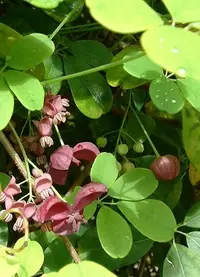
Chocolate vine, Akebia quinata, is a fast-growing deciduous climber valued for its twining stems, delicate leaves, and unusual spring flowers with a light cocoa-like scent. It typically climbs over supports, fences, or shrubs, forming a dense screen when conditions suit it.
This species is native to East Asia, especially Japan, China, and Korea, and has adapted well in many temperate gardens. It is considered relatively easy to grow but can become vigorous and spreading in mild climates.
Chocolate vine prefers sun to light shade, moderately moist but well-drained soil, and benefits from regular structural pruning. Understanding how to care for chocolate vine early helps keep its growth controlled and ornamental rather than invasive.

Care Difficulty
Moderate Care

Light Preference
Partial Sun

Water Requirements
Moderate Water

Temperature Preference
Cold Hardy

Hardiness Zone
4–9

Soil Texture
Sandy, Loamy, Organic-rich

Soil pH
Acidic (5.5–6.5), Slightly acidic (6.5–7.0)

Soil Drainage
Moist but well-drained

Fertilization
Minimal (feed rarely)
Scan your plant to receive care tips personalized for your specific plant
Available on iOS and Android
Akebia quinata grows best with moderate sun exposure and some protection from harsh midday rays.
Akebia quinata prefers evenly moist, well-drained soil rather than constant wetness or drought.
This vine is cold hardy yet grows most vigorously in moderate temperatures.
This vine tolerates a wide humidity range and rarely needs special humidity management outdoors.
Soil should be loose, draining freely, yet able to hold moderate moisture.
This species adapts well to large containers when structural support and root space are provided.
Akebia quinata grows well in average soil and needs only modest feeding to support healthy vines and flowering.
Thoughtful pruning keeps Akebia quinata within bounds and maintains flowering performance.
This vigorous climber is usually grown in the ground, with transplanting focused on managing size and site suitability.
New plants are commonly raised from cuttings, seeds, or layering, making Akebia quinata straightforward to multiply.
Mature plants are generally cold hardy, so chocolate vine needs limited winter care in most temperate gardens.

Plant Health Check
Not sure what's wrong with your plant? Check your plant's health inside the app.
The flowers produce a noticeable sweet fragrance that many people describe as similar to vanilla or chocolate, which is why the plant is commonly called chocolate vine.
Individual flowers on the same plant can function as either male or female, with large maroon female flowers and smaller male flowers often appearing together in dangling clusters.
The elongated purple fruit splits open when ripe to reveal a soft, translucent pulp that is traditionally eaten in parts of East Asia, although the numerous black seeds are not consumed.

In parts of Japan, the fibrous stems of Akebia quinata are harvested and woven into baskets and traditional crafts, making this vine not only an ornamental and fruiting plant but also a minor source of natural fiber.
This species spreads quickly by long, twining stems and sometimes by self-seeding. In mild climates it can become difficult to control. Use sturdy supports, prune regularly, and install root barriers or confined beds where spread is a concern.
Keep your plants happy and healthy with plant identification, disease detection, and easy care guidance.

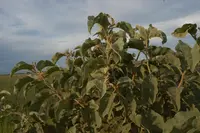
wolf-apple
Solanum lycocarpum
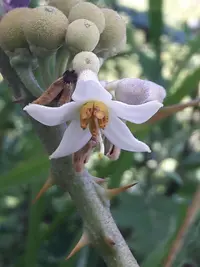
Solanum stramoniifolium
Solanum stramoniifolium
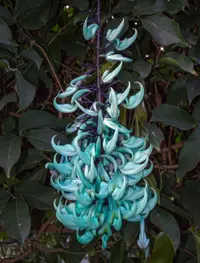
Jade vine
Strongylodon macrobotrys
Cucurbita pepo var. giromontiina
Cucurbita pepo var. giromontiina
beaked hazelnut
Corylus cornuta
Brassica rapa var. rosularis
Brassica rapa var. rosularis
Aeschynanthus hookeri
Aeschynanthus hookeri
Virginia strawberry
Fragaria virginiana