


Use fresh hardwood
For reliable fruiting, inoculate only freshly cut, healthy hardwood logs or stumps (oak is ideal) within 2–4 weeks of felling to minimize competing fungi and decay organisms.

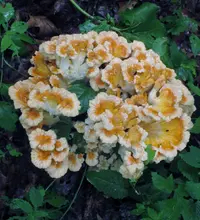
Laetiporus cincinnatus, commonly called white-pored chicken of the woods, is a wood-decay bracket fungus rather than a leafy plant. It forms thick, layered rosettes of overlapping, fan-shaped shelves with bright orange to salmon tops and distinct white pores underneath. The clusters usually emerge at or near the base of living or dead hardwood trees, especially oaks. In nature it helps break down heartwood, playing an important role in forest nutrient cycling.
Gardeners sometimes try to care for White-pored Chicken of the Woods on cut logs or buried wood. It generally prefers shady to dappled light, steady moisture, and well-aerated, woody substrates. Cultivation can be moderately challenging because it needs the right host wood and stable, humid conditions to produce healthy fruiting bodies.

Care Difficulty
Hard Care

Light Preference
Partial Shade

Water Requirements
Regular Water

Temperature Preference
Cool Climate

Hardiness Zone
Unknown

Soil Texture
Loamy, Organic-rich

Soil pH
Slightly acidic (6.5–7.0)

Soil Drainage
Moist but well-drained

Fertilization
Minimal (feed rarely)
Scan your plant to receive care tips personalized for your specific plant
Available on iOS and Android
This wood-decay fungus prefers bright, indirect forest light rather than intense open sun.
This species grows on living or dead hardwood and depends on steady wood moisture rather than surface watering.
This fungus fruits best in mild to warm conditions typical of late spring to early fall.
Humidity has little direct impact on Laetiporus cincinnatus, which relies more on wood moisture than ambient air humidity.
This wood-decaying fungus needs a moist, aerated, organic substrate rather than conventional garden soil.
This species is only moderately suited to container growing when logs or large wood sections are used as the substrate.
Laetiporus cincinnatus is a wood-decay fungus that usually gains all required nutrients from its host tree, so added fertilizer is rarely necessary.
Pruning is not applicable to Laetiporus cincinnatus in the same way as for vascular plants, since it forms fruiting bodies on wood rather than stems or foliage.
This fungus is typically established on living or dead hardwood outdoors, so transplanting focuses on moving colonized wood rather than repotting in soil.
Culturally, growing White-pored Chicken of the Woods relies on establishing the fungus on suitable hardwood rather than standard plant propagation methods.
In-ground Laetiporus cincinnatus on hardy hardwood hosts tolerates normal winter conditions in most temperate regions and needs little direct care.

Plant Health Check
Not sure what's wrong with your plant? Check your plant's health inside the app.
Unlike most chicken of the woods species that form overlapping shelves on standing trunks, this fungus usually produces rosette-like clusters at or near the base of living oaks or from underground roots.
The underside of the fruiting body has a bright white pore surface rather than the yellow pores typical of many related species, which is a key field character for separating it from look-alikes.
It is strongly associated with oaks and causes a brown cubical heart rot in the wood, gradually breaking down lignin and cellulose and returning nutrients to the forest soil.

This species often fruits from buried roots or subterranean wood, so large clusters can appear to emerge directly from soil with no visible connection to a trunk, which can mislead foragers and field mycologists about the true host tree.
Young, fresh brackets are generally considered edible when thoroughly cooked, but some people experience gastrointestinal upset or allergic reactions. Always identify accurately, avoid older or bug-damaged specimens, cook well, and try only a small amount initially.
Keep your plants happy and healthy with plant identification, disease detection, and easy care guidance.

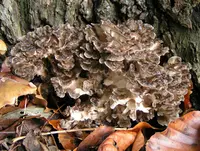
hen-of-the-woods
Grifola frondosa
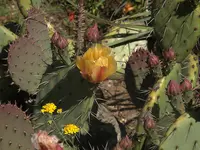
California Pricklypear
Opuntia × occidentalis
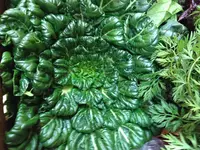
Brassica rapa var. rosularis
Brassica rapa var. rosularis
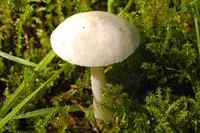
bearded dapperling
Cystolepiota seminuda
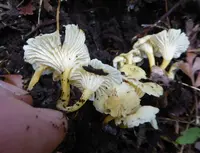
Cantharellus wellingtonensis
Cantharellus wellingtonensis
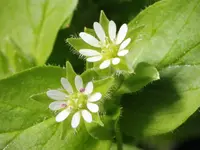
common chickweed
Stellaria media
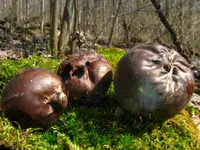
Tumbling puffball
Bovista pila
Russian olive
Elaeagnus angustifolia