Jade vine Care (Strongylodon macrobotrys)

Jade vine

About Jade vine

Jade vine, Strongylodon macrobotrys, is a vigorous tropical liana from the rainforests of the Philippines. It climbs high into trees and can form long, hanging flower clusters in suitable conditions.

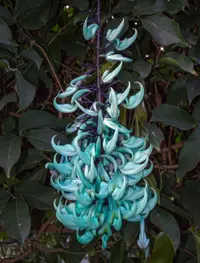
Its flowers are waxy, claw-shaped, and usually turquoise to blue-green, creating a striking display on mature plants. The foliage is evergreen, with glossy, divided leaves that give a dense, lush look.

The plant prefers warm, humid conditions, bright light, and consistent moisture, which makes it challenging in most homes. It suits large greenhouses or very bright, protected outdoor spaces in frost-free climates, and understanding how to care for Jade vine helps improve success.

Main Plant Requirements

Care Difficulty

Hard Care

Light Preference

Partial Sun

Water Requirements

Regular Water

Temperature Preference

Tropical / Frost Sensitive

Hardiness Zone

11–12

Soil Texture

Loamy, Sandy, Organic-rich

Soil pH

Acidic (5.5–6.5), Slightly acidic (6.5–7.0)

Soil Drainage

Moist but well-drained

Fertilization

Moderate (every 2–4 weeks)

Get Personalized Care Plan

Scan your plant to receive care tips personalized for your specific plant

Available on iOS and Android

How to Care for the Jade vine

Strongylodon macrobotrys needs bright, filtered light to flower and maintain healthy foliage.

  • Provide 4–6 hours of bright, indirect light daily, such as under a pergola or beneath high, open tree canopies.
  • Allow gentle morning sun but protect from strong midday and afternoon sun, which can scorch leaves and fade Jade vine flower color.
  • In hot summers, increase shade to 50–70%; in cooler seasons, give more exposure so growth does not slow from low light.

This tropical liana prefers evenly moist but not saturated soil throughout its main growing season.

  • Water when the top 3–5 cm of soil feels dry, soaking the root zone deeply, then let excess drain away fully.
  • Use fertile, well-draining soil; persistent wetness, sour smell, or yellowing leaves indicate overwatering and risk of root rot.
  • In cooler or less active months, extend the interval between waterings; slight leaf droop and dry upper soil signal the need to water Strongylodon macrobotrys.

This species thrives in consistently warm, frost-free conditions with only slight seasonal variation.

  • Aim for 70–85°F (21–29°C) for active growth, which supports vigorous vines and reliable flower production.
  • Protect from cold; growth slows below 60°F (16°C) and the plant can be damaged or killed near 40°F (4°C), especially with wind.
  • In hot climates, it tolerates 90–95°F (32–35°C) if roots are mulched and shaded, but flowering may decline under prolonged extreme heat.

This species prefers consistently humid air and reacts poorly to very dry conditions.

  • Aim for 60–80% humidity, especially for young vines and actively growing shoots.
  • Leaves may curl, brown at tips, or feel brittle under prolonged low humidity or strong drying drafts.
  • Increase humidity with grouped plants, pebble trays under pots, or a room humidifier rather than frequent misting.

This vine needs deep, moist, sharply drained soil that stays aerated around the roots.

  • Use a loose, organic-rich loam with coarse structure, such as 50% composted bark or peat-free potting mix, 25% perlite, and 25% coarse sand.
  • Ensure rapid drainage so water does not sit in the root zone, which strongly predisposes Strongylodon macrobotrys to root rot.
  • Keep soil slightly acidic to neutral, around pH 6.0–7.0, avoiding strongly alkaline mixes that can lock up micronutrients.
  • Improve aeration by incorporating chunky bark or pumice and avoiding fine, compacting garden soil or heavy clay-based mixes.

This species can be grown in large containers if structural support and root volume are carefully managed.

  • Choose a tall, heavy container that resists tipping once the vine climbs and develops substantial top weight.
  • Select a pot diameter that allows a deep, wide root run, as cramped containers limit vine vigor and flowering potential.
  • Use a pot material with moderate porosity, such as thick-walled terracotta or composite, to balance moisture retention with evaporation and root cooling in warm climates.

This vigorous tropical vine responds well to careful feeding during the warm growing season to support foliage and flowering.

  • Use a balanced liquid fertilizer (such as 10-10-10 or 20-20-20) at 1/2 strength every 4–6 weeks in spring and summer.
  • Alternatively, apply a slow-release balanced fertilizer in early spring, following the lower end of the label dosage.
  • Avoid high-nitrogen lawn products; they promote leaf growth at the expense of Jade vine blooms.
  • Stop feeding in fall and winter, when growth slows, to prevent weak, elongated growth.

Thoughtful pruning helps Strongylodon macrobotrys stay manageable and encourages flowering on well-lit growth.

  • Carry out main pruning after flowering, removing dead, damaged, or rubbing stems with clean, sharp bypass pruners.
  • Thin congested shoots to improve light and air flow along the vine framework, which supports flower cluster development.
  • Shorten excessively long, wandering stems to maintain size and direct growth onto strong supports or trellis wires.
  • Disinfect blades between plants and major cuts to reduce the risk of spreading fungal or bacterial diseases.

This large tropical climber is usually grown in the ground or in big containers, so transplanting or repotting focuses on root space and stability.

  • Plan major transplanting or up-potting in late spring to early summer, once temperatures are consistently warm.
  • Look for roots circling the container surface, pushing through drainage holes, or noticeably slower growth as signs more space is needed.
  • Shift into a container 1–2 sizes larger with a deep, sturdy structure and well-drained, rich, slightly acidic mix.
  • Handle the root ball gently, loosening only the outer roots, then water thoroughly and shade lightly for 3–7 days to limit transplant shock.

Reproducing this vine is possible but somewhat specialized, with semi-ripe cuttings being the most practical method for home growers.

  • Take semi-ripe stem cuttings in late spring or early summer, 10–15 cm long, with 2–3 nodes and healthy leaves.
  • Dip the cut base in rooting hormone, then place in a sterile, free-draining mix such as 50% perlite and 50% peat or coco coir.
  • Maintain bottom heat around 75–80°F, high humidity, and bright, indirect light to support root formation over several weeks.
  • Sow fresh seeds in warm conditions with the same mix; germination is slow and benefits from consistent moisture and stable temperatures.

This tropical species is highly frost-sensitive and needs careful winter management outside true frost-free climates.

  • Grow Strongylodon macrobotrys in USDA zones 10–11 outdoors; in cooler regions, keep it in a large container year-round.
  • Before night temperatures drop below 50°F, move container plants indoors to a bright, warm space.
  • For in-ground specimens in marginal climates, mulch the root zone with 5–10 cm of organic material to buffer soil temperature.
  • Avoid cold drafts or sudden temperature swings indoors, and water sparingly so the soil stays slightly moist, never saturated.

Care Tips

Sturdy Overhead Support

Install a strong pergola, arbor, or heavy-duty trellis before the plant matures, as woody stems and heavy flower clusters need fixed, load‑bearing support that will not sag or pull out of walls.

Train Young Vines

While stems are still flexible, gently spiral them onto wires or rafters and tie with soft, wide plant ties, checking every 2–3 months to loosen or move ties so they do not cut into thickening wood.

Root Zone Shading

Mulch the root area with 5–8 cm of coarse organic material and underplant with low, non-competitive groundcovers to keep roots cool and reduce stress in hot climates.

Hand Pollination Aid

In regions without natural pollinators, use a small, clean brush in the evening to transfer pollen between fresh flowers in different clusters, which can improve pod set when growing Jade vine outdoors or in a greenhouse.

Container Stability Management

For large container-grown plants, use wide, heavy pots or add weight (such as bricks at the base) and secure the trellis to prevent the vine from toppling in wind or when flower clusters become heavy.

Common Pests and Diseases

Spider mites

This pest thrives on jade vine in warm, dry, still air and causes fine stippling, dull foliage, and delicate webbing on leaf undersides. Symptoms include gradual yellowing and reduced vigor, especially in greenhouse or indoor specimens.

Solution

Rinse foliage thoroughly with a firm stream of lukewarm water, focusing on leaf undersides, then repeat every few days until populations drop. Improve humidity and air circulation, isolate the plant, and use insecticidal soap or horticultural oil labeled for mites, ensuring full coverage without spraying in direct sun.

Mealybugs

These insects are attracted to the fleshy stems and leaf joints, where they form white cottony clusters and excrete sticky honeydew. Symptoms include distorted new growth, leaf drop, and sooty mold developing on the honeydew.

Solution

Physically remove visible clusters with a cotton swab dipped in isopropyl alcohol, then wash the plant with lukewarm water and mild insecticidal soap. Inspect vines and flower racemes regularly, isolate affected plants, and repeat treatments weekly until no new insects appear as part of consistent Strongylodon macrobotrys plant care.

Scale insects

This pest appears as small, brown or tan, shell-like bumps along stems and leaf veins, where it feeds on plant sap. Symptoms include yellowing leaves, poor flowering, and sticky honeydew that can attract ants and sooty mold.

Solution

Prune out heavily infested stems and gently scrape or rub off individual scales with a soft cloth or fingernail. Follow with thorough applications of horticultural oil on stems and leaf undersides, repeating every 7–14 days while monitoring for crawler stages, and reduce excess nitrogen fertilization that encourages soft, susceptible growth.

Anthracnose leaf spot

This disease causes irregular brown or tan lesions on leaves and sometimes on young stems, often with darker margins. Symptoms include premature leaf drop and an overall thinning of the canopy, especially under warm, humid, poorly ventilated conditions.

Solution

Remove and discard affected leaves and any fallen debris to reduce inoculum, and avoid overhead watering that keeps foliage wet for long periods. Improve airflow around the vine, water at the base, and, if the problem persists, apply a copper-based or other labeled ornamental fungicide according to instructions, treating new growth during humid periods.

Powdery mildew

This disease appears as a white to gray, powdery coating on leaves and tender shoots, often starting on shaded or crowded parts of the vine. Symptoms include distorted new growth, dull foliage, and reduced flowering if the infection is heavy.

Solution

Increase light and airflow by thinning overcrowded stems and avoiding dense overhead structures that trap humidity, and water early in the day so foliage dries quickly. Remove heavily infected leaves and treat remaining foliage with a labeled powdery mildew fungicide or horticultural oil, applying in mild temperatures and repeating as directed until new growth emerges clean.

Interesting Facts

Turquoise claw flowers

The plant produces pendent flower clusters up to 3 m long, with claw-shaped flowers in a rare turquoise to blue-green color caused by an unusual mix of malvidin (purple) and saponarin (yellow) pigments.

Bat pollination strategy

In its native Philippine forests, the flowers are primarily pollinated by nectar-feeding bats that hang from the stiff, claw-like blooms and trigger pollen release through their weight and movement.

Threatened wild populations

Although widely cultivated in tropical gardens, it is considered vulnerable in the wild because of habitat loss in lowland Philippine rainforests, where natural populations have become highly fragmented.

Botan icon

Did you know?

The species is part of the legume family (Fabaceae) and forms nitrogen-fixing root nodules with symbiotic bacteria, allowing it to capture atmospheric nitrogen and enrich the surrounding soil in its native rainforest habitat.

FAQs about Jade vine

Lack of flowers usually comes from insufficient maturity, light, or seasonal temperature changes. This species often needs several years, strong support, cool dryish rest periods, and pollinators or hand‑pollination to set visible flower clusters.

Grow Healthy Plants with Botan Care

Keep your plants happy and healthy with plant identification, disease detection, and easy care guidance.

Botan plant care app — identify plants on mobile

Explore More Plants