Wind acclimation
In the first 1–2 years after planting, gradually expose young plants to stronger wind by removing temporary windbreaks in stages so the trunk and leaf bases can strengthen without snapping or bending.

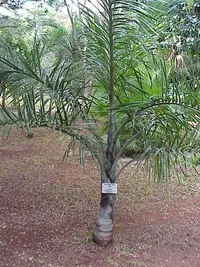
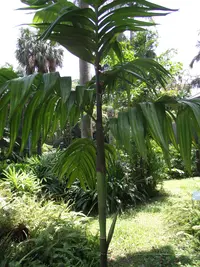
The Florida cherry palm, Pseudophoenix sargentii, is a slow-growing, single-trunk palm valued for its clean, architectural form. It typically develops a smooth, gray trunk with a rounded crown of stiff, feather-like fronds and small red fruits that attract attention in mature plants.
This species is native to coastal areas of southern Florida, the Caribbean, and parts of Central America, where it experiences high light, heat, and salt exposure. It is considered somewhat challenging, mainly due to its slow growth, sensitivity to cold, and need for sharp drainage. Gardeners who learn how to care for Florida cherry palm often succeed by matching its natural dry, sunny, and well-drained habitat as closely as possible.

Care Difficulty
Hard Care

Light Preference
Full Sun

Water Requirements
Low Water

Temperature Preference
Tropical / Frost Sensitive

Hardiness Zone
10–11

Soil Texture
Sandy, Loamy, Rocky

Soil pH
Slightly acidic (6.5–7.0), Neutral (7.0)

Soil Drainage
Well-drained

Fertilization
Minimal (feed rarely)
Scan your plant to receive care tips personalized for your specific plant
Available on iOS and Android
This palm thrives in strong light similar to bright coastal habitats.
This species prefers slightly dry, very well-drained conditions rather than constant moisture.
This palm is adapted to warm subtropical to tropical climates with mild winters.
Humidity is a minor factor for this drought-tolerant palm, which adapts to 30–60% indoor humidity.
This species prefers very well-drained, mineral soils that do not stay wet around the roots.
This palm can be grown in containers, especially in its younger stages, if stability and drainage are carefully managed.
This slow-growing palm needs modest feeding to support healthy foliage on poor soils.
Pseudophoenix sargentii needs minimal pruning and should be trimmed conservatively.
This palm dislikes disturbance, so transplant or up-pot only when clearly necessary.
This species is almost always propagated from seed, and germination is slow and specialized.
This tropical palm is sensitive to hard frost and benefits from targeted winter protection in cooler regions.

Plant Health Check
Not sure what's wrong with your plant? Check your plant's health inside the app.
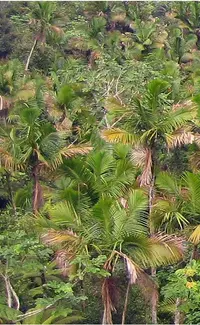
This species is naturally restricted to a small area of South Florida, the Florida Keys, Cuba, the Bahamas, and nearby Caribbean islands, typically on exposed coastal limestone or coral rock.
The trunk has a distinctive, swollen, gray to blue-green appearance due to specialized tissues that store calcium salts, which is characteristic of the genus and linked to its preference for alkaline, limestone-based soils.
In its native habitat it withstands coastal winds, salt spray, and long dry periods, surviving in very thin, rocky soils where many other tree species cannot persist.

This palm is considered one of the rarest native palms in the United States, with wild populations in South Florida and the Florida Keys having declined sharply due to historical overharvesting and habitat loss, which led to legal protection and focused conservation efforts.
This species grows slowly, usually adding only 7–15 cm of trunk per year under good conditions. It often spends several years establishing roots before visible trunk forms, so noticeable height gains can feel gradual.
Keep your plants happy and healthy with plant identification, disease detection, and easy care guidance.