Protect Tender Roots
Use a thick mulch layer of fine bark or composted leaf mold over the root zone to keep the shallow roots cool, retain moisture, and reduce transplant shock when growing Sierran palm outdoors in warm climates.

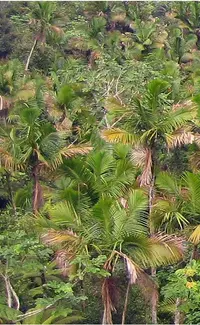
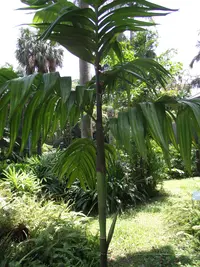
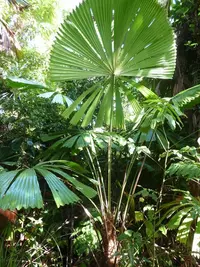
Sierran palm, Prestoea acuminata, is a feather-leaved palm native to moist mountain forests of Central and South America. It often grows in dense stands along streams and slopes. The plant forms a slender, upright trunk topped with a graceful crown of arching fronds, giving it a tall, elegant look in mature specimens. In cultivation it tends to stay smaller, especially in containers. This species prefers consistently moist conditions, filtered light, and well-drained, organic-rich soil. Its need for high humidity and steady warmth makes care for Sierran palm moderately challenging outside tropical and subtropical climates.

Care Difficulty
Hard Care

Light Preference
Partial Shade

Water Requirements
Keep Soil Moist

Temperature Preference
Tropical / Frost Sensitive

Hardiness Zone
11–12

Soil Texture
Loamy, Silty, Organic-rich

Soil pH
Acidic (5.5–6.5)

Soil Drainage
Waterlogged tolerant

Fertilization
Minimal (feed rarely)
Scan your plant to receive care tips personalized for your specific plant
Available on iOS and Android
Prestoea acuminata prefers bright, gentle light similar to a humid understory habitat.
Prestoea acuminata needs consistently moist but not waterlogged soil.
This palm thrives in warm, stable, frost-free conditions year-round.
This species needs high, stable humidity to maintain healthy fronds.
Prestoea acuminata prefers deep, moist, well-drained, organic-rich soil.
This palm can be grown in large containers when moisture and stability are managed carefully.
This palm responds well to moderate feeding in containers or managed landscapes.
Pruning Prestoea acuminata focuses on hygiene and safety rather than reshaping the crown.
This palm is usually grown in the ground, so attention centers on careful transplanting of young plants.
Prestoea acuminata is mainly propagated from seed under controlled, warm conditions.
This tropical palm is frost-sensitive and needs protection in any climate with cool winters.

Plant Health Check
Not sure what's wrong with your plant? Check your plant's health inside the app.
This palm naturally occurs in humid montane forests from Costa Rica to Bolivia, often between 800–2,000 m where clouds, frequent mist, and diffuse light dominate its environment.
It is one of the main wild sources of palm heart in parts of the northern Andes, where the edible inner stem has been harvested for local consumption and small-scale trade.
The species forms a single, unbranched trunk that can reach 10–20 m tall in the wild, topped by a relatively small crown of gracefully arching pinnate leaves adapted to intercept filtered forest light.

Genetic and morphological studies have shown that what was once treated as several different taxa in the Prestoea acuminata complex are very closely related, and some authors now group them as a single, geographically variable species across the northern and central Andes.
This species is moderate-growing. In warm, moist, shaded conditions it typically adds 15–30 cm of trunk per year once established. Young plants may grow slowly at first while roots develop, then gain speed under stable conditions.
Keep your plants happy and healthy with plant identification, disease detection, and easy care guidance.