Provide sturdy trellis
Install a long-lasting, rigid support such as a timber or steel trellis before planting, then loosely secure new vines with soft ties so the heavy, woody stems can mature without kinking or breaking.

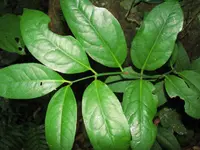
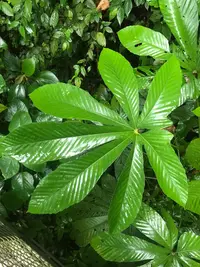
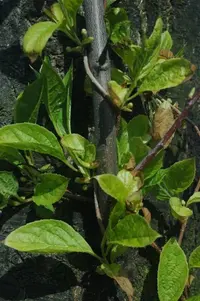
Austrobaileya scandens is an evergreen woody vine native to the rainforests of northeastern Queensland, Australia. It is one of the few members of an ancient plant lineage, valued mainly by collectors and botanic gardens. The plant climbs by twining stems and can form a dense curtain of leathery, glossy green leaves. Its unusual star-shaped, greenish to reddish flowers develop close to the stems and are more interesting botanically than ornamental in a typical home. It prefers a humid, sheltered environment with consistent moisture and organically rich, well-drained soil. Because it comes from a very specific rainforest habitat, how to care for Austrobaileya can be challenging for beginners without controlled indoor or greenhouse conditions.

Care Difficulty
Hard Care

Light Preference
Partial Shade

Water Requirements
Keep Soil Moist

Temperature Preference
Tropical / Frost Sensitive

Hardiness Zone
11–12

Soil Texture
Loamy, Organic-rich

Soil pH
Acidic (5.5–6.5)

Soil Drainage
Moist but well-drained

Fertilization
Minimal (feed rarely)
Scan your plant to receive care tips personalized for your specific plant
Available on iOS and Android
This rainforest climber prefers bright, gentle light that mimics a high-canopy forest edge.
This species prefers consistently moist but not waterlogged soil around its root zone.
This vine thrives in warm, frost-free climates similar to lowland or upland tropical forest.
This climber prefers consistently moist air, similar to a warm rainforest understory.
Provide a loose, organic-rich, sharply drained substrate that still holds steady moisture.
This species adapts well to container culture when the pot supports its climbing, woody habit.
This vine benefits from modest feeding in cultivation but Austrobaileya scandens is not a heavy feeder.
Pruning helps manage the long, twining stems of Austrobaileya scandens and maintains safe support structures.
This species is usually grown in the ground, so transplanting young plants matters more than repotting mature Austrobaileya scandens.
Propagation of Austrobaileya scandens is specialized and usually handled by experienced growers or conservation collections.
This vine is a warmth‑loving species with low frost tolerance, so some winter protection is important in cool climates.

Plant Health Check
Not sure what's wrong with your plant? Check your plant's health inside the app.
This vine belongs to one of the earliest diverging lineages of flowering plants, making it important for understanding how modern flowers evolved from ancestral forms.
It produces large, greenish, star-shaped flowers with thick tepals and a complex central structure that resembles early angiosperm floral organization studied in plant evolutionary biology.
The species is a woody climber native to the rainforests of northeastern Queensland, where it scrambles up trees in shaded, very humid habitats with consistently mild temperatures.

Fossil-calibrated evolutionary studies indicate that the family Austrobaileyaceae, represented in nature by Austrobaileya scandens, is one of the few living lineages that help bridge the morphological gap between the most primitive flowering plants and the vast diversity of modern angiosperms, making it a reference taxon in research on early flower evolution.
This species is a woody liana, so it climbs rather than creeping along the ground. Stems twine around supports and can become thick and woody with age, forming a long, looping vine rather than a bushy shrub.
Keep your plants happy and healthy with plant identification, disease detection, and easy care guidance.