Manage Self-Seeding
Leave a few healthy plants to flower and set seed if you want a naturalized patch, then lightly rake the soil in late summer to help seeds make contact while still removing excess seedlings from pathways or beds.

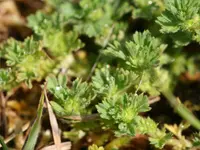
Parsley piert, Alchemilla arvensis, is a small, low-growing annual herb in the rose family. It often appears as a modest ground-hugging plant in lawns, paths, and open soil.
The plant forms tiny, finely divided, parsley-like leaves and produces very small, greenish flowers that are easy to overlook. It is native to Europe and western Asia but now appears in many temperate regions, especially in disturbed or cultivated ground.
Parsley piert is generally hardy, self-seeding, and tolerant of poor, dry soils, which makes it easy to persist once established. Those who want to care for Parsley Piert should know it favors open, sunny to lightly shaded spots with reasonably well-drained soil.

Care Difficulty
Easy Care

Light Preference
Partial Sun

Water Requirements
Moderate Water

Temperature Preference
Cold Hardy

Hardiness Zone
4–8

Soil Texture
Sandy, Loamy, Silty

Soil pH
Acidic (5.5–6.5), Slightly acidic (6.5–7.0)

Soil Drainage
Well-drained

Fertilization
Minimal (feed rarely)
Scan your plant to receive care tips personalized for your specific plant
Available on iOS and Android
Alchemilla arvensis prefers cool, moderate light similar to its natural field and grassland habitats.
Alchemilla arvensis prefers consistently lightly moist, well-drained soil rather than extremes of drought or saturation.
This species is adapted to temperate climates and tolerates a fairly wide range of outdoor temperatures.
This species is adapted to open, dry habitats and usually does not need special humidity control when grown outdoors or in typical indoor air.
This small annual prefers moderately fertile, well-drained mineral soils that do not stay wet for long.
This species can be grown in small containers, mainly for study or display rather than long-term ornamental effect.
Alchemilla arvensis is a small wild herb that usually needs only modest feeding in garden or container conditions.
Alchemilla arvensis benefits from simple, light pruning to keep plants neat and control self-seeding.
This species is usually grown in the ground, so focus on gentle transplanting rather than frequent repotting.
This annual or short-lived perennial is most commonly propagated by seed rather than by cuttings.
Alchemilla arvensis is cold hardy in most temperate climates and usually needs little specific winter care.

Plant Health Check
Not sure what's wrong with your plant? Check your plant's health inside the app.
This species is an annual member of the lady’s-mantle group, unlike most Alchemilla relatives, which are perennial; it completes its entire life cycle from seed to seed within a single growing season.
Its dry fruits are dispersed by a simple mechanical catapult: tension in the fruiting structures can flick the tiny seeds short distances, helping the plant spread in disturbed soils and field edges.
The plant often thrives in light, nutrient-poor, and sometimes compacted soils such as arable fields, paths, and dry banks, showing an adaptation to habitats where many taller competitors struggle.
This species behaves mainly as an annual in most gardens, germinating, flowering, and setting seed within 1 year. In mild climates it may overwinter as a short-lived perennial, but individual plants usually do not persist long-term.
Keep your plants happy and healthy with plant identification, disease detection, and easy care guidance.