Rocky pocket planting
Tuck bulbs into shallow pockets between rocks or along the edge of a dry wall so their roots stay cool while foliage and flowers receive full exposure and good air flow.

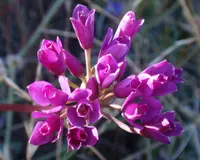
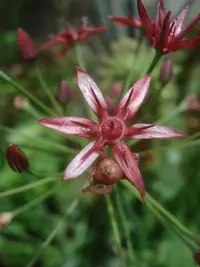
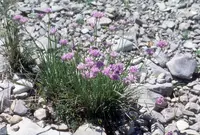
Coastal onion (Allium dichlamydeum) is a small, bulb-forming perennial from the Pacific coast of California and Oregon. It usually grows in rocky bluffs and coastal grasslands. Plants form narrow, grassy leaves and short stems topped with dense clusters of bright pink to magenta star-shaped flowers. The bulbs rest dormant in dry periods, then resprout when conditions improve. This natural cycle makes the species quite resilient in well-drained, low-fertility soils. It suits rock gardens, coastal landscapes, and naturalistic plantings where drainage is sharp and watering is moderate. Gardeners who want to learn how to care for coastal onion benefit from understanding its dry-summer, mild-winter native habitat.

Care Difficulty
Easy Care

Light Preference
Full Sun

Water Requirements
Low Water

Temperature Preference
Cold Hardy

Hardiness Zone
6–9

Soil Texture
Sandy, Loamy, Rocky

Soil pH
Slightly acidic (6.5–7.0), Neutral (7.0)

Soil Drainage
Well-drained

Fertilization
Minimal (feed rarely)
Scan your plant to receive care tips personalized for your specific plant
Available on iOS and Android
Allium dichlamydeum grows best in bright, open sites with strong sun exposure.
This bulb prefers dry to moderately dry conditions and is sensitive to excess moisture.
This coastal species is adapted to mild, maritime climates but shows good cold tolerance in the ground.
Humidity is rarely critical for Allium dichlamydeum, which is adapted to dry, breezy coastal habitats.
Allium dichlamydeum needs lean, sharply drained soil that mimics its rocky native sites.
This species is suitable for container growing when provided with fast-draining media and a stable pot.
Allium dichlamydeum needs only light feeding and often thrives in lean, well-drained soils.
Allium dichlamydeum needs minimal pruning, focused on cleanup rather than shaping.
This species is usually grown in the ground, so focus on careful transplanting or infrequent container repotting.
Allium dichlamydeum is most commonly propagated by bulb division, with seed used mainly for larger or wild-style plantings.
This coastal bulb is generally cold hardy and needs little winter care in mild to moderately cold climates.

Plant Health Check
Not sure what's wrong with your plant? Check your plant's health inside the app.
This species is native to the central and northern California coast, where it grows naturally on sea bluffs, rocky headlands, and coastal prairie within reach of salty ocean air.
Leaves and bulbs tolerate salt spray and strong onshore winds, an adaptation that allows the plant to persist in exposed cliff habitats where many inland onions cannot survive.
It produces compact, showy heads of bright magenta to rose-purple flowers on short stalks, each umbel arising close to the leaves and often giving the plant a low, cushion-like appearance on rocky slopes.

This coastal onion is considered a California endemic, meaning it occurs naturally only within that state and is restricted mainly to a narrow band of Pacific coastline habitats.
Lack of flowers often comes from insufficient winter chill, too much shade, or bulbs planted too deeply. Overly rich, high‑nitrogen fertilizer and frequent disturbance of clumps can also reduce flowering in this coastal species.
Keep your plants happy and healthy with plant identification, disease detection, and easy care guidance.