Staking Heavy Blooms
Install discreet, thin stakes at planting time and loosely tie stems before buds fully expand so the large flower heads stay upright and are not damaged by wind or heavy rain.

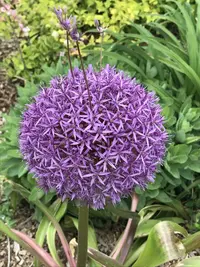
Giant allium Allium giganteum 'Globemaster' is a bulb-forming perennial grown mainly for its large, spherical flower heads. It belongs to the onion family and produces sturdy, upright stems topped with dense globes of tiny purple flowers above a low clump of broad leaves.
This cultivar does not occur in the wild; it is a garden selection derived from species native to Central and southwestern Asia. It is considered relatively easy to grow in climates with cool to cold winters, provided it gets full sun, well-drained soil, and moderate moisture.
The bulbs need a dry, well-aerated resting period and dislike heavy, waterlogged ground. Once the soil conditions are right, it is straightforward to care for Giant Allium in mixed borders or dedicated bulb beds.

Care Difficulty
Easy Care

Light Preference
Full Sun

Water Requirements
Moderate Water

Temperature Preference
Cold Hardy

Hardiness Zone
5–8

Soil Texture
Sandy, Loamy, Organic-rich

Soil pH
Slightly acidic (6.5–7.0), Slightly alkaline (7.0–7.5)

Soil Drainage
Well-drained

Fertilization
Minimal (feed rarely)
Scan your plant to receive care tips personalized for your specific plant
Available on iOS and Android
This bulb needs strong light to fuel spring growth and flowering.
This bulb prefers evenly moist but not saturated soil during active growth.
This hardy bulb experiences cool winters and mild springs in most growing regions.
This bulb is adapted to dry, open sites and typical home or outdoor humidity is usually sufficient.
Allium giganteum 'Globemaster' needs a sharply drained, loose mineral soil to keep the bulbs dry and aerated.
This species is suitable for container growing if the pot is deep and very free-draining.
Allium giganteum 'Globemaster' benefits from modest feeding in rich, well-prepared soil.
Allium giganteum 'Globemaster' needs only light pruning to keep the planting tidy and to support bulb strength.
This ornamental allium is usually grown in garden beds, with transplanting focused on crowded clumps rather than frequent repotting.
Multiplying Allium giganteum 'Globemaster' is usually done by bulb division, with seed used mainly by specialists.
Established bulbs are generally cold hardy in-ground and need minimal winter attention in most temperate climates.

Plant Health Check
Not sure what's wrong with your plant? Check your plant's health inside the app.
This ornamental onion is a complex hybrid selected by Dutch breeders rather than a naturally occurring wild species, combining traits for large flower heads and sturdy stems from several Allium parents.
Its violet globes are made of many small, mostly sterile florets, so the plant is propagated almost entirely by bulbs rather than by viable seed in gardens.
Despite low seed production, the nectar-rich florets attract bees, hoverflies, and other pollinators, providing an early summer food source when some other ornamentals have already finished blooming.

The flower heads of this hybrid can reach roughly the size of a small melon on proportionally thick, wind-resistant stems, which is why it is frequently used as a structural focal point in formal mixed borders and display gardens.
Yellowing leaves late in the season are normal as the bulb goes dormant after flowering. Early yellowing can result from waterlogged soil, nutrient-poor ground, overcrowded bulbs, or fungal root issues. Improve drainage and spacing to help recovery.
Keep your plants happy and healthy with plant identification, disease detection, and easy care guidance.