Contain Spreading Clumps
Plant bulbs in buried nursery pots or sturdy edging rings if you want to limit spread, as this species naturalizes quickly and can invade nearby beds.

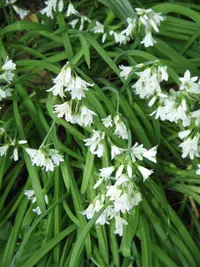
Threecorner leek, Allium triquetrum, is a bulb-forming perennial from the Mediterranean region, now naturalized in many mild, coastal climates. It grows in clumps of narrow, soft green leaves and nodding white bell-shaped flowers marked with green, usually appearing in late winter to spring. The stems are distinctly three-angled, which gives the plant its common name. This species spreads readily by bulbs and seed, so it can become invasive in suitable conditions. It favors moist, well-drained soil and partial shade, especially under trees or along shady borders. Understanding how to care for threecorner leek starts with recognizing its vigorous growth and tendency to naturalize quickly.

Care Difficulty
Easy Care

Light Preference
Partial Shade

Water Requirements
Moderate Water

Temperature Preference
Cold Hardy

Hardiness Zone
7–10

Soil Texture
Sandy, Loamy, Organic-rich

Soil pH
Acidic (5.5–6.5), Slightly acidic (6.5–7.0)

Soil Drainage
Moist but well-drained

Fertilization
Minimal (feed rarely)
Scan your plant to receive care tips personalized for your specific plant
Available on iOS and Android
This woodland bulb prefers soft, cool light rather than intense, direct sun.
This bulb favors evenly moist but not waterlogged soil during active growth.
This cool-season bulb is adapted to mild, maritime-type climates.
Humidity is not a critical factor for Allium triquetrum, which adapts well to typical outdoor conditions in temperate climates.
Allium triquetrum grows best in loose, moist, well‑drained soil that mimics a light woodland or meadow edge.
This species is suitable for container growing when the pot is deep enough for its bulb and root system.
This bulb needs minimal feeding, as threecorner leek stores energy efficiently in its bulbs.
Pruning Allium triquetrum is mainly about tidiness and limiting spread rather than shaping the plant.
Gardeners usually transplant this species in the ground rather than maintain it long term in containers.
Propagation of this species is straightforward and often occurs both by bulbs and by seed.
This bulb is generally cold hardy in mild to moderate climates and needs little specific winter care outdoors.

Plant Health Check
Not sure what's wrong with your plant? Check your plant's health inside the app.
The species name triquetrum refers to its distinctly three-angled, almost triangular flowering stems, which are a reliable way to distinguish it from other white-flowering wild alliums.
This plant breaks dormancy in autumn, sending up leaves through winter and flowering in late winter to spring, then disappearing completely above ground for the dry summer dormancy period.
In its introduced range, this species often forms dense carpets in moist, partially shaded sites such as stream banks and under tree canopies, where it can outcompete many low-growing native herbs.

Allium triquetrum is fully fertile and sets large quantities of viable seed that can be transported by water and soil movement, which helps explain how it rapidly naturalizes and becomes invasive along river systems and damp woodland edges in several mild-climate regions.
This bulbous species spreads readily by both seed and bulb offsets, forming dense patches over time. In mild climates it can become weedy. Deadheading spent flowers and lifting excess bulbs help limit spread and maintain control.
Keep your plants happy and healthy with plant identification, disease detection, and easy care guidance.