Label Dormant Patches
Mark the clump locations with discreet labels or stones in late spring so you do not disturb the dormant tubers when digging, mulching, or planting nearby later in the year.

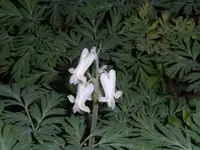
Squirrel corn, Dicentra canadensis, is a small spring-blooming woodland perennial native to eastern North America. It grows from rounded, yellowish underground tubers that resemble kernels of corn. The plant forms low mounds of finely divided, bluish-green foliage and sends up short stems of white, heart-shaped flowers with a faint fragrance. It typically appears in early spring and goes dormant by early summer, which is normal rather than a sign of poor health. In gardens, it suits shaded, cool, humus-rich sites and needs consistent moisture in spring. Once these needs are understood, it is relatively straightforward to care for squirrel corn in suitable climates.

Care Difficulty
Moderate Care

Light Preference
Partial Shade

Water Requirements
Regular Water

Temperature Preference
Cold Hardy

Hardiness Zone
3–8

Soil Texture
Loamy, Silty, Organic-rich

Soil pH
Acidic (5.5–6.5), Slightly acidic (6.5–7.0)

Soil Drainage
Moist but well-drained

Fertilization
Minimal (feed rarely)
Scan your plant to receive care tips personalized for your specific plant
Available on iOS and Android
This woodland perennial prefers cool, shaded light conditions that mimic its natural forest habitat.
This species needs steadily moist but not waterlogged soil, especially during its spring growth period.
This cool-climate spring ephemeral grows best in moderate temperatures and tolerates substantial winter cold.
This woodland perennial prefers moderately moist air but usually adapts to typical indoor humidity.
Dicentra canadensis grows best in loose, humus-rich soil that stays evenly moist yet drains freely.
This species can be grown in containers if the pot replicates cool, shaded, woodland-like root conditions.
This woodland native needs minimal feeding, but light fertilization can support healthy clumps in garden settings when caring for squirrel corn.
Pruning Dicentra canadensis is simple and mainly focuses on cleanliness rather than shaping.
This species is usually grown in the ground, so focus on careful transplanting or rare container division.
Propagation of this woodland perennial is typically done by division, with seed used more by specialists.
This species is cold hardy in much of its native range and usually needs little active winter care once established.

Plant Health Check
Not sure what's wrong with your plant? Check your plant's health inside the app.
This species relies heavily on myrmecochory, a process where ants carry its seeds away from the parent plant, attracted by a fleshy nutrient-rich appendage on the seed called an elaiosome.
Squirrel corn is a classic spring ephemeral that completes most of its growth and flowering before the forest canopy leafs out, then goes dormant underground for the rest of the growing season.
The plant stores energy in small, yellowish corms that resemble kernels of corn, which is the source of the common name squirrel corn and helps it survive long dormant periods in deciduous forests.

Genetic and morphological studies indicate that Dicentra canadensis and its close relative Dicentra cucullaria likely evolved from a common woodland ancestor, then diverged into distinct species that now occupy overlapping but subtly different microhabitats in eastern North American forests.
Lack of flowers usually comes from too much sun, dry soil, or bulbs planted too shallow. It needs cool, moist, humus-rich woodland conditions and time to store energy after flowering before the foliage goes dormant.
Keep your plants happy and healthy with plant identification, disease detection, and easy care guidance.