Spring sowing cycles
Stagger sowing in 1–2 week intervals in early spring so flowering and seed set occur over a longer period, which makes selecting the strongest plants easier.

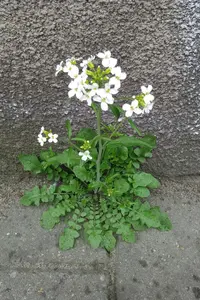
Sand rock-cress (Arabidopsis arenosa) is a small, short-lived perennial or biennial herb in the mustard family. It forms low rosettes with slender, upright flowering stems and small white to pale pink flowers.
This species occurs naturally on dry, rocky slopes, riverbanks, and open grasslands across parts of Europe and western Asia. It often grows in relatively poor, well-drained, often sandy or gravelly soils.
Arabidopsis arenosa is generally undemanding but prefers open, sunny sites with moderate moisture that does not stay waterlogged. Understanding these natural conditions makes it easier to care for Sand Rock-cress in a garden or rockery setting.

Care Difficulty
Moderate Care

Light Preference
Full Sun

Water Requirements
Moderate Water

Temperature Preference
Cool Climate

Hardiness Zone
4–8

Soil Texture
Sandy, Loamy, Rocky

Soil pH
Slightly acidic (6.5–7.0), Neutral (7.0)

Soil Drainage
Well-drained

Fertilization
Minimal (feed rarely)
Scan your plant to receive care tips personalized for your specific plant
Available on iOS and Android
Arabidopsis arenosa prefers bright exposure with protection from the harshest midday sun.
This species prefers evenly moist, well-drained soil that never stays saturated for long.
This plant is a cool-temperate species that tolerates a fairly wide outdoor temperature range.
This species tolerates a broad humidity range and rarely needs special humidity management indoors or outdoors.
This plant prefers mineral, well-drained, slightly alkaline soil that mimics dry, rocky habitats.
This species can be grown in containers if the pot replicates its naturally dry, stony conditions.
Arabidopsis arenosa is adapted to low-nutrient soils, so use light fertilization only when grown in pots or very poor substrates.
Pruning Arabidopsis arenosa is minimal and mainly for tidiness and plant health in garden or research settings.
This species is usually grown in open beds or research trays, so focus on careful transplanting rather than frequent repotting.
Arabidopsis arenosa is most commonly propagated by seed, which allows rapid generation turnover and genetic work.
This species is generally cold hardy in temperate climates and often needs little special winter care in the ground.

Plant Health Check
Not sure what's wrong with your plant? Check your plant's health inside the app.
This species often occurs on sandy, rocky or gravelly soils where many other plants struggle, using a deep root system and fast life cycle to exploit these harsh, nutrient-poor habitats.
Populations of this species exist both as diploids (2 chromosome sets) and autotetraploids (4 sets), making it a model for studying how genome duplication influences adaptation and evolution in the wild.
In some European regions it naturally hybridizes with its close relative Arabidopsis lyrata, providing an important system for research on reproductive barriers and gene flow between closely related species.

Arabidopsis arenosa has been used extensively to study adaptation to human-made habitats such as railway ballast and disturbed industrial sites, where it has independently evolved traits that tolerate high soil temperatures, drought, and mechanical disturbance in multiple locations across Europe.
This species is naturally adapted to sunny, rocky outdoor habitats and generally performs better outside. Indoors it tends to stretch and weaken unless light, airflow, and drainage are carefully managed, so outdoor planting is usually more reliable.
Keep your plants happy and healthy with plant identification, disease detection, and easy care guidance.