Bridge penstemon Care (Penstemon rostriflorus)

Also known as: Scarlet beardtongue, Bridge's Beardtongue
Bridge penstemon

About Bridge penstemon

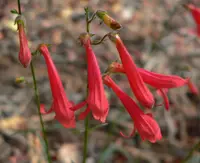
Bridge penstemon (Penstemon rostriflorus) is a small, long-blooming perennial in the plantain family, valued for its narrow, tubular red flowers that attract hummingbirds. It typically forms upright clumps with slender stems and fine-textured foliage. Native to rocky slopes and canyons in the mountains of the western United States, it is naturally adapted to lean, well-drained soils and dry conditions. This background makes it a good candidate for xeriscapes and low-water gardens when sited correctly. It is generally considered easy to grow if provided with full sun, good drainage, and not too much fertilizer or water, which are key points in how to care for Bridge penstemon.

Main Plant Requirements

Care Difficulty

Easy Care

Light Preference

Full Sun

Water Requirements

Low Water

Temperature Preference

Cold Hardy

Hardiness Zone

4–8

Soil Texture

Sandy, Loamy, Rocky

Soil pH

Slightly acidic (6.5–7.0), Neutral (7.0)

Soil Drainage

Well-drained

Fertilization

Minimal (feed rarely)

Get Personalized Care Plan

Scan your plant to receive care tips personalized for your specific plant

Available on iOS and Android

How to Care for the Bridge penstemon

This sun-loving perennial thrives in open, bright conditions typical of western dry habitats.

  • Provide full sun for 6–8 hours daily; Bridge penstemon flowers best with strong, direct light, especially morning sun.
  • Tolerates light afternoon shade in hot regions, but dense shade reduces flowering and encourages leggy, weak growth.
  • In summer, avoid heat reflected from south-facing walls or pavement that can scorch leaves; in winter, ensure an unshaded spot so low-angle sun still reaches the plant.

This species prefers dry to moderately dry soil and is adapted to low-water conditions once established.

  • Allow the top 5–8 cm of soil to dry before watering; in many climates this means deep but infrequent watering focused around the root zone.
  • Increase watering slightly during the first growing season and in prolonged drought, watching leaves for sustained wilting or crisping as a sign of underwatering.
  • Ensure very sharp drainage with sandy or gravelly soil; yellowing, soft stems or a sour soil smell indicate Penstemon rostriflorus is staying too wet and at risk of root rot.

This hardy perennial is adapted to climates with cold winters and warm, dry summers.

  • Active growth and flowering occur best around 60–80°F (16–27°C), typical of late spring and early summer conditions in many western regions.
  • Established plants tolerate winter lows near -10°F (-23°C) with good drainage; young plants benefit from mulch to buffer rapid freeze–thaw cycles.
  • In hot spells above 90°F (32°C), performance improves with afternoon shade and slightly increased watering, while avoiding waterlogged soil that is warm and stagnant.

This species is naturally adapted to dry mountain air, so humidity management is rarely a concern.

Penstemon rostriflorus prefers mineral, sharply drained soil that mimics rocky slopes.

  • Use a sandy or gravelly loam with 30–50% coarse material such as grit, small gravel, or coarse sand to prevent water retention.
  • Aim for slightly acidic to neutral pH around 6.0–7.5, avoiding heavy additions of peat that can hold excess moisture.
  • In containers or amended beds, mix roughly 1 part compost with 2 parts sandy topsoil and 1–2 parts grit or perlite for strong aeration.
  • Avoid dense clay, waterlogged spots, or thick mulch layers directly over the crown, which increase rot risk.

This species can grow well in containers if drainage and root conditions are carefully managed.

  • Choose a deep, heavy pot or wide, low container to anchor the upright stems and prevent tipping in wind.
  • Fill the container with a fast-draining, gritty mix and keep the top 2–3 cm slightly drier to protect the crown from rot.
  • Use light-colored or unglazed pots in hot climates to limit root-zone overheating while still allowing some moisture evaporation.

This drought-tolerant native needs only light feeding, so caring for Bridge penstemon focuses more on soil quality than fertilizer.

  • Use a light application of compost or a low-dose balanced fertilizer such as 5-5-5 in early spring if growth seems weak.
  • Apply granular slow-release fertilizer sparingly, following label rates at the low end to avoid lush, floppy growth.
  • Avoid feeding during the hottest part of summer and stop all fertilizer in fall and winter.
  • Do not use high-nitrogen lawn products nearby, as they can reduce flowering and shorten plant lifespan.

Penstemon rostriflorus responds well to modest pruning that maintains a tidy clump and sustained flowering.

  • In late winter or very early spring, cut back old, weathered stems to just above the basal foliage with clean hand pruners.
  • During bloom season, deadhead spent flower spikes down to a strong set of leaves to encourage continued flowering.
  • Remove any dead, broken, or congested stems at the base to improve air flow and reduce disease risk.
  • Avoid cutting into fresh green basal growth in cold regions until danger of hard frost has passed.

This species is more often grown in the ground than in containers, and it dislikes frequent disturbance.

  • Plan transplanting for early spring or early fall, when temperatures are mild and soil moisture is steady.
  • Move plants only if necessary, such as when growth declines or clumps become crowded by neighbors.
  • Dig a wide, shallow hole to keep the relatively fine root system as intact as possible, then replant at the same depth.
  • Water thoroughly after transplanting, then keep soil lightly moist for 1–2 weeks to reduce stress before returning to normal drought-tolerant care.

Penstemon rostriflorus is commonly propagated by seed and, to a lesser extent, by softwood cuttings.

  • Sow fresh seeds in late fall outdoors or use cold stratification at 35–40°F for 4–6 weeks before spring sowing.
  • Use a fast-draining, gritty seed mix and maintain light, even moisture until germination under bright, indirect light.
  • For cuttings, take 7–10 cm non-flowering shoots in late spring, remove lower leaves, and insert into moist, well-drained medium.
  • Provide bottom warmth around 68–72°F and high humidity with good air movement to encourage rooting and prevent rot.

This perennial is reasonably cold hardy and usually needs minimal winter care in most temperate climates.

  • In zones near its hardiness limit, apply a 5–7 cm layer of loose mulch around, but not over, the crown after the ground cools.
  • Leave some old stems standing over winter to catch insulating snow and protect emerging basal buds.
  • For container-grown plants in cold regions, move pots to an unheated garage or sheltered wall to reduce freeze–thaw stress.

Care Tips

Staggered Rejuvenation

Every 3–4 years, cut back one-third of the oldest, woodiest stems at ground level in late winter to keep the clump youthful and encourage heavier flowering on newer growth.

Targeted Deadheading

After the first main flush, snip off spent flower spikes just above a strong leaf node, leaving a few seed heads only if seed collection or wildlife support is desired, to extend bloom time without exhausting the plant.

Lean-Soil Edge Placement

Site plants at the upper edge of slopes, rock walls, or raised beds where drainage is fastest and neighboring plants are not heavily irrigated, which helps prevent root rot in this drought-adapted species.

Winter Drainage Check

Before winter, confirm that mulch or fallen leaves are not burying the crown and that water does not pool around the base, since constant cold wetness is more damaging than low temperatures for long-term Penstemon rostriflorus plant care.

Pollinator Corridor Planning

Arrange several plants in a loose drift with other late-summer nectar species 20–40 cm away to create a continuous pollinator corridor, which improves pollination and seed set when growing Bridge penstemon.

Common Pests and Diseases

Leaf spot

This disease causes small brown, tan, or purplish spots on leaves that may merge into larger blotches, often appearing in humid or overcrowded plantings.

Solution

Remove and discard affected leaves, avoid overhead watering, and thin surrounding vegetation to improve air circulation; in persistent wet conditions, a copper-based fungicide labeled for ornamental perennials can be applied early in the season according to label directions.

Powdery mildew

This disease produces a white to gray powdery coating on leaves and stems, which can lead to leaf distortion and reduced flowering in dense clumps or during humid periods.

Solution

Increase spacing and air movement around plants, water at soil level in the morning, remove heavily infected foliage, and apply a sulfur or potassium bicarbonate fungicide at the first sign of disease if environmental conditions remain favorable for spread.

Aphids

These insects cluster on young stems and flower spikes, sucking sap and causing distorted growth, sticky honeydew, and sometimes sooty mold on leaves.

Solution

Spray stems and flower spikes with a firm stream of water to dislodge colonies, encourage lady beetles and other natural predators, and use an insecticidal soap or horticultural oil on the undersides of shoots if populations stay high.

Spider mites

This pest thrives in hot, dry conditions and causes fine stippling, bronzing, and eventual leaf drop, often with delicate webbing between leaves and stems.

Solution

Rinse foliage with water to knock down mite numbers, maintain moderate soil moisture to reduce stress, and, if needed, apply a horticultural oil or miticide labeled for ornamentals, repeating treatments as directed to cover new mite hatchings.

Leafhoppers

These insects feed by piercing and sucking leaf sap, leading to pale stippling, leaf edge browning, and possible transmission of leafhopper-borne pathogens that can weaken plants over time.

Solution

Monitor foliage regularly, remove nearby weedy hosts, use fine mesh row covers in high-pressure areas before insects arrive, and, if damage is significant, apply an insecticidal soap or pyrethrin product in the evening when pollinator activity is low.

Interesting Facts

High-elevation specialist

This species naturally occurs in rocky slopes and open conifer forests of the southern Rocky Mountains and adjacent ranges, often above 2,000 m where temperature swings and strong UV are common.

Hummingbird-adapted flowers

The long, tubular, scarlet to orange-red flowers are shaped for hummingbird pollination, with nectar held deep in the corolla and pollen positioned to contact a hummingbird’s head and bill as it feeds.

Fire-following behavior

Populations often increase in recently burned or disturbed mountain sites, where higher light levels and reduced competition favor seedling establishment and long-term growing Bridge penstemon success.

Botan icon

Did you know?

Penstemon rostriflorus commonly forms natural hybrids with closely related red-flowered penstemon species where their ranges overlap, creating intermediate plants that can make field identification challenging even for experienced botanists.

FAQs about Bridge penstemon

This species is highly attractive to hummingbirds and many native bees due to its tubular red flowers and summer bloom period. Planting it in clusters increases visibility and nectar availability, supporting local pollinator populations in dry, sunny gardens.

Grow Healthy Plants with Botan Care

Keep your plants happy and healthy with plant identification, disease detection, and easy care guidance.

Botan plant care app — identify plants on mobile

Explore More Plants