Wind exposure training
Expose young plants to moderate, unobstructed wind so stems flex but do not snap, which encourages a stronger trunk and deeper anchoring roots important for long-term stability in coastal or open sites.

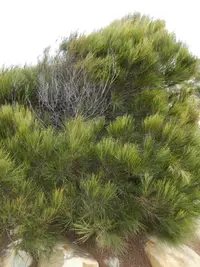
Allocasuarina thalassoscopica is a coastal shrub or small tree from eastern Australia, adapted to sandy, wind-exposed habitats near the sea. It belongs to the she-oak group, with fine, jointed branchlets that give a soft, needle-like appearance. Cones are small and woody, adding a distinctive texture to the plant. Growth is usually upright and narrow, suited to hedging or windbreaks in mild climates. This species is generally hardy once established, but young plants need good drainage and protection from prolonged waterlogging. For those who want to care for Allocasuarina thalassoscopica, it prefers full sun, low to moderate moisture, and poor to moderately fertile soils.

Care Difficulty
Moderate Care

Light Preference
Full Sun

Water Requirements
Low Water

Temperature Preference
Warm Climate

Hardiness Zone
9–11

Soil Texture
Sandy, Loamy, Rocky

Soil pH
Acidic (5.5–6.5), Slightly acidic (6.5–7.0)

Soil Drainage
Well-drained

Fertilization
Minimal (feed rarely)
Scan your plant to receive care tips personalized for your specific plant
Available on iOS and Android
This coastal species prefers bright, open conditions similar to its native dune and headland habitats.
This plant is adapted to sandy, low-nutrient coastal soils and prefers a relatively dry, free-draining root zone.
This coastal tree tolerates a wide temperature range but grows best in mild, frost-free conditions.
Humidity is rarely a limiting factor for Allocasuarina thalassoscopica in typical home or outdoor conditions.
This species prefers lean, fast-draining, sandy soils that do not stay wet.
This species can be grown in containers for several years, especially in its younger stages.
This coastal casuarina is adapted to low-nutrient soils and only benefits from light, infrequent feeding in cultivation.
This species needs only modest pruning to maintain structure and remove problem wood.
Allocasuarina thalassoscopica is mainly a landscape tree, so guidance focuses on transplanting young specimens from containers into the ground.
Propagation of Allocasuarina thalassoscopica is usually done from seed and can be slow but reliable under suitable conditions.
This coastal species is best suited to mild, frost-free climates and benefits from some attention where winter temperatures drop.

Plant Health Check
Not sure what's wrong with your plant? Check your plant's health inside the app.
This species is naturally restricted to exposed coastal headlands and cliffs of eastern New South Wales, where it withstands strong salt-laden winds and very shallow, rocky soils.
Its fine, jointed branchlets function as leaves and tolerate constant salt spray, reducing water loss and wind damage compared with broadleaf coastal shrubs.
Like other she-oaks, it forms specialized root nodules with Frankia actinobacteria, allowing the plant to fix atmospheric nitrogen and improve poor, sandy coastal substrates over time.
Container growing is possible while the plant is young, using a deep, very free-draining mix and a tall pot to accommodate its taproot. Long term, it prefers in-ground planting, as restricted roots can stunt growth and stability.
Keep your plants happy and healthy with plant identification, disease detection, and easy care guidance.