Spore-friendly debris
Leave a thin layer of decaying conifer needles and small twigs around existing clusters instead of clearing the forest floor completely, as this helps maintain the fungal habitat and supports future fruiting.

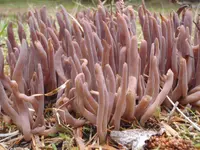
Purple spindles (Alloclavaria purpurea) is a club fungus, not a traditional leafy plant. It forms tight clusters of slender, upright, purple clubs emerging from the forest floor.
This species is typically found in cool, moist coniferous forests, often among moss and decaying needles. Its simple shape and slow, steady development give it a distinctive, architectural look in the understory.
In cultivation, it is considered challenging because it is linked to specific forest soils and decaying organic matter that are hard to reproduce at home. Most enthusiasts focus on observing it in nature rather than trying to care for Purple Spindles indoors or in gardens.

Care Difficulty
Hard Care

Light Preference
Partial Shade

Water Requirements
Keep Soil Moist

Temperature Preference
Cold Hardy

Hardiness Zone
3–8

Soil Texture
Loamy, Silty, Organic-rich

Soil pH
Strongly acidic (4.5–5.5), Acidic (5.5–6.5)

Soil Drainage
Moist but well-drained

Fertilization
Minimal (feed rarely)
Scan your plant to receive care tips personalized for your specific plant
Available on iOS and Android
This woodland fungus prefers soft, filtered light rather than direct open sun.
This species depends on consistently moist, not saturated, forest soil to fruit well.
This fungus is adapted to cool to mild forest conditions with distinct seasonal changes.
Humidity is not a key factor for Alloclavaria purpurea compared with moisture of the substrate it fruits from.
Alloclavaria purpurea fruits best from consistently moist, well-aerated forest substrates rather than conventional potting soil.
This species is not well suited to conventional container growing, as it is adapted to complex forest-floor substrates and natural decay processes.
Alloclavaria purpurea is a wild, mycorrhizal fungus that does not need or benefit from conventional fertilization in garden settings.
Pruning is not a standard practice for Alloclavaria purpurea, since its fruiting bodies are seasonal and short-lived.
This fungus is best left in place, as transplanting Alloclavaria purpurea is rarely successful and generally not recommended.
Intentional propagation of Alloclavaria purpurea is challenging and not commonly practiced outside scientific or specialized cultivation.
This species is naturally cold hardy in its native woodland range and requires no special winter care from gardeners.

Plant Health Check
Not sure what's wrong with your plant? Check your plant's health inside the app.
This species is a true coral fungus in the family Repetobasidiaceae, forming upright, unbranched, club-like fruiting bodies rather than the highly branched coral shapes seen in many related genera.
It typically fruits from late summer into late autumn in North America, often persisting after many other mushrooms have disappeared, which makes its purple clubs stand out against leaf litter or moss.
It is most often found on the ground in coniferous or mixed conifer forests, where it appears among mosses and needles, likely deriving nutrients from decaying organic matter rather than directly from living trees.

Molecular studies showed that this species, once placed in the genus Clavaria, is genetically distinct enough to warrant its own genus, Alloclavaria, making it an example of how DNA sequencing reshaped the classification of coral fungi.
This fungus is generally classified as inedible. It is not known to be dangerously toxic, but it offers no culinary value and may be confused with less safe species. Foragers should avoid eating it.
Keep your plants happy and healthy with plant identification, disease detection, and easy care guidance.